


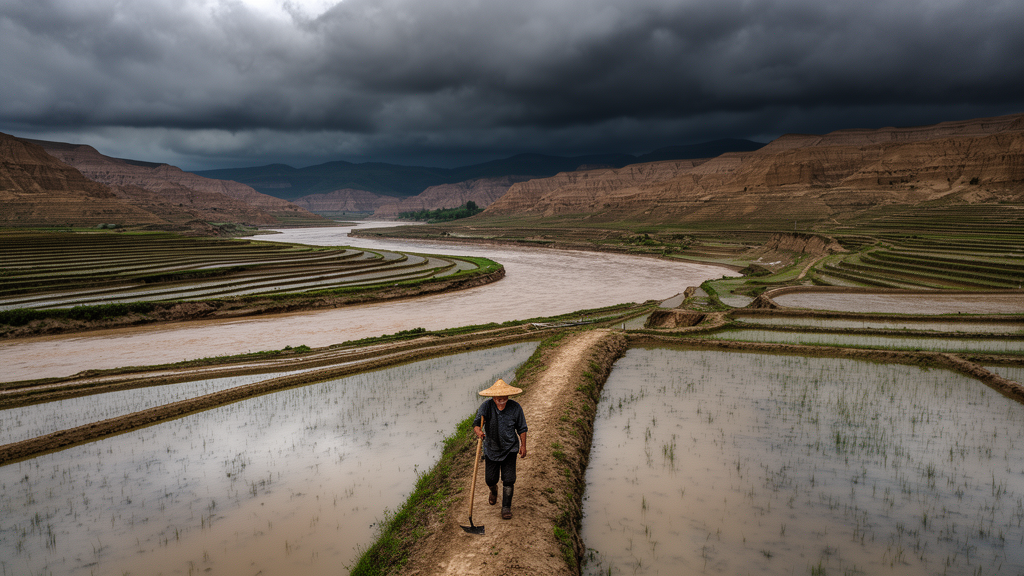
When a river basin the size of France starts to change how it rains, the first thing most people want to know is simple: is it getting wetter or drier? A new study of the Yellow River Basin, published in Theoretical and Applied Climatology, shows that the answer is far stranger and more consequential than a simple yes or no. Over the 64 years from 1961 to 2024, the basin’s precipitation extremes did not simply intensify across the board. Instead, they concentrated, reorganized, and split into three fundamentally different regional responses, each with its own implications for floods, droughts, and the 120 million people who depend on the Yellow River for water.
The research, led by Lirong Huang and Yongcai Dang of Qilu Normal University in Shandong, China, examined daily precipitation records across the entire Yellow River Basin using the CHM_PRE V2 gridded precipitation dataset, a high-resolution product built from gauge observations across the Chinese mainland. Rather than treating the basin as a single unit, the team divided it into three hydroclimatic zones: the high-cold plateau region in the upper reaches, the monsoon climate region in the lower reaches, and the arid–semi-arid transition region in between. This zone-by-zone approach revealed something that basin-wide averages had long obscured: the same basin is responding to climate change in three different ways at once.
The headline finding is that the basin’s wet extremes are getting more intense, not more frequent. The simple daily intensity index — a measure of how hard it rains on days when it rains at all — increased significantly at a rate of 0.08 millimeters per day per decade. Meanwhile, the amount of precipitation falling on very wet days, the heaviest downpours, rose by 3.63 millimeters per decade. By contrast, the annual total wet-day precipitation and the annual maximum 1-day precipitation amount showed only weak, statistically insignificant increases. In other words, the basin is not necessarily getting more total rain, but when it rains, it rains harder, and a larger share of the year’s precipitation is packed into a smaller number of very wet days.
This intensification pattern is consistent with what atmospheric physics predicts under global warming. As air temperature rises, the atmosphere can hold roughly 7 percent more water vapor per degree Celsius of warming, following the Clausius–Clapeyron relationship. That extra moisture is available to fuel heavier downpours when the right conditions converge. Previous studies, including work by Allan and Soden in Science and by O’Gorman and Schneider in the Proceedings of the National Academy of Sciences, have shown that precipitation extremes tend to intensify faster than mean precipitation under warming — precisely the pattern now observed in the Yellow River Basin. The new study extends this picture into a large hydroclimatic transition basin where monsoon, plateau, and arid climates meet.
The study also found a significant decrease in annual maximum consecutive dry days — the longest annual dry spell — at a rate of 1.25 days per decade. This means the basin’s annual dry spells are getting shorter. At first glance, shorter dry spells might sound like good news for a semi-arid basin. But the picture is more complicated. The decrease in dry-spell length was not uniform across the basin, and the spatial reorganization of dry extremes was asynchronous with the reorganization of wet extremes. In some zones, wet extremes and dry-spell persistence evolved in different places at different times, meaning that the geography of flood risk and the geography of drought risk are shifting independently of each other.
To track this spatial reorganization, the team used centroid migration analysis — a technique borrowed from ecology, where it is used to track shifting range margins of populations — along with hotspot evolution analysis based on Getis–Ord spatial statistics. The centroid of wet extremes migrated across the basin over the 64-year period, and hotspots of extreme precipitation appeared, disappeared, and reappeared in different locations. The arid–semi-arid transition region showed weak regional mean trends but more frequent intermittent hotspots, suggesting that extreme precipitation events in this zone are becoming more spatially erratic rather than simply more intense. This intermittency matters for water resource managers, because it means the same zone can swing between flood and drought conditions within a single year.
The three hydroclimatic zones showed fundamentally different responses. The high-cold plateau region, which includes the Yellow River’s source on the Tibetan Plateau, showed a wetting-dominated response — more precipitation overall, consistent with previous findings that the Tibetan Plateau is amplifying climate extremes under global warming. The monsoon climate region showed an intensification-dominated response — harder downpours without necessarily more total rain, consistent with the behavior of the East Asian summer monsoon under warming. The arid–semi-arid transition region showed weak regional mean trends but more frequent intermittent hotspots — a spatially erratic response that is hardest to plan for. This zone-dependence is the study’s central message: assessing precipitation-extreme changes and related climate risks in the Yellow River Basin requires looking at each hydroclimatic zone separately, not just at basin-wide averages.
The implications for the Yellow River Basin are significant. The basin supplies water to roughly 12 percent of China’s population and irrigates a large share of the country’s wheat and corn production. Intensified wet-day precipitation and a larger contribution from very wet days increase the risk of flash flooding, particularly in the Loess Plateau region, where steep slopes and erodible soils make the landscape acutely sensitive to heavy rainfall. Previous studies have shown that extreme precipitation events in the middle reaches of the Yellow River drive large increases in sediment yield, threatening reservoirs and infrastructure. At the same time, the asynchronous reorganization of dry-spell persistence means that drought risk is not simply decreasing everywhere — it is shifting, concentrating in some places while easing in others.
The study’s use of the CHM_PRE V2 dataset, which is available from the National Tibetan Plateau / Third Pole Environment Data Center, along with SRTM GL3 90-meter digital elevation data, allowed the team to resolve precipitation extremes at a spatial resolution fine enough to capture the basin’s complex topography. The Yellow River Basin spans more than 3,000 meters of elevation range, from the Tibetan Plateau source region down to the floodplain near the river’s mouth, and this topographic complexity strongly shapes where extreme precipitation falls. The dataset’s daily resolution also allowed the team to compute standard climate extremes indices, including the simple daily intensity index, very wet-day precipitation, and consecutive dry days, following the methodology established by the Expert Team on Climate Change Detection and Indices.
As global warming continues, the Yellow River Basin’s precipitation extremes are likely to keep intensifying and reorganizing. The study’s findings — that intensification dominates in monsoon zones, wetting dominates in plateau zones, and spatial intermittency dominates in arid transition zones — provide a template for understanding how other large hydroclimatic transition basins around the world may respond. From the Mekong to the Niger to the Colorado, basins that span multiple climate zones are likely to show similarly zone-dependent responses, and the Yellow River Basin study offers a methodological roadmap for detecting them. For the 120 million people who live in the Yellow River Basin, the message is clear: the rain is changing, but not uniformly, and preparing for what comes next means preparing for three different futures at once.
Subject of Research: Changes in precipitation extremes across the Yellow River Basin from 1961 to 2024
Article Title: Intensification, concentration, and spatial reorganization of precipitation extremes in the yellow river basin during 1961–2024
Article References: Intensification, concentration, and spatial reorganization of precipitation extremes in the yellow river basin during 1961–2024. (n.d.). https://doi.org/10.1007/s00704-026-06619-8
Image Credits: AI Generated
DOI: 10.1007/s00704-026-06619-8
Keywords: Intensification, concentration, spatial, reorganization, precipitation, extremes, yellow, river, basin, during, scientific research
Cite Scienmag News
Violet Maxwell. (October 15, 2026). China’s Yellow River Basin Is Getting Wetter, But Not the Way You Think. Scienmag. https://scienmag.com/chinas-yellow-river-basin-is-getting-wetter-but-not-the-way-you-think/
Violet Maxwell. "China’s Yellow River Basin Is Getting Wetter, But Not the Way You Think." Scienmag, 15 October 2026, https://scienmag.com/chinas-yellow-river-basin-is-getting-wetter-but-not-the-way-you-think/. Accessed 15 October 2026.
Violet Maxwell. "China’s Yellow River Basin Is Getting Wetter, But Not the Way You Think." Scienmag. October 15, 2026. https://scienmag.com/chinas-yellow-river-basin-is-getting-wetter-but-not-the-way-you-think/


