


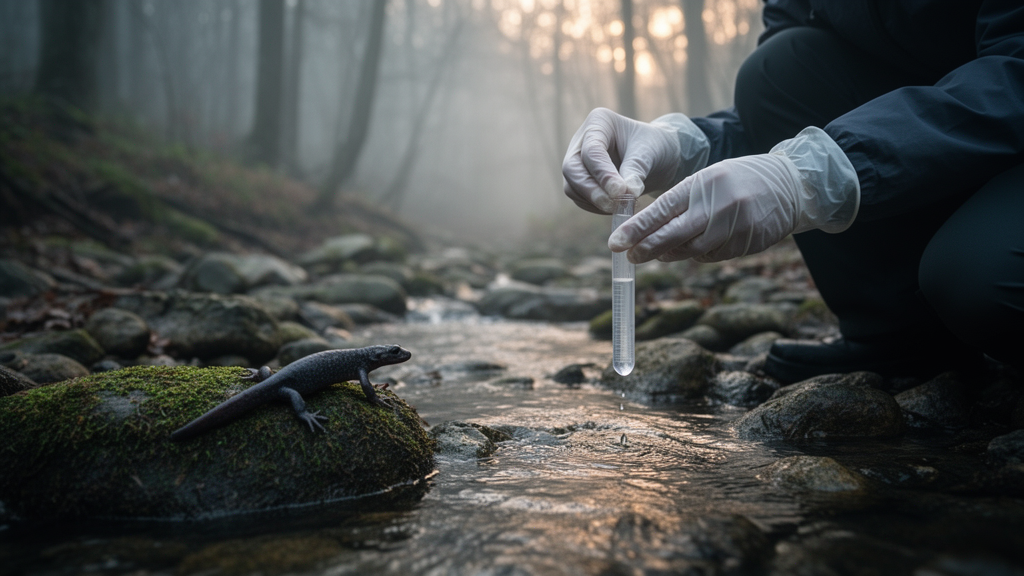
Deep in the mountain valleys of the Republic of Korea, two species of clawed salamander lead lives so secretive that scientists have struggled for decades to pin down when, and how often, they breed. Now, a year-long study combining environmental DNA analysis with traditional field surveys has revealed that the two species follow strikingly different reproductive schedules. The findings, published in the journal Herpetozoa, offer some of the clearest evidence yet that closely related amphibians sharing similar habitats can time their breeding in fundamentally different ways.
The clawed salamanders of the genus Onychodactylus are among the most enigmatic amphibians of Northeast Asia. These lungless salamanders, equipped with degenerated lungs that force them to rely on cutaneous respiration, inhabit cold, oxygen-rich mountain valley streams and surrounding deciduous broadleaf forests. Larvae spend two to three years in the valley stream before metamorphosing and can be observed throughout the year. Adults, however, are detected only sporadically, mainly during the breeding season. Their reproduction, which involves external fertilization, occurs largely in underground habitats such as caves, subterranean streams, or beneath the streambed where spring water emerges. During mating, females lay egg sacs, and males grasp the sacs and release sperm onto them. Because of these subterranean habits, the timing and frequency of breeding remain unclear across species and habitats.
Understanding breeding frequency and duration is essential for conserving amphibians, a group facing an extinction crisis of global proportions. Approximately 41 percent of amphibian species are threatened worldwide, and salamanders and newts, with their low mobility and limited habitats, are particularly prone to population decline. Without knowledge of when species breed, conservation measures such as establishing protection periods and habitat conservation areas become difficult to apply. Environmental DNA analysis, which detects the genetic material organisms release into the environment through skin cells, mucus, and feces, has emerged as a powerful tool for overcoming these limitations, especially for species that spend part or all of their lives underground.
The research team, led by MW Park and colleagues, conducted their study in two mountain valley streams in the Republic of Korea. Mount Daeryong in Chuncheon, Gangwon Province, at 410 meters above sea level, was selected for Onychodactylus koreanus, while Mount Biseul in Dalseong, Daegu Metropolitan City, at 400 meters above sea level, was selected for O. sillanus. Three eDNA sampling sites were established along the upper, middle, and lower sections of each valley. On Mount Daeryong, the sites were 50 and 120 meters apart, whereas on Mount Biseul, they were 80 and 100 meters apart. eDNA sampling was conducted biweekly, with one liter of stream water filtered through a Sterivex filter with a pore size of 0.45 micrometers. Thirty sampling events were conducted on Mount Daeryong between April 2024 and May 2025, and 27 sampling events were conducted on Mount Biseul between May 2024 and May 2025.
After each eDNA sampling, two researchers conducted population surveys for approximately 30 minutes along designated stretches of stream. Tree debris, stones, and boulders were searched for individual organisms, which were then repositioned after the survey. Larvae were classified as one year old if their total length was less than 5 centimeters and as two years old or older if their total length exceeded 5 centimeters. Metamorphosed individuals less than 10 centimeters in total length were classified as subadults, while those more than 10 centimeters were considered full-grown adults. The sex of adults was determined based on cloacal morphology, and females were further classified as ovulated or oviposited depending on whether ovulated eggs were visible inside the abdomen. In externally fertilizing salamanders, only breeding females emerge at breeding sites, making this classification particularly informative.
For the eDNA analysis, the team used a previously developed qPCR primer and probe set targeting the mitochondrial DNA cytochrome c oxidase I gene for O. koreanus. However, because the sensitivity of this probe was low for O. sillanus, the researchers designed a new TaqMan probe using Primer3 in Geneious Primer software. The new probe was tested in silico against the COI sequences of 168 individuals from 11 amphibian and seven reptile species that may cohabit with O. sillanus, and subsequently validated with tissue DNA from 10 amphibian and five reptile species. The limit of detection for the new primer-probe set was 0.962 copies per microliter, and the limit of quantification was 2 copies per microliter, with a PCR efficiency of 89.3 percent. All qPCR runs included gBlock standards for quantification, a field control, and a no-template control, with all PCRs performed in triplicate.
The results revealed dramatic differences between the two species. On Mount Daeryong, a total of 153 O. koreanus larvae were observed across 30 survey events, including 84 one-year-old and 69 two-year-old larvae. A total of 63 adults were also observed, including 47 males, one ovulated female, and 15 oviposited females. Adult emergence occurred in three distinct periods: from April to June 2024, from September to November 2024, and from March to May 2025. On Mount Biseul, 288 O. sillanus larvae were observed, with a significantly higher proportion of two-year-old larvae (59.0 percent) than on Mount Daeryong (45.1 percent). However, no full-grown breeding adults of O. sillanus were observed during the entire study period, despite similar survey efforts. Only three subadults were detected on Mount Biseul, suggesting that adult O. sillanus may use microhabitats during the breeding season that differ spatially from those of adult O. koreanus, possibly remaining deeper underground in more subterranean and cryptic activity.
The eDNA detection patterns were equally revealing. The overall eDNA detection frequency was significantly higher on Mount Daeryong (84.6 percent) than on Mount Biseul (43.8 percent), with detection rates differing significantly among the upper, middle, and lower sections of each valley. On Mount Daeryong, two major eDNA detection periods occurred in early May and early December, aligning closely with the breeding periods observed through population surveys. On Mount Biseul, eDNA detections occurred between January and June, suggesting that O. sillanus may breed once per year over a long period from late winter to early summer. The concentration of eDNA changed significantly over time at both study sites, and the major detection patterns were largely consistent across the three sampling sections within each valley, indicating that the pattern of major eDNA detections may reflect overall population dynamics in the valley stream habitat.
The researchers suggest that the different breeding frequencies and periods may be related to the climatic conditions of each species’ distribution range. O. sillanus is restricted to the southeastern part of the Korean Peninsula, where temperatures are relatively high, while O. koreanus is observed in most areas of the peninsula. The relatively warm conditions in the southern regions may allow O. sillanus to extend its breeding season over a longer period, whereas O. koreanus, inhabiting cooler environments, breeds twice per year in spring and late autumn. These findings are consistent with previous reports for O. fischeri in the Russian Federation and O. japonicus in Japan, which also show two breeding events per year in spring and late autumn.
The study also highlights the challenges of interpreting eDNA data from larvae, which release only small amounts of genetic material compared to adults. In a previous study, the amount of detected eDNA was not related to the number of larvae, and larvae of the salamander Salamandrella keyserlingii release only one-fifth as much eDNA as adults. The researchers recommend that future studies develop more sensitive or larval-specific primers and investigate the relationship between larval numbers and the amount of released eDNA. Nevertheless, Onychodactylus larvae can serve as good indicators of population dynamics, as they can be observed in the valley throughout the year. The team emphasizes that whether the observed differences between the two species are species-specific or habitat-specific needs further exploration, and that comparative studies of similar latitudinal populations could provide clues about their adaptive breeding strategies and resilience to changing climate conditions.
Subject of Research: Ecology and Conservation Biology
Article Title: Verification of the breeding periods of two clawed salamander species ( Onychodactylus koreanus and O. sillanus ) using environmental DNA analysis and field surveys
Article References: Park, D., Park, J., Kim, J., Park, J., Joo, N., Nam, H., Jeong, J., Kim, Y.-G., & Park, M.-W. (2026). Verification of the breeding periods of two clawed salamander species (Onychodactylus koreanus and O. sillanus) using environmental DNA analysis and field surveys. Herpetozoa, 39, 389-400. https://doi.org/10.3897/herpetozoa.39.e200797
Image Credits: AI Generated
DOI: 10.3897/herpetozoa.39.e200797
Keywords: Verification, breeding, periods, clawed, salamander, species, Onychodactylus, koreanus, sillanus, environmental, analysis, field
Cite Scienmag News
Drew Townsend. (October 15, 2026). Environmental DNA Reveals Hidden Breeding Secrets of Korea’s Clawed Salamanders. Scienmag. https://scienmag.com/environmental-dna-reveals-hidden-breeding-secrets-of-koreas-clawed-salamanders/
Drew Townsend. "Environmental DNA Reveals Hidden Breeding Secrets of Korea’s Clawed Salamanders." Scienmag, 15 October 2026, https://scienmag.com/environmental-dna-reveals-hidden-breeding-secrets-of-koreas-clawed-salamanders/. Accessed 15 October 2026.
Drew Townsend. "Environmental DNA Reveals Hidden Breeding Secrets of Korea’s Clawed Salamanders." Scienmag. October 15, 2026. https://scienmag.com/environmental-dna-reveals-hidden-breeding-secrets-of-koreas-clawed-salamanders/


