


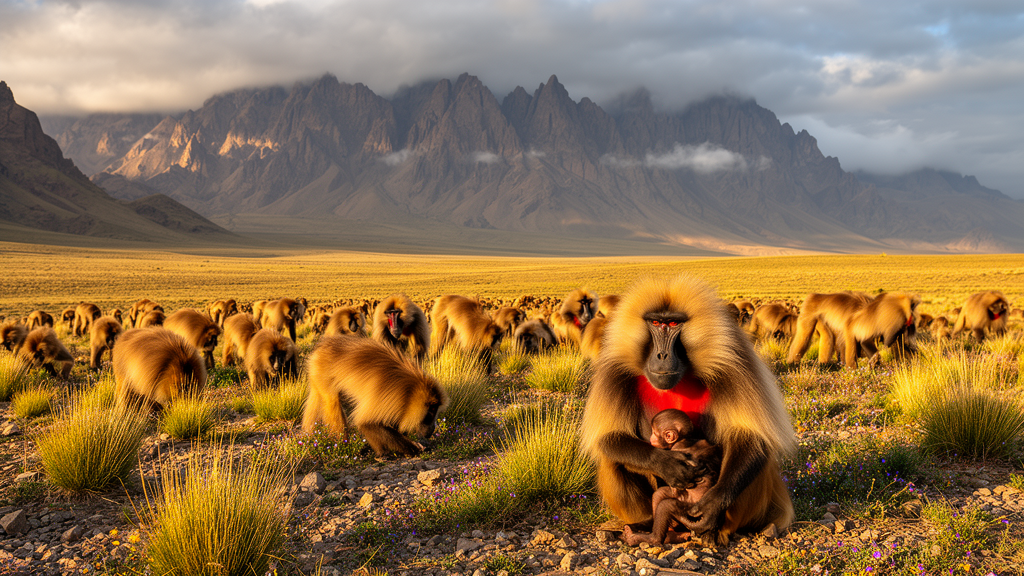
High on the windswept peaks of Abune Yosef, where night temperatures plunge toward freezing and the vegetation dies back to bare stubble every dry season, one of the world’s most specialized primates is quietly demonstrating an extraordinary capacity for behavioral reinvention. A new study of the Southern Gelada (Theropithecus gelada obscurus) in Ethiopia’s Abune Yosef Zigit Community Conservation Area reveals that these graminivorous monkeys do not simply endure one of the planet’s harshest Afro-alpine ecosystems — they dynamically rewrite their entire foraging playbook between seasons, shifting from selective grass-eaters in the wet months to broad-niched root excavators when the landscape desiccates. The findings, published in BioRisk, offer some of the clearest field evidence yet that Optimal Foraging Theory and the Fallback Food Hypothesis operate in tandem even under the most extreme environmental constraints primates face anywhere on Earth.
The research team, led by investigators working across the conservation area’s full elevational range of 3,505 to 4,284 meters above sea level, spent months tracking two focal gelada groups whose combined home ranges spanned the region’s primary ecological gradients — from extensive Festuca grasslands to mixed communities dominated by the endemic Giant Lobelia (Lobelia rhynchopetalum). Using instantaneous scan sampling across both the dry season (February to April 2021) and the wet season (June to August 2021), the observers generated 960 scan samples and 761 discrete feeding records encompassing 25 distinct food items. The dataset represents the first comprehensive assessment of Southern Gelada feeding ecology in this purely Afro-alpine setting, which lacks the sub-Afro-alpine buffer zones found at other Ethiopian study sites and therefore amplifies every seasonal fluctuation to its biological limit.
The headline result is a diet dominated not by grasses, as might be expected for the world’s most graminivorous primate, but by forbs — herbaceous plants whose roots, leaves, flowers, stems, and young shoots constituted 55.7 percent of all feeding records. Grasses accounted for 42.7 percent, while insects contributed a marginal 1.6 percent. This proportion deviates notably from gelada populations at Borena Sayint National Park, where grasses make up nearly 80 percent of the diet, and the discrepancy likely reflects the steep slopes, heavy livestock grazing pressure, and reduced grass palatability characteristic of Abune Yosef’s high-altitude terrain. Among individual species, Festuca simensis emerged as the clear staple, representing 24.05 percent of total diet utilization — a role consistent with its abundance and relatively high digestibility across gelada habitats throughout Ethiopia.
Seasonal comparisons revealed a highly significant association between season and plant-part consumption (chi-square = 65.29, p < 0.001), with standardized residuals pinpointing the exact nature of the shift. Grass-blade consumption rose significantly in the wet season, while root consumption rose significantly in the dry season. Underground roots and rhizomes — energetically expensive fallback foods requiring substantial excavation effort — comprised 65.93 percent of dry-season feeding records but only 22.09 percent in the wet season. This pattern aligns precisely with the Fallback Food Hypothesis, which predicts that primates broaden their diet during periods of scarcity by incorporating less preferred but accessible resources. As above-ground biomass desiccates and loses nutritional quality in the dry months, geladas switch to digging up roots and rhizomes that provide essential water and carbohydrates when other options vanish.
Dietary niche breadth, quantified using the Shannon Diversity Index, expanded dramatically in the dry season (H’ = 2.31) and contracted in the wet season (H’ = 1.92). Monthly analysis using the Friedman test confirmed that feeding diversity declined progressively from February (H’ = 2.38) to August (H’ = 1.82), with Dunn’s post-hoc contrasts showing significantly higher diversity in the early dry months than in the later wet months. This trajectory confirms that geladas progressively narrowed their dietary niche as the wet season advanced and high-quality grasses became abundant — exactly the selective foraging predicted by Optimal Foraging Theory when preferred resources are plentiful. Levin’s niche breadth index, which measures the variety of broad food categories utilized, similarly indicated a wider dietary niche in the dry season, reinforcing the picture of a species that broadens its ecological footprint under stress and specializes when conditions improve.
Perhaps the most striking finding concerns dietary selectivity. Using three complementary indices — the Forage Ratio, the Electivity Index, and Jacobs’ index — the researchers demonstrated that geladas do not feed randomly or in proportion to availability but exercise strong, context-dependent selection that shifts almost completely between seasons. Overall, Haplocarpha schimperi (Forage Ratio = 5.87, Electivity = 0.71) and Lobelia rhynchopetalum (Forage Ratio = 5.26, Electivity = 0.68) were the most preferred species, consumed disproportionately to their abundance. Yet in the dry season, both of these highly preferred species were actively avoided, while Rumex nepalensis and Festuca richardii became the primary targets. When the wet season arrived, Delosperma abyssinicum, Festuca richardii, and Thymus schimperi rose to prominence as the main selection targets, and avoidance of Haplocarpha and Lobelia intensified further. The weak Spearman correlation between seasonal preference rankings (rs = 0.36) confirms that foraging strategies are anything but static.
This dynamic reorganization of selectivity suggests that plant choice is closely tied to shifting phenological states — flowering, new leaf growth, desiccation — rather than to any intrinsic, year-round nutritional superiority of particular species. Lobelia rhynchopetalum, for instance, is known to have high water content, which could be crucial for hydration in the arid Afro-alpine environment, while the preference for Haplocarpha schimperi might reflect nutrient density or low concentrations of secondary compounds such as tannins. Conversely, the active avoidance of Festuca abyssinica and Bidens macroptera, despite their presence in the environment, points to possible physical or chemical defenses — Bidens species often bear hooked bristles that might cause irritation, and F. abyssinica might be tougher or chemically protected. The researchers caution that without direct phytochemical analyses, the underlying drivers of these preferences remain speculative, though the strong correlation between availability and consumption (rs > 0.8) indicates that selectivity operates within the boundaries of what the environment actually offers.
The temporal dimension of gelada foraging adds another layer of sophistication. Kernel density estimation of feeding activity across 960 scans revealed a consistent bimodal pattern in both seasons, with distinct peaks in the early morning (07:30–09:00) and late afternoon (15:00–16:30), and a pronounced midday decline between 12:00 and 14:00. This schedule likely represents a thermoregulatory adaptation, synchronizing the most energetically demanding activities with cooler ambient temperatures to reduce the risk of hyperthermia under intense high-altitude solar radiation. Intriguingly, the composition of the diet also shifted across the day: morning feeding was predominantly grass-based in both seasons (72 percent in the dry season, 65 percent in the wet season), while afternoon feeding incorporated a higher proportion of forbs and insects. The researchers suggest this diurnal shift might reflect a strategy for managing digestive constraints — consuming grasses earlier in the day to maximize fiber digestion through longer gut retention times, then balancing nutrient intake with forbs and insects later on.
The narrow dietary richness recorded at Abune Yosef — just 22 plant species, compared with 56 at Guassa Community Conservation Area, 74 at Borena Sayint National Park, 61 at Arsi, and 41 at Abo Gedam — most likely reflects the extreme altitudinal constraints of a purely Afro-alpine ecosystem rather than behavioral rigidity. Between 3,505 and 4,284 meters, the landscape inherently supports lower floristic diversity than the sub-Afro-alpine or transitional ecosystems at those other sites. The physical limitation of available forage species, rather than any inability of the geladas to diversify, therefore explains the narrower dietary breadth observed here. This distinction matters for conservation: the Southern Gelada’s remarkable plasticity is being expressed at the very edge of what the habitat permits, and any further reduction in floristic heterogeneity — whether from climate change, overgrazing, or habitat conversion — could push the population beyond its adaptive limits.
The study opens several critical avenues for future research. Combining phytochemical and proximate analyses of key forage species and seasonal roots would determine whether preference shifts are driven by fluctuating protein content, specific mineral requirements, or changes in plant secondary metabolites. Targeted investigation of the persistent midday feeding decline — pairing fine-scale microclimatic data with physiological measures such as body temperature and respiration rate — would test whether this rhythm is strictly thermoregulatory or governed by other ecological constraints. And comparing multiple social units across varying degrees of human disturbance will be essential to quantify the true behavioral limits of the Southern Gelada’s ecological plasticity. For now, the geladas of Abune Yosef stand as a vivid reminder that even in the harshest corners of the biosphere, evolution has equipped some primates with a foraging flexibility so complete that the line between specialist and generalist dissolves with the seasons.
Subject of Research: Behavioral Ecology
Article Title: Seasonal niche shifts and foraging plasticity of the Southern Gelada ( Theropithecus gelada obscurus Heuglin, 1863) ( Cercopithecidae , Papionini ) within the extreme Afro-alpine ecosystem of the Abune Yosef Zigit Community Conservation Area, Ethiopia
Article References: Seasonal niche shifts and foraging plasticity of the Southern Gelada ( Theropithecus gelada obscurus Heuglin, 1863) ( Cercopithecidae , Papionini ) within the extreme Afro-alpine ecosystem of the Abune Yosef Zigit Community Conservation Area, Ethiopia. (n.d.). https://doi.org/10.3897/biorisk.24.206086
Image Credits: AI Generated
DOI: 10.3897/biorisk.24.206086
Keywords: geladas, Ethiopia, Afro-alpine, foraging behavior, primates, fallback foods, optimal foraging, behavioral plasticity, Abune Yosef, seasonal diet, Seasonal, niche
Cite Scienmag News
Daisy Hatcher. (October 15, 2026). Geladas Rewrite the Rules of Survival on Ethiopia’s Frozen Roof. Scienmag. https://scienmag.com/geladas-rewrite-the-rules-of-survival-on-ethiopias-frozen-roof/
Daisy Hatcher. "Geladas Rewrite the Rules of Survival on Ethiopia’s Frozen Roof." Scienmag, 15 October 2026, https://scienmag.com/geladas-rewrite-the-rules-of-survival-on-ethiopias-frozen-roof/. Accessed 15 October 2026.
Daisy Hatcher. "Geladas Rewrite the Rules of Survival on Ethiopia’s Frozen Roof." Scienmag. October 15, 2026. https://scienmag.com/geladas-rewrite-the-rules-of-survival-on-ethiopias-frozen-roof/


