


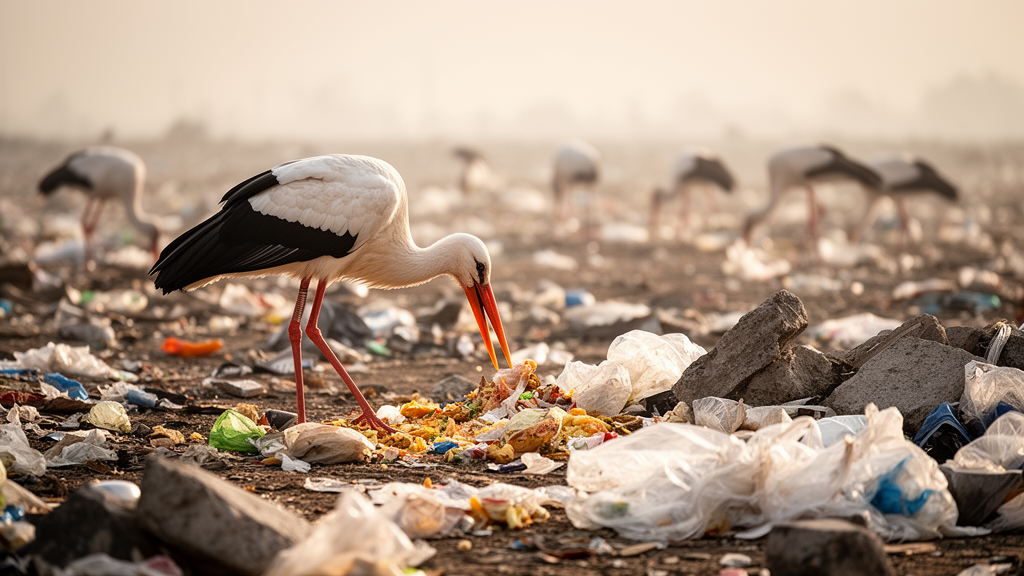
In the sprawling suburbs of Alcalá de Henares, just outside Madrid, White Storks have been quietly rewriting the rules of urban wildlife ecology. A new study, published in One Ecosystem, reveals how a population of these iconic migratory birds, breeding on historic churches and municipal buildings in central Spain, has undergone a dramatic epidemiological transformation driven by one thing: garbage. By examining the gastrointestinal parasites and enteric bacteria of 44 adult storks between 2022 and 2023, researchers have uncovered a fascinating sanitary trade-off at the heart of landfill foraging — one that carries significant implications for waste management policy, wildlife health, and the risk of zoonotic disease spillover into human communities.
The story begins decades ago. The White Stork population in Alcalá de Henares was once a mere handful of pairs — roughly 15 in the 1970s. But in 1984, the opening of a nearby open-sky landfill transformed the birds’ fortunes. With an abundant, predictable food source on their doorstep, the population exploded to more than 130 breeding pairs by 2017. Then, in 2021, in compliance with European waste management directives, the local landfill was closed. The storks, faced with a sudden loss of their primary foraging ground, adapted with remarkable behavioural flexibility: they began commuting daily to more distant active landfills, while partially incorporating natural habitats such as wetlands and croplands into their foraging routines. This post-closure context provided researchers with a unique natural experiment — a population caught mid-transition, still heavily reliant on refuse but forced to travel further for it.
Under a One Health framework, which recognises the intrinsic interconnection between human, animal and ecosystem health, highly mobile synanthropic species like the White Stork act as biological vectors, bridging human waste reservoirs with urban environments. When these birds habitually forage at municipal solid waste landfills, their capacity for pathogen dispersal is drastically amplified. Landfills serve as massive aggregation hotspots where high faecal shedding turns the sites into critical contagion hubs. The storks, breeding in close proximity to human activity, then carry whatever they have picked up — bacteria, parasites, antimicrobial resistance elements — back to their urban nesting sites, effectively connecting outer-urban ecosystems with human settlements.
The research team, working with a population that has been systematically monitored since 2009 via remote identification of alphanumeric PVC rings, captured 44 adult White Storks at their foraging sites using nylon nest traps across four distinct sampling sessions between 2022 and 2023. Seventeen birds were sampled on 1 March 2022, eight on 15 February 2023, thirteen on 19 July 2023 and six on 29 November 2022, covering both pre-breeding and post-breeding periods. All captured individuals were fully feathered adults in fit to excellent physical condition, as evaluated using the Scaled Mass Index. Fresh faeces were collected from 40 of the 44 birds using sterile Mini Parasep® faecal parasite concentrators, while cloacal swabs were taken from all 44 individuals for microbiological screening.
The parasitological analysis revealed a remarkably low burden of gastrointestinal helminths. Five taxa were identified through microscopic examination at 100× and 400× magnifications: the trematode Chaunocephalus ferox, the cestodes Choanotaenia infundibulum and Raillietina spp., the nematode Contracaecum microcephalum, and the gapeworm Syngamus trachea. C. ferox was the most frequently detected helminth, exhibiting an overall prevalence of just 15.9 percent (95% CI: 7.9–29.4 percent, Wilson score method). The remaining taxa were detected at even lower frequencies: Raillietina spp. showed a prevalence of 4.5 percent, while C. infundibulum, Contracaecum spp. and S. trachea each presented a prevalence of 2.3 percent. No enteroparasitic protozoa were found at all.
These low prevalences are striking when compared with other populations. The 15.9 percent prevalence for C. ferox is drastically lower than the 77.7 percent reported in necropsy studies by Girisgin and colleagues in 2017. Similarly, the prevalence for S. trachea is lower than the 5.26 percent published by Michalczyk and colleagues in 2020, and the 4.5 percent for Raillietina spp. is markedly below the 23.07 percent recorded in other populations. The detection of C. infundibulum represents a particularly rare finding, with very few cases previously reported in White Storks and none previously in Spain. The researchers suggest that these discrepancies may be attributed to geographical distributions or differences in foraging strategies, as the compared populations often exhibit a hybrid foraging behaviour combining landfills with natural wetlands or croplands.
The mechanism behind this parasite suppression lies in the biological life cycles of the helminths themselves. Parasites with indirect life cycles — which require specific intermediate hosts such as insects, earthworms, snails, fish or small vertebrates — often exhibit reduced prevalence when storks bypass their natural prey. The cestodes C. infundibulum and Raillietina spp. require the ingestion of arthropods; C. infundibulum is well-documented for utilising the housefly and various beetles as intermediate hosts, while Raillietina species typically depend on ants or coleopterans. The trematode C. ferox involves a primary developmental stage in Planorbidae snails followed by encystment in fish or amphibians. Similarly, the nematode C. microcephalum follows a cycle involving aquatic copepods as first intermediate hosts and fish as second intermediate hosts. By substituting natural prey with human organic waste, White Storks may experience a reduced exposure rate to the infective stages required to complete these parasitic life cycles — a functional barrier in trophic transmission chains.
Conversely, the enteric bacterial analysis highlighted a high and continuous burden of bacterial exposure. All 44 samples were positive for presumptive Escherichia coli, resulting in a 100 percent overall prevalence (95% CI: 92.0–100 percent). Meanwhile, presumptive Campylobacter spp. and presumptive Salmonella spp. were detected at overall prevalences of 6.8 percent and 4.5 percent, respectively. Notably, one of the Campylobacter-positive samples was also positive for presumptive Shigella spp., determined by its appearance on selective culture plates. Landfills serve as environmental reservoirs for human-derived enteropathogens and antimicrobial resistance elements, exposing wildlife to clinical waste and antibiotic residues. The consumption of decaying organic matter facilitates infection by pathogenic bacteria, and the unnaturally high density of individuals congregating at landfills promotes faecal–oral transmission.
Crucially, the inferential statistical analyses revealed that both helminth prevalences and bacterial shedding remained stable across the studied timeframe. Fisher’s exact tests showed no statistically significant differences for any parasitic taxon between pre-breeding and post-breeding periods (all p ≥ 0.677) or across the four specific sampling dates (all p ≥ 0.635). Similarly, no significant temporal variations were observed for Salmonella spp. or Campylobacter spp. This lack of seasonal variation strongly suggests that the reduced exposure to natural intermediate hosts is a constant, year-round phenomenon in this population, pointing to a chronic and continuous exposure source for enteric bacteria.
Ultimately, the study underscores a profound sanitary trade-off. Landfills offer an abundant caloric influx that relaxes natural foraging constraints and facilitates population growth, but potentially at the expense of altered parasite assembly rules and increased exposure to anthropogenic pathogens. While the caloric abundance of waste deposits has driven the storks’ urban expansion, it functions as an ecological trap that compromises the long-term physiological integrity and evolutionary fitness of avian populations. The findings demonstrate how anthropogenic refuse drives epidemiological shifts in synanthropic birds and assess the associated public health risks for surrounding urban communities, offering a valuable case study at the interface of urban wildlife ecology and public health — and highlighting the far-reaching health implications of waste management policies.
Subject of Research: The influence of landfill foraging: enteric helminths and bacteria in a population of White Stork ( Ciconia ciconia ) from central Spain
Article Title: The influence of landfill foraging: enteric helminths and bacteria in a population of White Stork ( Ciconia ciconia ) from central Spain
Article References: Garces-Herrero, M., Verdu-Exposito, C., Sanz-Miranda, A., & Pérez-Serrano, J. (2026). The influence of landfill foraging: enteric helminths and bacteria in a population of White Stork (Ciconia ciconia) from central Spain. One Ecosystem, 11, Article e200352. https://doi.org/10.3897/oneeco.11.e200352
Image Credits: AI Generated
DOI: 10.3897/oneeco.11.e200352
Keywords: influence, landfill, foraging, enteric, helminths, bacteria, population, White, Stork, Ciconia, central, Spain
Cite Scienmag News
Gavin Prescott. (October 15, 2026). Landfill Foraging Reshapes Gut Parasites and Bacteria in Urban White Storks. Scienmag. https://scienmag.com/landfill-foraging-reshapes-gut-parasites-and-bacteria-in-urban-white-storks/
Gavin Prescott. "Landfill Foraging Reshapes Gut Parasites and Bacteria in Urban White Storks." Scienmag, 15 October 2026, https://scienmag.com/landfill-foraging-reshapes-gut-parasites-and-bacteria-in-urban-white-storks/. Accessed 15 October 2026.
Gavin Prescott. "Landfill Foraging Reshapes Gut Parasites and Bacteria in Urban White Storks." Scienmag. October 15, 2026. https://scienmag.com/landfill-foraging-reshapes-gut-parasites-and-bacteria-in-urban-white-storks/


