


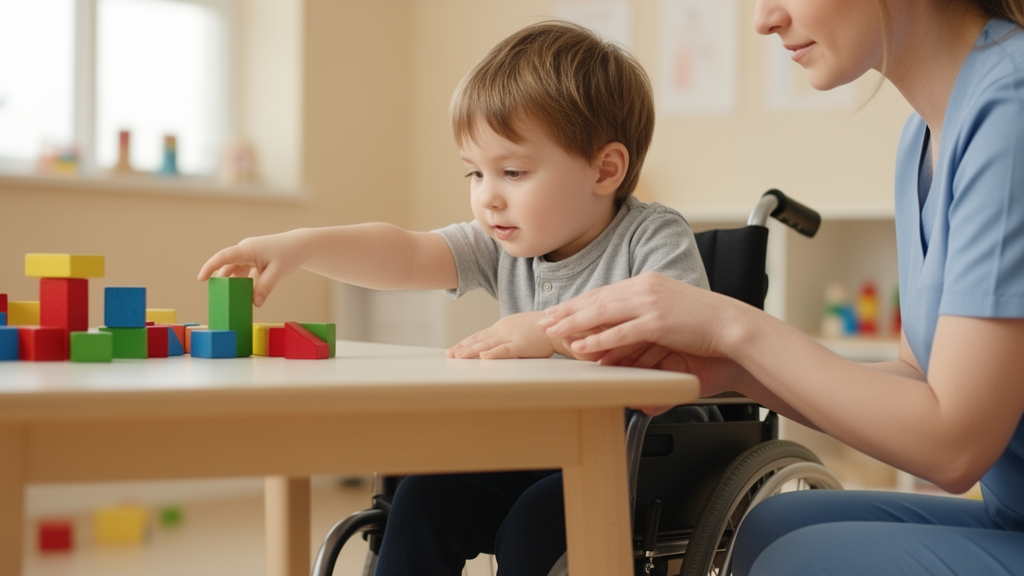
For preschoolers with the most physically demanding form of cerebral palsy, what the eyes see may matter almost as much as what the muscles can do. A new study published in BMC Pediatrics by Aybüke Yurteri Tiryaki of the University of Health Sciences Türkiye, Mustafa Cemali of Trakya University, and Berkan Torpil of the University of Health Sciences Türkiye provides some of the clearest evidence yet that cortical visual impairment, a condition in which the eyes themselves may be healthy but the brain cannot interpret visual signals, compounds the developmental and functional challenges faced by children with quadriplegic cerebral palsy. The findings arrive at a moment when rehabilitation specialists are increasingly recognizing that vision, long treated as a secondary concern in children with severe motor impairments, may be a central lever for unlocking developmental progress.
Cerebral palsy is the most common motor disability of childhood, arising from injury or atypical development of the developing brain before, during, or shortly after birth. In its quadriplegic form, all four limbs are affected to a substantial degree, and children typically face profound difficulties with movement, posture, and self-care. But the motor symptoms are only part of the story. The same brain injury that disrupts movement control frequently disrupts the visual system as well, not by damaging the eyes but by impairing the cortical and subcortical networks that assemble raw visual input into usable perception. The resulting condition, cortical visual impairment or CVI, has become one of the leading causes of visual impairment in children in developed countries, and it is especially prevalent among children with severe cerebral palsy.
The challenge for clinicians has been that CVI is notoriously easy to miss. A child may pass a basic eye examination, with structurally normal eyes and reactive pupils, yet be functionally blind to much of the visual world because the brain cannot process what arrives. In a child who already cannot walk or speak fluently, detecting that the child also cannot reliably interpret faces, objects, or spatial layouts is extraordinarily difficult. This diagnostic blind spot has real consequences: interventions that rely on visual demonstration, visual attention, or visually guided reaching may fail not because the child cannot learn, but because the therapy is invisible to the child.
To quantify how much CVI actually matters for everyday development, the research team recruited 80 preschool children aged between 36 and 60 months, all diagnosed with quadriplegic cerebral palsy. Forty of the children had quadriplegic cerebral palsy alone, with an average age of about 44 months, while the other 40 had quadriplegic cerebral palsy combined with cortical visual impairment, averaging roughly 46 months. The groups were closely matched in age, allowing the researchers to isolate the contribution of visual impairment from the motor severity that both groups shared. This design is what gives the study its analytical power: any systematic difference between the groups could be attributed to the visual system rather than to gross motor status.
The team deployed a battery of validated instruments, each targeting a different developmental domain. Developmental functioning across multiple areas was assessed with the Ankara Developmental Screening Inventory, a standardized tool that screens cognitive, language, fine motor, gross motor, and social self-care development in young children. Functional independence, meaning the child’s capacity to perform everyday activities such as feeding, dressing, bathing, and mobility with or without assistance, was measured with the Pediatric Evaluation of Disability Inventory, widely regarded as one of the most rigorous functional assessment instruments in pediatric rehabilitation. Gross motor skills were quantified with the Gross Motor Function Measure-88, the international gold standard for evaluating motor function in cerebral palsy. Crucially, the severity of visual impairment was itself graded using the Visual Function Classification Scale, an ordinal classification system that places a child’s functional vision on one of five levels, from near-normal visual function to no visual function, providing a standardized way to ask not just whether vision matters but how much.
The results were unambiguous. Children with quadriplegic cerebral palsy and cortical visual impairment scored significantly lower than their peers without CVI on both functional independence and developmental measures, with all comparisons reaching statistical significance at the p < 0.01 threshold. In practical terms, the presence of cortical visual impairment was associated with a measurable additional burden on top of the severe motor disability that both groups carried. The children with CVI were less independent in daily activities and showed weaker performance across developmental domains, a pattern consistent with the idea that vision acts as a gateway sense for early learning: much of what a preschooler learns about objects, space, communication, and social interaction is scaffolded by visual attention and visual exploration.
Perhaps the most striking finding emerged from the analysis within the CVI group itself. When the researchers stratified children by their Visual Function Classification Scale level, a clear dose-response relationship appeared: the higher the VFCS level, indicating more severe visual impairment, the lower the child’s functional independence and developmental scores. All of these within-group comparisons were also statistically significant at p < 0.01. A dose-response gradient of this kind is scientifically important because it suggests a graded, systematic relationship rather than a binary effect. Each step of lost visual function corresponded to a step of lost developmental and functional capacity, which strengthens the argument that the visual system is not merely correlated with outcome but is causally entangled in the child’s developmental trajectory.
The implications for clinical practice are substantial. The authors conclude that visual functioning should be explicitly considered in clinical assessment, intervention planning, and future research involving children with cerebral palsy. In concrete terms, this means that a preschooler with quadriplegic cerebral palsy should not be assumed to have usable vision simply because an ophthalmological exam is unremarkable. Standardized classification of functional vision, using tools such as the VFCS, should become part of the routine evaluation. Rehabilitation programs may need to adapt their methods for children with CVI, for example by emphasizing tactile and auditory input, controlling visual clutter, using high-contrast materials, and positioning objects within the child’s functional visual field. Therapeutic goals for self-care skills may need to be recalibrated when visual guidance is unavailable, and progress may look different for a child learning to feed themselves by touch rather than by sight.
The study also carries a broader message about how developmental disability is measured and understood. Functional independence and developmental scores are composite outcomes shaped by many interacting systems, and this work demonstrates that a single, frequently overlooked sensory factor can shift those outcomes substantially even when motor severity is held constant. For researchers, the finding argues for including visual function as a covariate or stratification variable in studies of cerebral palsy outcomes, since pooling children with and without CVI may obscure meaningful differences and lead to misattributed conclusions about the effectiveness of motor interventions. For families, the message is one of vigilance and advocacy: asking specifically about cortical visual impairment, and seeking assessment by clinicians familiar with the condition, could change the shape of a child’s intervention plan.
Published as an open-access article in BMC Pediatrics, with ethics approval from Lokman Hekim University and conducted in accordance with the Declaration of Helsinki, the study adds to a growing body of literature reframing cerebral palsy as a whole-brain condition rather than a purely motor one. The dose-response relationship between visual impairment severity and developmental outcomes gives clinicians a quantifiable reason to treat the visual system as a primary target of assessment and intervention in this population. As screening tools for cortical visual impairment improve and awareness spreads, the hope is that children with quadriplegic cerebral palsy will receive interventions designed for how they actually perceive the world, turning a hidden disability into a visible and treatable one.
Subject of Research: Functional independence and developmental outcomes in preschool children with quadriplegic cerebral palsy and cortical visual impairment
Article Title: Investigation of functional independence and developmental areas in preschool children with quadriplegic cerebral palsy and cortical visual impairment
Article References: Yurteri Tiryaki, A., Cemali, M., & Torpil, B. (2026). Investigation of functional independence and developmental areas in preschool children with quadriplegic cerebral palsy and cortical visual impairment. BMC Pediatrics. https://doi.org/10.1186/s12887-026-07699-1
Image Credits: AI Generated
DOI: 10.1186/s12887-026-07699-1
Keywords: cerebral palsy, cortical visual impairment, quadriplegia, functional independence, child development, pediatric rehabilitation, Visual Function Classification Scale, Gross Motor Function Measure-88, Pediatric Evaluation of Disability Inventory, neurodevelopmental disorders, preschool children, vision assessment
Cite Scienmag News
Cassandra Pierce. (October 15, 2026). When the Brain’s Visual Wiring Fails: Hidden Vision Loss Deepens Disability in Children with Cerebral Palsy. Scienmag. https://scienmag.com/when-the-brains-visual-wiring-fails-hidden-vision-loss-deepens-disability-in-children-with-cerebral-palsy/
Cassandra Pierce. "When the Brain’s Visual Wiring Fails: Hidden Vision Loss Deepens Disability in Children with Cerebral Palsy." Scienmag, 15 October 2026, https://scienmag.com/when-the-brains-visual-wiring-fails-hidden-vision-loss-deepens-disability-in-children-with-cerebral-palsy/. Accessed 15 October 2026.
Cassandra Pierce. "When the Brain’s Visual Wiring Fails: Hidden Vision Loss Deepens Disability in Children with Cerebral Palsy." Scienmag. October 15, 2026. https://scienmag.com/when-the-brains-visual-wiring-fails-hidden-vision-loss-deepens-disability-in-children-with-cerebral-palsy/


