


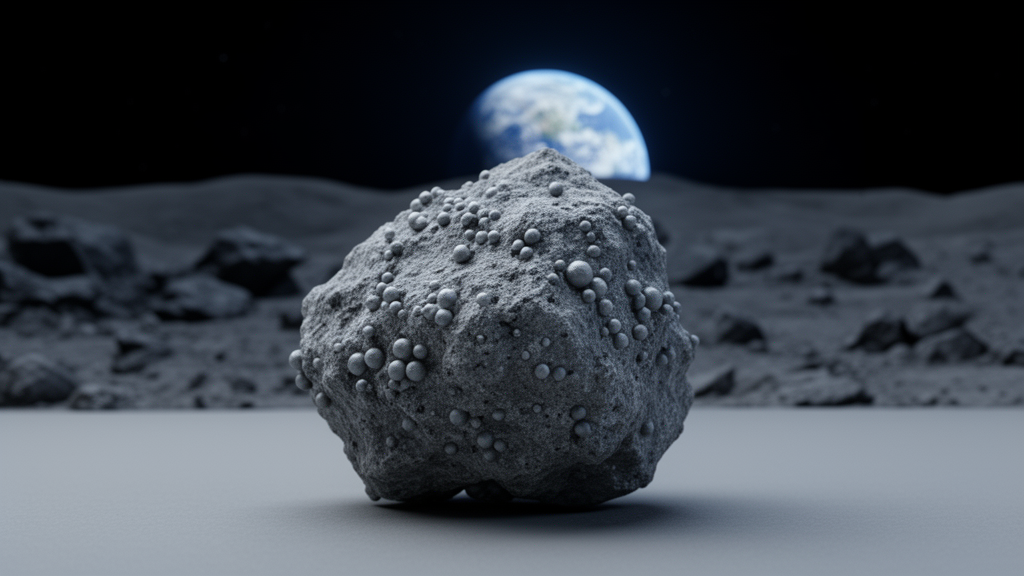
The lunar farside has quietly been collecting dust from the inner Solar System for billions of years, and the fingerprints of that cosmic rain are now readable in nickel atoms. A research team led by Kewei Chen, Yingnan Zhang and Liping Qin at the University of Science and Technology of China analyzed regolith and rock fragments returned by China’s Chang’e-6 mission, the first spacecraft ever to bring material from the far side of the Moon. Their study, published in Communications Earth & Environment, shows that the long-term average of material accreting onto the lunar surface was dominantly sourced from the inner Solar System, a conclusion drawn from some of the most sensitive isotope measurements ever applied to extraterrestrial samples.
Space weathering, the cumulative surface modification caused by meteoritic and micrometeoritic impacts, plays a fundamental role in altering planetary surfaces everywhere in the Solar System. On the Moon, which lacks an atmosphere to burn up incoming debris, micrometeorites strike the regolith at hypersonic speeds, vaporizing both impactor and target and welding exotic material into the topmost soil grains. Yet two basic questions have remained unresolved: where do these impactors actually come from, and how does impact-induced evaporation control the accretion of micrometeorite material? The Chang’e-6 samples offered a fresh, unsampled lunar locale to attack both problems at once.
The team measured the isotopic composition of nickel in regolith and in lithic clasts, individual rock fragments embedded in the soil. Nickel is a particularly clever tracer because it carries two kinds of isotopic information. The ratio of its heavier to lighter stable isotopes, expressed as δ60Ni, records evaporation processes, since lighter isotopes escape preferentially when material vaporizes. Meanwhile, tiny nucleosynthetic anomalies, expressed in parts per million as μ60Ni and μ62Ni, act as a genetic barcode distinguishing materials formed in different regions of the early Solar System.
The results for the bulk regolith were striking. The Chang’e-6 regolith and some of the lithic clasts exhibit systematically enriched heavy nickel isotopic compositions, with δ60Ni values ranging from 1.07 to 1.25 per mil. These values are consistent with cumulative evaporation during repeated micrometeoritic bombardment under quasi-saturated conditions. In other words, each micrometeorite impact briefly creates a vapor cloud that is nearly saturated with nickel, limiting further fractionation per event, but the sheer number of impacts over billions of years drives the surviving soil progressively heavier in its nickel isotope signature. The regolith is, in effect, a palimpsest recording countless evaporation episodes.
Even more intriguing was a subset of basaltic clasts from the Chang’e-6 collection, which recorded unusually light nickel isotopic compositions, with δ60Ni values between −0.95 and −0.48 per mil. These values fall beyond the range previously reported for any lunar materials. The researchers interpret them as evidence of post-evaporation recondensation: after impact vapor plumes boiled away lighter nickel isotopes, some of that vapor recondensed locally, depositing material with the opposite, light isotopic signature into the basaltic fragments. It is a rare direct capture of both halves of the vaporization cycle, the escape and the return, within a single sample suite.
The genetic part of the story came from the nucleosynthetic anomalies. The Chang’e-6 regolith shows μ60Ni of 7 ± 3 and μ62Ni of −6 ± 9, values that point toward materials originating in the inner Solar System rather than the outer realms. This matters because planetary scientists have long debated the balance of impactor flux reaching the Moon. Some models emphasize cometary material delivered from the outer Solar System, particularly on the farside, which faces outward into interplanetary space. The nickel isotope anomalies suggest instead that the long-term average accreting materials to the lunar surface were dominantly sourced from the inner Solar System, meaning asteroidal and planetary debris from the region inside the main belt.
The technical achievement underlying these conclusions should not be understated. Nucleosynthetic isotope anomalies in nickel are measured in parts per million, requiring extraordinary instrumental precision and rigorous correction for interferences. Applying such measurements to a mere handful of grams of Chang’e-6 regolith, and to individual clasts within it, demanded careful sample preparation and repeated analysis. The consistency between the evaporation signal in the bulk soil and the recondensation signal in the clasts strengthens the interpretation that micrometeorite bombardment, not some exotic lunar process, generated the observed patterns.
These findings also refine our understanding of space weathering itself. Because the heavy nickel isotope enrichment in the regolith matches predictions for cumulative evaporation under quasi-saturated conditions, the measurements provide a quantitative constraint on how micrometeorite accretion proceeds on airless bodies. The light isotope signatures in the basaltic clasts, indicative of post-evaporation recondensation, show that impact vapor does not simply disperse into space; a portion recondenses and is preserved in the local geology. That has implications for how exotic elements and isotopic signatures are redistributed across planetary surfaces, from Mercury to asteroids.
For the wider community, the study demonstrates the scientific payoff of the Chang’e-6 mission beyond its headline achievement of farside sample return. The sampling site sits within the South Pole–Aitken basin context, a region geologically distinct from the nearside locales visited by Apollo and Luna missions, and the nickel isotope data confirm that the farside regolith records the same inner Solar System impactor dominance seen in other tracers. As more laboratories gain access to these samples, isotope systems like nickel will continue to decode the impact history of the Moon and, by extension, the delivery of material throughout the inner Solar System over the past several billion years.
Subject of Research: Geochemistry
Article Title: Nickel isotopes reveal micrometeorite accretion on the lunar farside dominated by inner Solar System materials
Article References: Chen, K., Zhang, Y., Wang, Z., Shen, J., Yang, B., Zhou, M., Sun, J., Liu, K., Chen, D., & Qin, L. (2026). Nickel isotopes reveal micrometeorite accretion on the lunar farside dominated by inner Solar System materials. Communications Earth & Environment. https://doi.org/10.1038/s43247-026-04038-1
Image Credits: AI Generated
DOI: 10.1038/s43247-026-04038-1
Keywords: Chang'e-6, lunar farside, nickel isotopes, micrometeorites, space weathering, inner Solar System, lunar regolith, evaporation, Nickel, isotopes, reveal, micrometeorite
Cite Scienmag News
Grant Pearson. (October 15, 2026). Nickel isotopes from Chang’e-6 samples trace lunar farside micrometeorite rain to inner Solar System. Scienmag. https://scienmag.com/nickel-isotopes-from-change-6-samples-trace-lunar-farside-micrometeorite-rain-to-inner-solar-system/
Grant Pearson. "Nickel isotopes from Chang’e-6 samples trace lunar farside micrometeorite rain to inner Solar System." Scienmag, 15 October 2026, https://scienmag.com/nickel-isotopes-from-change-6-samples-trace-lunar-farside-micrometeorite-rain-to-inner-solar-system/. Accessed 15 October 2026.
Grant Pearson. "Nickel isotopes from Chang’e-6 samples trace lunar farside micrometeorite rain to inner Solar System." Scienmag. October 15, 2026. https://scienmag.com/nickel-isotopes-from-change-6-samples-trace-lunar-farside-micrometeorite-rain-to-inner-solar-system/


