


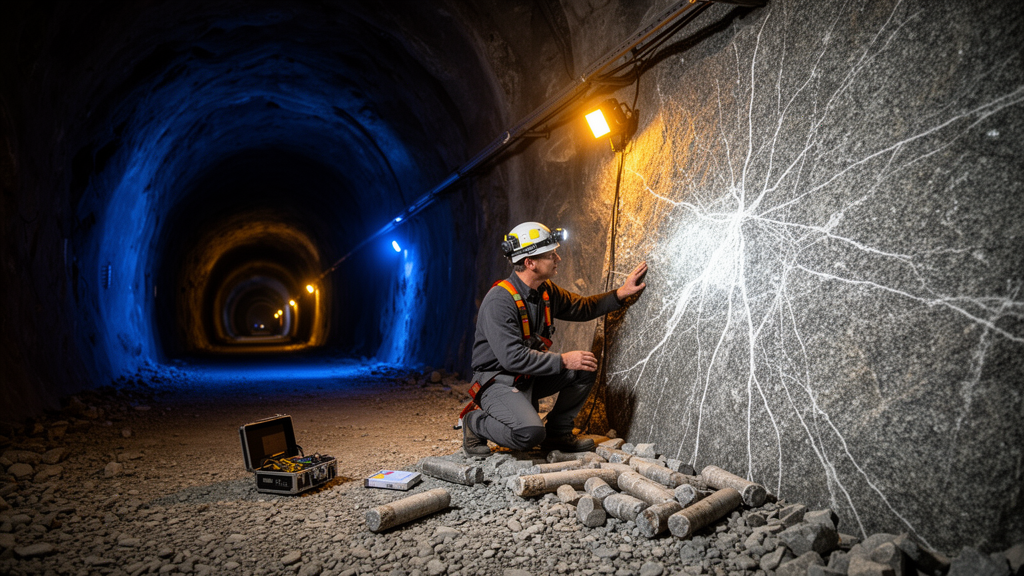
More than a kilometer beneath the peaks of the Swiss Central Alps, scientists have carved a brand-new tunnel through solid granite and watched, in unprecedented detail, as the rock began to break. The experiment, known as PRECODE, was carried out at the BedrettoLab, an underground research laboratory established by ETH Zurich in a disused access tunnel near the Gotthard Pass. Over the course of 2024 and 2025, a research team led by Pooya Hamdi of RWTH Aachen University excavated a roughly 100-meter-long side tunnel in Rotondo Granite at an overburden depth of about 1,300 meters, deep enough for the natural stresses in the mountain to fracture the rock on their own. Their goal is nothing less than understanding how damage around underground excavations forms, spreads, and quietly evolves over decades and centuries, a question that sits at the heart of plans to bury nuclear waste deep in the Earth for the next hundred thousand years.
The stakes are considerable. Deep geological repositories are widely regarded as the safest option for the long-term disposal of heat-generating nuclear waste, and several countries, including Switzerland, Finland, and Sweden, are pursuing crystalline host rocks such as granite. The trouble is that excavating a tunnel inevitably damages the surrounding rock. This so-called excavation damage zone, or EDZ, contains new microcracks and macroscopic fractures that can dramatically increase permeability, potentially creating preferential pathways along which radionuclides could migrate away from the repository. Unlike claystones and salt rocks, crystalline rocks possess no natural self-sealing ability, so the damage tends to persist and, under unfavorable conditions, may keep growing long after the tunnel is finished.
Rock mechanics has long known that stress-induced fracturing around tunnels begins at stress levels well below the rock’s laboratory-measured strength. In massive crystalline rocks, brittle fracturing typically initiates at roughly 35 to 60 percent of the unconfined compressive strength determined on lab samples, coinciding with the crack initiation threshold that can be detected through strain measurements or acoustic emission monitoring. Beyond a characteristic spalling limit, defined by the ratio of the maximum to minimum principal stresses, the rock fails in an extensional mode, forming visible fractures and V-shaped notches at points of maximum stress concentration. What remains far less certain is the long-term story: whether, and how fast, this damage continues to grow over the service life of a repository, driven by slow processes such as subcritical crack growth and stress corrosion in chemically reactive environments.
Previous underground experiments have provided tantalizing hints. At Canada’s Underground Research Laboratory in Manitoba, the famous Mine-by experiment showed that microseismic events clustered in the tunnel roof and floor, where differential stresses were highest, and that V-shaped spalling notches developed in those locations. Comparisons between drill-and-blast and tunnel-boring-machine excavation at the same site revealed that the blasted tunnel suffered dramatically more damage, with acoustic emission rates roughly ten times higher. Similar contrasts emerged from the ZEDEX project at Sweden’s Äspö Hard Rock Laboratory and at Finland’s Onkalo site, where the damage zone around blasted sections reached up to a meter in depth while bored sections showed only a few centimeters. But even the longest-running in-situ observations span only about five to twenty years, a fleeting window compared with the hundred-thousand-year lifespan expected of a repository.
The Bedretto Tunnel itself offers a rare glimpse of that longer timescale. Constructed in the 1970s and 1980s as a spoil-removal adit for the Furka Base Tunnel, the 5.2-kilometer-long horseshoe tunnel has remained largely unlined since 1982. Laser scanning campaigns along its high-overburden stretches have revealed systematic spalling reaching depths of 1.1 to 1.5 meters in the most affected granite sections, along with distinctive onion-skin fractures, kink bands, and tension cracks. The damage is strikingly asymmetrical, indicating that the principal stresses are neither horizontal nor vertical nor parallel to the tunnel axis. Because the tunnel has stood for more than forty years, its mature damage zone provides a natural laboratory for studying time-dependent brittle fracturing under natural environmental conditions, including humidity that regularly exceeds 80 percent.
To capture the short-term formation of the damage zone from its very first moments, the PRECODE team instrumented the rock mass before excavating a single meter. A network of 31 acoustic emission sensors was installed in longitudinal boreholes about one meter from the future tunnel wall, sampling continuously at 200 kilohertz to catch individual microcracking events. Distributed acoustic and strain sensing cables, fiber-optic Fiber Bragg Grating sensors for deformation monitoring, electrical resistivity tomography arrays bolted permanently to the tunnel wall, ground-penetrating radar surveys, and terrestrial laser scanning completed the geophysical toolkit. Multi-packer borehole systems isolated discrete monitoring intervals at distances ranging from about one to more than four meters from the tunnel wall, allowing real-time pore pressure measurement with micro-kilopascal resolution and repeated hydraulic pulse tests before, during, and after excavation.
The excavation itself was deliberately split into two techniques. The first ten meters were excavated in 2024 using controlled drill-and-blast, advancing about one meter per day. The next eleven meters used a gentler method called line-drilling and rock-breaking, in which a ring of perimeter boreholes decouples the intended tunnel profile from the surrounding rock before the inner core is removed with a rock splitter and hammer. This soft excavation advanced at only 0.1 to 0.25 meters per day but promised to minimize construction-induced damage. By comparing the two sections under nearly identical geology and stress, the team can separate damage caused purely by stress redistribution from damage caused by the excavation method itself, a distinction no previous experiment in granite has resolved so cleanly.
The preliminary results are revealing. Acoustic emission activity was dramatically higher during the blasting phase, with roughly 72,717 events per meter of excavation compared with about 46,664 to 48,232 events per meter in the two soft-excavated sections, a difference of 50 to 55 percent. The events concentrated along the tunnel sidewalls, where stresses are highest, and their spatial distribution suggests the maximum principal stress is inclined about 15 degrees from vertical. Event density was highest within the first half meter from the tunnel wall, corresponding to the zone of visible surface damage, while lower-density activity extended to roughly 1.5 meters, likely marking the outer limit of the damage zone. Laser scanning showed maximum spalling depths of about 60 centimeters, concentrated in the lower northwest and upper southeast walls, confirming that the measurable surface damage represents only the inner core of a broader damaged volume.
The geophysical data reinforce the picture. Electrical resistivity tomography, collected nearly a year after excavation once the newly fractured rock had partially saturated, showed lower resistivities in the blasted section and higher resistivities in the soft-excavated section, consistent with more intact rock where gentler methods were used. The inverted resistivity values, spanning roughly 40 to 24,000 ohm-meters across the profile, fall between published values for intact dry granite cores and water-bearing fractured zones, matching an EDZ that is cracked but not fully saturated. Together with the acoustic emission counts and the laser-scanned overbreak maps, the data demonstrate that reducing excavation disturbance measurably preserves rock mass integrity, with practical implications for how future repository tunnels should be built.
What comes next may matter even more than what has already been measured. The PRECODE tunnel runs parallel to a natural fault zone that is the target of the separate FEAR experiment, in which researchers will stimulate the fault under controlled conditions, offering a unique opportunity to observe how fault activation and induced seismicity affect tunnel stability and damage-zone permeability. In parallel, laboratory fatigue, relaxation, and fracture mechanics tests on Rotondo Granite under controlled temperature, humidity, and pore-fluid chemistry aim to quantify the stress corrosion and subcritical crack growth processes that govern long-term strength degradation. By comparing hydraulic properties in the forty-year-old damage zone of the original tunnel with those in the freshly excavated PRECODE section, the team hopes to measure permeability evolution directly across decades. For a repository that must outlast every human institution on Earth, those slow, invisible processes may ultimately prove the most important of all.
Subject of Research: Excavation damage zone formation and time-dependent evolution in granitic rocks at the BedrettoLab underground research laboratory
Article Title: Understanding spatial and temporal evolution of progressive excavation damage zone in granitic rocks – development of a novel mine-by and laboratory experimental framework at the BedrettoLab
Article References: Hamdi, P., Dickmann, J., Kruszewski, M., Rinaldi, A. P., Villiger, L., Shakas, A., Perras, M., Bahrani, N., Bianchi, P., Achtziger-Zupančič, P., Gaines, S., Bröker, K., Ma, X., Selvadurai, P. A., Durand, V., Khaledi, K., Jalali, M., Golabchi, Y., Harris, S., … Amann, F. (2026). Understanding spatial and temporal evolution of progressive excavation damage zone in granitic rocks – development of a novel mine-by and laboratory experimental framework at the BedrettoLab. Solid Earth, 17(10), 1139-1165. https://doi.org/10.5194/se-17-1139-2026
Image Credits: AI Generated
Keywords: BedrettoLab, excavation damage zone, granite, nuclear waste repository, acoustic emission monitoring, spalling, drill and blast, line-drilling, subcritical crack growth, permeability evolution, deep geological disposal, rock mechanics
Cite Scienmag News
Violet Maxwell. (October 15, 2026). Deep Beneath the Swiss Alps, a New Tunnel Reveals How Rock Damage Grows Over Time. Scienmag. https://scienmag.com/deep-beneath-the-swiss-alps-a-new-tunnel-reveals-how-rock-damage-grows-over-time/
Violet Maxwell. "Deep Beneath the Swiss Alps, a New Tunnel Reveals How Rock Damage Grows Over Time." Scienmag, 15 October 2026, https://scienmag.com/deep-beneath-the-swiss-alps-a-new-tunnel-reveals-how-rock-damage-grows-over-time/. Accessed 15 October 2026.
Violet Maxwell. "Deep Beneath the Swiss Alps, a New Tunnel Reveals How Rock Damage Grows Over Time." Scienmag. October 15, 2026. https://scienmag.com/deep-beneath-the-swiss-alps-a-new-tunnel-reveals-how-rock-damage-grows-over-time/


