


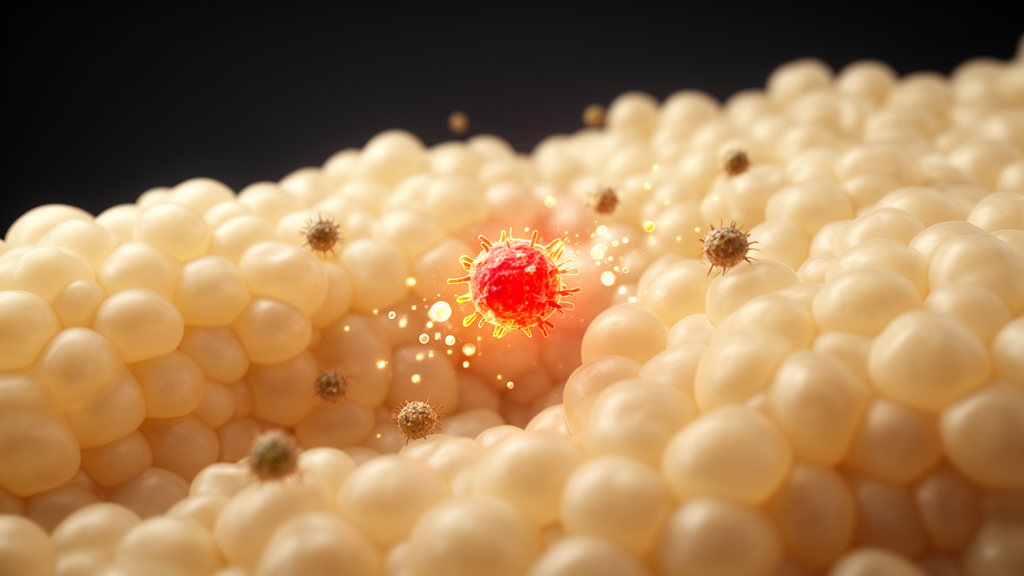
Chronic inflammatory diseases—from rheumatoid arthritis to inflammatory bowel disease—share a stubborn molecular signature: macrophages locked into a destructive, inflammatory state and a cellular signaling pathway called NF-κB that refuses to switch off. A new mini-review published in Molecular Biology Reports argues that a largely overlooked biological material harvested from human fat tissue could help break that deadlock. Ratna Puspita, of Universitas Pembangunan Nasional Veteran Jakarta in Indonesia, examined the literature on the secretome of the adipose-derived Stromal Vascular Fraction, or SVF, and concluded that this freshly isolated cocktail of secreted molecules may act as a powerful immunomodulator, capable of shifting inflamed tissue environments from destructive to regenerative.
The SVF is the heterogeneous cell population left behind when adipose tissue is processed to remove mature fat cells. Unlike culture-expanded mesenchymal stem cells, which are grown in laboratories over weeks, the SVF can be isolated fresh and contains a mixture of stromal cells, pericytes, endothelial cells, and immune cells. Its secretome—the full complement of soluble factors, growth factors, cytokines, and extracellular vesicles that these cells release—differs in important ways from the conditioned media of cultured stem cells. Puspita’s review emphasizes that this distinction matters, because the freshly isolated secretome retains a biochemical complexity and pericyte-rich secretory activity that culture expansion can diminish or alter.
At the heart of the review lies a detailed mechanistic proposal centered on NF-κB, one of the most intensively studied signaling pathways in immunology. In resting cells, NF-κB transcription factors—in particular the p65/p50 dimer—sit inertly in the cytoplasm, tethered there by inhibitory proteins known as IκB. When pattern-recognition receptors on macrophages detect inflammatory triggers such as bacterial lipopolysaccharide, the IκB kinase, or IKK, complex phosphorylates IκBα, marking it for degradation. Freed from its anchor, NF-κB translocates into the nucleus and switches on a battery of genes encoding tumor necrosis factor-alpha, interleukin-1 beta, interleukin-6, inducible nitric oxide synthase, and cyclooxygenase-2. When this circuit fails to resolve, tissue damage accumulates and chronic inflammation takes hold.
According to the review, components of the SVF secretome are proposed to intervene at the earliest steps of this cascade. Specifically, they may modulate the phosphorylation of the IKK complex, thereby supporting the stabilization of IκBα. If IκBα remains intact, the p65/p50 dimer stays sequestered in the cytoplasm, and the nuclear translocation that drives inflammatory gene expression is hindered. The downstream consequence would be a measurable reduction in the output of pro-inflammatory mediators that perpetuate tissue destruction. Puspita suggests this mechanism could explain observations across multiple experimental systems in which adipose-derived secreted factors dampen inflammatory signaling in macrophages and other immune cells.
But blocking NF-κB is only half of the story. The review devotes equal attention to the second arm of the proposed mechanism: active reprogramming of macrophages away from the inflammatory M1 state and toward the reparative M2-like phenotype. Macrophages are remarkably plastic cells, and their polarization state is tightly coupled to their metabolism. Classically activated M1 macrophages rely predominantly on glycolysis, the rapid but inefficient glucose-burning pathway that supports their antimicrobial and inflammatory functions. Alternatively activated M2 macrophages, by contrast, depend on oxidative phosphorylation in their mitochondria, a metabolic mode that sustains their roles in tissue repair, debris clearance, and resolution of inflammation.
Puspita proposes that SVF secretome components encourage precisely this metabolic shift, pushing macrophages toward oxidative phosphorylation and thereby supporting M2-like polarization through the STAT6/PPAR-γ pathway. STAT6 is the signal transducer activated by interleukin-4 and interleukin-13, the canonical M2-polarizing cytokines, while PPAR-γ is a nuclear receptor whose activity reinforces the oxidative metabolic program and anti-inflammatory gene expression. By engaging this axis, the secretome would not merely silence inflammation but actively recruit macrophages into a regenerative identity—one that secretes interleukin-10, promotes angiogenesis, and rebuilds damaged extracellular matrix.
The interleukin-10 dimension deserves particular attention. This cytokine is among the most potent immunosuppressive molecules the body produces, acting through the STAT3 axis to restrain inflammatory responses in macrophages and regulatory T cells. Recent work highlighted in the review’s bibliography explores how extracellular vesicles can deliver stabilized, functional IL-10 to macrophages, and how the IL-10/STAT3/SOCS3 circuit contributes to anti-inflammatory effects in diverse disease models. Because SVF-derived extracellular vesicles can encapsulate cytokines, growth factors, and microRNAs, they may serve as natural delivery vehicles that concentrate and protect these immunomodulatory payloads, extending their half-life and targeting them to receptive cells within inflamed tissue.
The therapeutic implications span a remarkable range of chronic inflammatory conditions. In rheumatoid arthritis, the M1/M2 balance within the synovium is a well-documented determinant of disease severity, and shifting that balance toward M2 could reduce joint destruction. In inflammatory bowel disease, macrophage polarization via the STAT1 and STAT6 pathways has been shown to influence colitis outcomes in experimental models. Wound healing represents another promising arena: studies of mesenchymal secretome delivery in hydrogels have demonstrated suppression of neutrophil extracellular trap formation and acceleration of diabetic wound closure, while SVF combined with hyaluronic acid has shown benefits in bone regeneration models. Dermatology, adipogenesis, and neovascularization applications round out the translational landscape.
Yet the review is candid about the obstacles standing between laboratory promise and clinical reality. Chief among them is biochemical variability. The composition of the SVF secretome depends on the donor, the isolation method, the processing system used, and even the degree of tissue fragmentation, with microfragmented adipose tissue reported to contain higher pericyte content and greater secretory activity than enzymatically derived fractions. This heterogeneity complicates dosing, standardization, and regulatory approval. Puspita therefore recommends that future investigation establish standardized, GMP-compliant isolation methods and systematically evaluate how donor characteristics—age, sex, metabolic status, and health history—shape the secretome’s biochemical profile and therapeutic potency.
Safety considerations, at least, appear encouraging. An exhaustive literature review of autologous adipose-derived SVF in clinical use, cited in the review, suggests a favorable safety profile for the cell fraction itself, and the cell-free nature of secretome-based therapy sidesteps several risks associated with live cell transplantation, including unwanted engraftment and uncontrolled proliferation. Freeze-dried, GMP-compliant exosome formulations have already been proposed as stable pharmaceutical products for acellular immunomodulant therapy. If standardized SVF secretome preparations can be manufactured reproducibly and their mechanisms validated in rigorous preclinical and clinical studies, they could join a growing arsenal of cell-free regenerative medicines—offering patients with chronic inflammatory diseases a way to quiet the fire not by suppressing the immune system wholesale, but by teaching it, molecule by molecule, to heal.
Subject of Research: Immunomodulatory mechanisms of the adipose-derived Stromal Vascular Fraction secretome in NF-κB inhibition and macrophage reprogramming for chronic inflammatory disease treatment
Article Title: The role of the adipose-derived Stromal Vascular Fraction (SVF) secretome as an immunomodulator in the treatment of chronic inflammatory diseases through NF-κB and macrophage reprogramming
Article References: Puspita, R. (2026). The role of the adipose-derived Stromal Vascular Fraction (SVF) secretome as an immunomodulator in the treatment of chronic inflammatory diseases through NF-κB and macrophage reprogramming. Molecular Biology Reports, 53(1), Article 1604. https://doi.org/10.1007/s11033-026-12799-3
Image Credits: AI Generated
DOI: 10.1007/s11033-026-12799-3
Keywords: Stromal Vascular Fraction, SVF secretome, NF-κB, macrophage polarization, M1/M2 macrophages, immunomodulation, adipose tissue, cell-free therapy, STAT6, PPAR-gamma, chronic inflammation, regenerative medicine
Cite Scienmag News
Drew Townsend. (October 15, 2026). Fat Tissue’s Hidden Cocktail May Rewire Inflamed Immune Cells, Review Finds. Scienmag. https://scienmag.com/fat-tissues-hidden-cocktail-may-rewire-inflamed-immune-cells-review-finds/
Drew Townsend. "Fat Tissue’s Hidden Cocktail May Rewire Inflamed Immune Cells, Review Finds." Scienmag, 15 October 2026, https://scienmag.com/fat-tissues-hidden-cocktail-may-rewire-inflamed-immune-cells-review-finds/. Accessed 15 October 2026.
Drew Townsend. "Fat Tissue’s Hidden Cocktail May Rewire Inflamed Immune Cells, Review Finds." Scienmag. October 15, 2026. https://scienmag.com/fat-tissues-hidden-cocktail-may-rewire-inflamed-immune-cells-review-finds/


