


For patients with advanced hepatocellular carcinoma, the most common form of primary liver cancer, the presence of a portal vein tumor thrombosis has long been one of the most ominous findings a clinician can deliver. When tumor cells invade the portal vein, the large vessel that carries nutrient-rich blood from the digestive system into the liver, the cancer has effectively commandeered the liver’s main supply line. These tumor thrombi seed new lesions, accelerate the spread of disease, and have historically limited treatment options to systemic drug therapy alone. Now, a prospective controlled study conducted at Peking University Cancer Hospital & Institute and published in BMC Medicine suggests that adding a regional chemotherapy technique to the current standard of care may substantially change the outlook for this difficult patient population.
The trial, registered at ClinicalTrials.gov under identifier NCT05166239, enrolled 66 patients with previously untreated advanced hepatocellular carcinoma complicated by portal vein tumor thrombosis between December 2021 and December 2023. Participants were assigned to one of two treatment strategies. The control group received lenvatinib, an oral multikinase inhibitor that blocks several receptors driving tumor blood vessel growth and cell proliferation, combined with a programmed death receptor 1 inhibitor, an immunotherapy that releases the molecular brakes cancer places on T cells. The experimental group received the same drug combination plus hepatic arterial infusion chemotherapy, a technique in which chemotherapeutic agents are delivered directly into the hepatic artery, the vessel that supplies liver tumors with most of their blood.
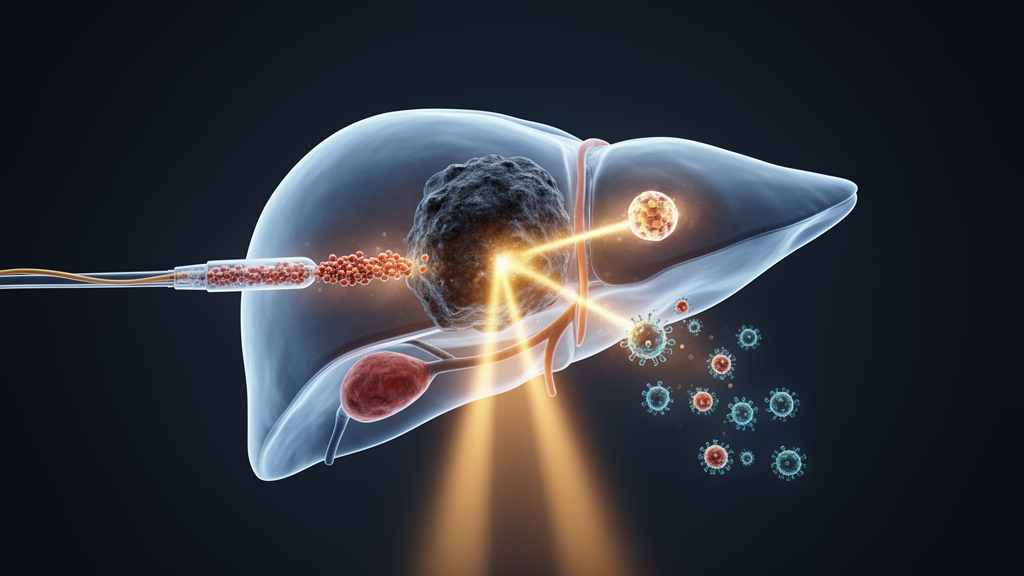
The logic behind this triple combination rests on the distinctive vascular anatomy of liver tumors. Hepatocellular carcinoma is overwhelmingly fed by the hepatic artery, while the surrounding healthy liver parenchyma draws most of its blood from the portal vein. By infusing chemotherapy through the hepatic artery, clinicians can achieve very high local drug concentrations inside the tumor while limiting systemic exposure and the toxicity that follows it. This regional approach also matters for tumor thrombi in the portal vein itself, because arterial blood can supply the thrombus through tiny vascular networks that form within the clot. Delivering chemotherapy through the artery therefore reaches both the primary tumor mass and the malignant invasion of the portal vasculature that makes this stage of disease so lethal.
The immunotherapy component adds another layer of biological rationale. Programmed death receptor 1 inhibitors work by blocking the interaction between the PD-1 receptor on T cells and its ligand, which tumors exploit to render attacking immune cells dysfunctional. Lenvatinib has been shown in preclinical work to remodel the tumor microenvironment, reducing immunosuppressive cells and increasing the infiltration of activated T cells, which may sensitize tumors to immune checkpoint blockade. The open question was whether adding hepatic arterial infusion chemotherapy to this systemic duo would amplify the benefit or simply pile on toxicity. The new results provide a clear answer on the efficacy side: the triple regimen was associated with markedly better outcomes across every efficacy endpoint the investigators measured.
The primary endpoint of the study was the six-month progression-free survival rate, a measure of how many patients remain alive without their cancer worsening at the half-year mark. In the triple-therapy group, 78.8 percent of patients were progression-free at six months, compared with 46.9 percent in the group receiving only lenvatinib and the PD-1 inhibitor, a difference that reached statistical significance. Median progression-free survival, the point at which half of the patients had experienced disease progression, was 13.7 months in the triple-therapy arm versus 5.9 months in the control arm, corresponding to a hazard ratio of 0.422. In plain terms, patients receiving the added regional chemotherapy had roughly 58 percent lower risk of progression at any given time during follow-up.
The survival advantage extended to overall survival, the most consequential endpoint in oncology. Median overall survival was 25.4 months in the triple-therapy group compared with 12.6 months in the control group, with a hazard ratio of 0.502, meaning the risk of death was approximately halved. Time to progression followed the same pattern, at 15.1 months versus 6.2 months and a hazard ratio of 0.345. Perhaps most striking was the objective response rate assessed under the modified Response Evaluation Criteria in Solid Tumors, the imaging standard designed specifically for hepatocellular carcinoma that measures tumor viability rather than size alone. In the triple-therapy arm, 78.8 percent of patients achieved an objective tumor response, nearly double the 42.4 percent observed in the systemic-therapy-only arm.
Because this was a prospective controlled study rather than a fully randomized trial, the investigators took additional statistical precautions to guard against bias from imbalances between the two groups. They performed a sensitivity analysis using propensity score overlap weighting, a method that reweights the comparison groups to resemble a randomized experiment by balancing measured baseline characteristics. The treatment effect estimates from this analysis were generally similar in both direction and magnitude to the primary findings, strengthening confidence that the observed benefits were attributable to the therapy itself rather than to differences in patient characteristics between the groups.
Safety data told a more nuanced story. The incidence of grade 3 or 4 treatment-related adverse events, the severe toxicities that can interrupt or force discontinuation of treatment, was 57.6 percent in the triple-therapy group compared with 42.4 percent in the control group. This increase reflects the added burden of intra-arterial chemotherapy layered on top of two systemic agents, each of which carries its own toxicity profile. The investigators characterized the safety profile of the triple regimen as acceptable, and the substantial gains in survival and tumor response appear to justify the additional toxicity for many patients, though the finding underscores that this intensified approach requires careful patient selection, experienced procedural teams, and vigilant monitoring for liver function deterioration, cytopenias, and other serious events graded under the Common Terminology Criteria for Adverse Events.
The clinical significance of these numbers becomes clear when placed in context. Advanced hepatocellular carcinoma with macrovascular invasion has historically carried a grim prognosis, with median survival often measured in months rather than years. The control arm of this study, receiving lenvatinib plus a PD-1 inhibitor, represents the current standard of care and achieved a median overall survival of 12.6 months, consistent with what systemic therapy alone typically delivers in this setting. Doubling that figure to 25.4 months by adding a catheter-based regional chemotherapy procedure represents one of the larger survival improvements reported for this patient population, and the near-doubling of objective response rates suggests that shrinking the tumor and its portal vein invasion may open doors to further local treatments in some patients.
The authors and independent commentators alike emphasize that confirmation in larger randomized studies is warranted before the triple regimen can be considered a new standard of care. This study was conducted at a single center, which raises questions about generalizability across different patient populations, treatment protocols, and levels of interventional expertise, and the open-label design means neither patients nor treating physicians were blinded to the assignment. Nevertheless, the consistency of the benefit across progression-free survival, overall survival, time to progression, and objective response rate, together with supportive sensitivity analyses, marks this trial as one of the most compelling pieces of evidence to date that regional hepatic arterial infusion chemotherapy can meaningfully augment systemic immunotherapy-based treatment. For patients facing a diagnosis that combines advanced liver cancer with portal vein tumor thrombosis, a combination once considered a near-uniform death sentence, the study offers something that has been in short supply: a credible path toward two additional years of life.
Subject of Research: Hepatic arterial infusion chemotherapy combined with lenvatinib and PD-1 inhibitor therapy for hepatocellular carcinoma with portal vein tumor thrombosis
Article Title: Hepatic arterial infusion chemotherapy plus lenvatinib and programmed death receptor 1 inhibitor for hepatocellular carcinoma with portal vein tumor thrombosis: a prospective controlled study
Article References: Hepatic arterial infusion chemotherapy plus lenvatinib and programmed death receptor 1 inhibitor for hepatocellular carcinoma with portal vein tumor thrombosis: a prospective controlled study. (n.d.). https://doi.org/10.1186/s12916-026-05309-6
Image Credits: AI Generated
DOI: 10.1186/s12916-026-05309-6
Keywords: hepatocellular carcinoma, portal vein tumor thrombosis, hepatic arterial infusion chemotherapy, lenvatinib, PD-1 inhibitor, immunotherapy, liver cancer, progression-free survival, overall survival, clinical trial, interventional oncology, BMC Medicine
Cite Scienmag News
Nathaniel Bowman. (October 15, 2026). Triple Therapy Doubles Survival in Advanced Liver Cancer with Portal Vein Clots. Scienmag. https://scienmag.com/triple-therapy-doubles-survival-in-advanced-liver-cancer-with-portal-vein-clots/
Nathaniel Bowman. "Triple Therapy Doubles Survival in Advanced Liver Cancer with Portal Vein Clots." Scienmag, 15 October 2026, https://scienmag.com/triple-therapy-doubles-survival-in-advanced-liver-cancer-with-portal-vein-clots/. Accessed 15 October 2026.
Nathaniel Bowman. "Triple Therapy Doubles Survival in Advanced Liver Cancer with Portal Vein Clots." Scienmag. October 15, 2026. https://scienmag.com/triple-therapy-doubles-survival-in-advanced-liver-cancer-with-portal-vein-clots/


