


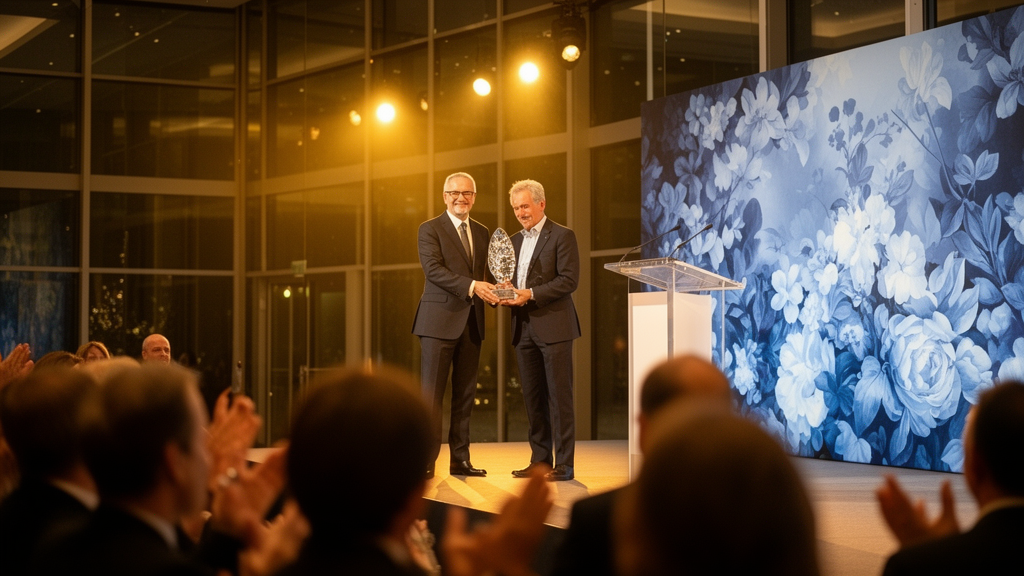
Every published paper carries the visible names of its authors, but behind nearly every one of them stands a largely invisible network of editors who decide which studies deserve scrutiny, which reviewers should be summoned, and whether the final record can be trusted. Springer Nature has once again tried to drag some of that invisible labour into the light with its annual Editor of Distinction Awards, and the 2026 round, announced through the BMC Geriatrics journal updates page, recognises dozens of editors whose day-to-day judgements shape what the geriatrics and gerontology literature actually contains. The awards are split into two categories this year: the Springer Nature Editorial Contribution Award, given for meticulous assessment of submissions and rigorous management of the peer review process, and the Springer Nature Author Service Award, which recognises exceptional service in improving the author experience and keeping peer review efficient, constructive and fair.
The Editorial Contribution Award list for 2026 runs to thirty names, and it reads like a map of international ageing research. Among the recipients are A R M Saifuddin Ekram, Agnieszka Wiśniowska-Szurlej, Antoine Christiaens, Bart Spaetgens, Chang Dae Lee, Chen Pao-Huan, Ellen Freiberger, Esma Nur Kolbasi Dogan, Francesco Curcio, Gu Eon Kang, Guogui Huang, Hui-Chuan Hsu, Javier Jerez-Roig, Jonathan K. L. Mak, Kazuhiro Miyata, Koen Milisen, Krystal Warmoth, Padmore Adusei Amoah, Qingsong Chang, Seyedeh Saleheh Mortazavi, Shanshan Shen, Shirin Vellani, Silvia Giovannini, Stefano Cacciatore, Takashi Mori, Tino Prell, Tsuyoshi Harada, Xue-Qiang Wang, Yang Zhao and Zeynep Şahiner. The publisher frames the award as safeguarding the scientific accuracy of the published record, which is a technical way of saying that these editors are the first line of defence against flawed methods, overclaimed conclusions and the slow accumulation of unreliable results in a field where the stakes are the health of older adults.
What does that safeguarding actually involve? When a manuscript lands in the editorial system of a journal such as BMC Geriatrics, the handling editor performs an initial assessment that goes far beyond a quick skim of the abstract. They check whether the study falls within scope, whether the research question is answerable with the design described, whether the statistical approach matches the data structure, and whether the ethical approvals and consent statements are in order before a single reviewer is approached. In geriatrics this triage stage carries particular weight, because submissions routinely span heterogeneous populations, from community-dwelling older people to hospitalised patients with multimorbidity, and an editor must judge whether the sampling and outcome measures can support the comparisons the authors intend to make.
Once a paper passes triage, the editor’s most consequential technical decision is the selection of peer reviewers. Modern editorial platforms allow editors to search reviewer databases, check publication histories and conflict-of-interest declarations, and weigh factors such as methodological expertise against geographic and institutional diversity. A well-chosen reviewer panel for a longitudinal cohort study of frailty might include a biostatistician familiar with handling attrition and competing risks, a clinician who understands the measurement instruments used for activities of daily living, and a gerontologist who can spot when a covariate has been misclassified. The editor then has to synthesise reviews that may pull in different directions, deciding which criticisms demand new analysis, which can be answered in a rebuttal letter, and which reveal a fatal flaw that no revision can repair.
The second category of the 2026 awards, the Springer Nature Author Service Award, highlights a different but equally technical dimension of the job. Its thirty recipients include Alex Smithson, Bart Spaetgens, Bartłomiej K. Sołtysik, Chang Dae Lee, Chen Pao-Huan, Cheng Lei, Dario Calafiore, Dongshan Zhu, Fan Yang, Fengjuan Hu, Franziska Saxer, Gustave Mabiama, Hao Luo, Hui-Chuan Hsu, Ippei Chiba, Jaehoon Seol, Javier Jerez-Roig, Jonathan K. L. Mak, Kazuhiro Miyata, Krystal Warmoth, Lisa Kouladjian Odonnell, Luís Sousa, Monika Pathania, Peng Nie, Shiou Liang Wee, Shirin Vellani, Tsuyoshi Harada, Xuewen Wang, Yanfeng Jiang, Yeji Hwang. Several names appear on both lists, including Spaetgens, Chang Dae Lee, Chen Pao-Huan, Hui-Chuan Hsu, Jerez-Roig, Mak, Miyata, Warmoth, Vellani and Harada, a doubling-up that suggests the same individuals are shouldering both the gatekeeping and the mentoring sides of editorial work.
Author service, as Springer Nature describes it, is about ensuring that peer review is efficient, constructive and fair, and each of those adjectives maps onto concrete editorial practices. Efficiency is measured in the time from submission to first decision, a metric that journals track closely because long delays push authors toward faster competitors and slow the circulation of findings that clinicians may need. Constructiveness depends on how editors phrase decision letters: a rejection that explains precisely why a confounder adjustment was inadequate teaches the authors something they can fix, whereas a curt desk rejection teaches nothing. Fairness enters through conflict-of-interest screening, consistent application of journal policies, and vigilance against reviewer suggestions that are really attempts to stack the review panel with friendly colleagues, a known manipulation vector in scholarly publishing.
The announcement itself is candid about why such recognition matters. Editorial teams, the publisher notes, work tirelessly to advance discovery, from developing networks for authors and peer reviewers to helping authors improve their papers and advocating for their journal communities. That description captures a shift in how the publishing industry understands the editor’s role. Two decades ago, an academic editor at a large open-access journal was often conceived of as a filter; today the role is closer to that of a community steward who recruits reviewers, encourages submissions from underrepresented regions, mediates disputes between authors and referees, and feeds recurring problems back into journal policy. The Editor of Distinction Awards institutionalise that broader job description by making it something that can be formally recognised rather than absorbed silently into unpaid academic labour.
There is also a structural reason why geriatrics journals in particular depend so heavily on their editors. Research on ageing is unusually interdisciplinary, drawing in geriatric medicine, nursing, physiotherapy, epidemiology, social science, rehabilitation and health services research, and no single reviewer pool covers all of it. BMC Geriatrics, as an open-access title in the BMC series, receives a high volume of submissions from around the world, including many from countries where ageing research infrastructure is still being built. Editors who can both uphold methodological standards and coach authors through revision, rather than simply rejecting marginal papers, effectively expand the pool of publishable, trustworthy evidence on older populations. The 2026 recipient list, with honorees affiliated with institutions across Asia, Europe, the Middle East, Africa and the Americas, reflects that global editorial footprint.
The awards also land at a moment when the integrity of peer review is under intense scrutiny. Publishers and researchers alike are experimenting with tools that flag image manipulation, screen text for undisclosed use of generative artificial intelligence, and verify statistical reporting before review even begins. Yet none of these automated checks replaces the human judgement of an editor who notices that a subgroup analysis looks suspiciously like an outcome switch, or that a reviewer’s comments reveal a failure to read the methods section. Recognition programmes such as the Editorial Contribution Award implicitly acknowledge that the published scientific record is only as reliable as the people who curate it, and that curatorial work deserves career-level credit rather than being treated as a footnote to a researcher’s own publications.
For the honorees themselves, the practical value of the award lies partly in visibility. Editorial service is typically voluntary or lightly compensated, performed alongside clinical duties, teaching and grant-funded research, and it rarely appears in promotion criteria with the weight it deserves. By naming thirty editors in each category and stating plainly what the awards are for, Springer Nature gives early- and mid-career researchers a citable marker of service excellence, and it gives journal communities a public account of who has been steering their literature. The full 2026 recipient lists for both the Editorial Contribution Award and the Author Service Award are published on the BMC Geriatrics journal updates page, where the publisher also thanks all of its editors for their dedication to their journals and the research communities they serve.
Subject of Research: Springer Nature's 2026 Editor of Distinction Awards recognising editorial contributions to peer review and author service in geriatrics journals
Article Title: Springer Nature Editor of Distinction Awards 2026
Article References: Springer Nature Editor of Distinction Awards 2026. (n.d.). Original publication
Image Credits: AI Generated
DOI: Not provided
Keywords: Springer Nature, Editor of Distinction Awards, BMC Geriatrics, peer review, editorial contribution award, author service award, scientific publishing, geriatrics, research integrity, academic editors, open access, scholarly communication
Cite Scienmag News
Ophelia Keating. (October 15, 2026). Peer Review Champions Honoured in Springer Nature Editor of Distinction Awards 2026. Scienmag. https://scienmag.com/peer-review-champions-honoured-in-springer-nature-editor-of-distinction-awards-2026-5/
Ophelia Keating. "Peer Review Champions Honoured in Springer Nature Editor of Distinction Awards 2026." Scienmag, 15 October 2026, https://scienmag.com/peer-review-champions-honoured-in-springer-nature-editor-of-distinction-awards-2026-5/. Accessed 15 October 2026.
Ophelia Keating. "Peer Review Champions Honoured in Springer Nature Editor of Distinction Awards 2026." Scienmag. October 15, 2026. https://scienmag.com/peer-review-champions-honoured-in-springer-nature-editor-of-distinction-awards-2026-5/


