


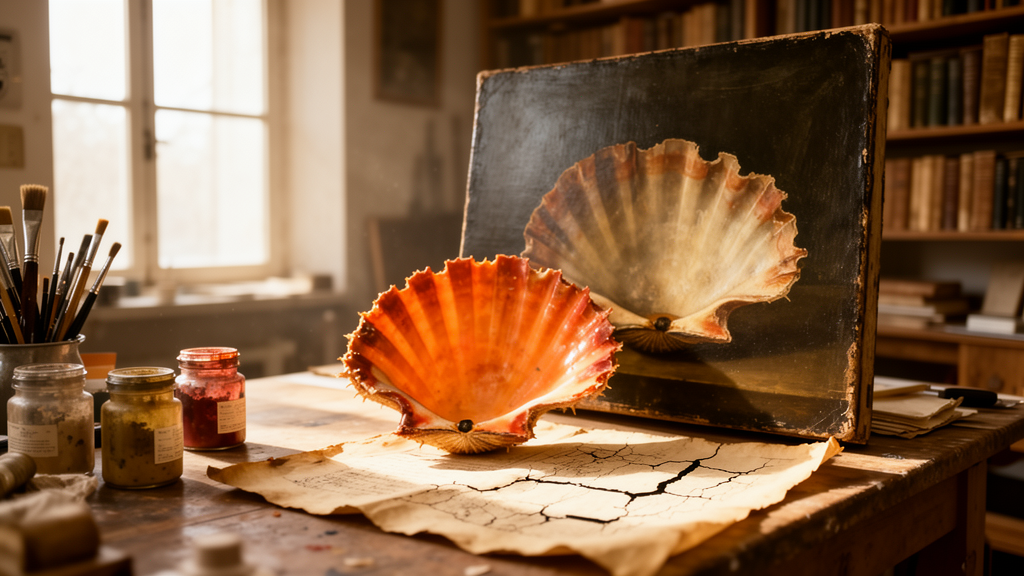
A spiky, scarlet-hinged mollusk that once starred on dinner plates and canvases across the Mediterranean has been quietly slipping out of collective memory. A new study published in PLOS One on 14 October 2026 sets out to recover that memory, tracing the thorny oyster, Spondylus gaederopus Linnaeus, 1758, through Italian paintings, historical texts, and testimonies to reconstruct what the researchers call its forgotten history. The work, led by authors based in France and funded through the Ocean & Climate PPR jointly run by CNRS and Ifremer under the France 2030 program, demonstrates how art history and natural history can be read together to answer questions that neither field can settle alone.
The thorny oyster is one of the most distinctive bivalves in the Mediterranean Sea. Its heavy, fluted shell is armored with prominent spines, and the animal cements itself directly to rocky substrates, hinge-down, with the vividly colored interior of the valves facing outward. When the shell gapes, that interior flashes a striking palette that has long caught the human eye. The species is endemic to the Mediterranean, meaning it occurs naturally nowhere else, and it shares its range today with a relative, the invasive Spondylus spinosus, which has spread through the eastern basin after entering via the Suez Canal. Mapping the two species’ current distributions, using occurrence data from GBIF, was one of the technical threads of the new analysis, providing a modern baseline against which the historical record could be compared.
The central methodological move of the study is interdisciplinary triangulation. The researchers combed fine art collections for depictions of the animal, searched archival and literary sources for references to its collection and consumption, and gathered testimonies documenting more recent uses. Paintings proved to be an unexpectedly rich archive: because artists rendered the thorny oyster’s unmistakable spiny valves in still lifes and kitchen scenes, those canvases function as dated visual records of where and how the species appeared in human settings. When a seventeenth- or eighteenth-century Italian painter placed a Spondylus shell on a fishmonger’s stall or a banquet table, the image preserved evidence of a trade and a taste that written sources often passed over in silence.
What emerges from that triangulated evidence is a portrait of a mollusk with genuine cultural and culinary standing. Historical texts and testimonies indicate that the thorny oyster was eaten in Mediterranean communities, and the visual record places it in contexts of food preparation and display. The animal’s flesh, like that of other edible bivalves, was a local seafood resource, and its dramatic shell gave it a presence on the table and in the market that plainer clams could not match. The study’s title phrase, hidden in historical sources, captures the point: the species’ role in daily life was never entirely erased, but it was dispersed across media that specialists rarely read together, from oil paintings to cookery references to the recollections of people who still encounter the shell on southern Italian coasts.
Italy sits at the heart of the story. The researchers’ analysis of Italian paintings anchors the rediscovery, and modern field records confirm that the living animal remains part of the region’s marine landscape. One of the photographs accompanying the study shows a Spondylus gaederopus specimen photographed by a restaurant customer in Apulia, in southern Italy, in January 2020, a small but telling sign that the species still surfaces in the contemporary culinary world. Another image, taken in September 2025 at a rocky outcrop at Ile Jarre in the western Mediterranean, documents the animal in its natural habitat, cemented among the rocks with its spiny valves intact. Together, the photographs bridge the gap between the historical archive and the living sea.
The distribution maps assembled for the paper add a conservation dimension to the story. Plotting occurrences of the endemic Spondylus gaederopus across the Mediterranean alongside those of the invasive Spondylus spinosus reveals two species with overlapping ranges but very different trajectories. The invasive thorny oyster, which colonized the eastern Mediterranean after migrating through the Suez Canal, has established populations across large areas, while the endemic species’ documented occurrences are more scattered. For a bivalve that has been harvested by humans for centuries, understanding where it persists today is a prerequisite for any effort to manage its populations, and the historical record assembled in the study provides a baseline for judging how much its footprint in human culture has contracted.
The rediscovery also has implications for how scientists think about shifting baselines in marine ecosystems and in human foodways. When a species fades from markets, menus, and paintings, each generation inherits a slightly narrower sense of what the sea once provided. By recovering the thorny oyster’s presence in Italian art and archives, the study shows that the animal’s cultural footprint was once considerably larger than its current low profile suggests. That kind of reconstruction matters for marine historical ecology, a field that uses archives, archaeology, and art to establish what ocean life looked like before modern surveys began. A painting, in this framework, is not merely an aesthetic object but a data point with a date, a location, and a documented subject.
The technical rigor of the study rests on careful identification. Spondylus shells are variable, and distinguishing the endemic gaederopus from the invasive spinosus requires attention to spine arrangement, valve morphology, and coloration, features that skilled painters often captured well enough to permit identification. Linnaeus himself formally described Spondylus gaederopus in 1758, in the tenth edition of his Systema Naturae, the founding document of zoological nomenclature, which gives the species a fixed name that has anchored three centuries of records. The researchers’ combination of Linnaean taxonomy, GBIF occurrence data, QGIS mapping with Natural Earth public-domain base layers, art historical analysis, and testimony collection reflects a deliberately multi-source design intended to make the forgotten history verifiable rather than anecdotal.
Why did such a conspicuous animal become forgotten in the first place? The study does not offer a single cause, but the pattern it documents is consistent with broader changes in Mediterranean fisheries and food culture. Bivalves that require rocky substrates and careful collection are vulnerable to overharvesting and habitat change, and culinary fashions shift as supply chains industrialize. As the thorny oyster receded from markets, the memory of its use receded with it, surviving mainly in old canvases and old texts. The invasive Spondylus spinosus, meanwhile, has been colonizing the eastern basin, in some places becoming abundant enough to attract renewed attention as a potential resource, an irony that underscores how quickly human relationships with marine species can invert.
The broader lesson of the research is methodological as much as biological. The authors, writing in PLOS One with no declared competing interests, argue through their evidence that art, archives, and cultural knowledge constitute a genuine scientific archive for marine species, one that can be mined systematically. Their reconstruction of the thorny oyster’s history shows that a mollusk can be simultaneously a biological organism with a mapped distribution, a culinary resource with a documented past, and a visual motif with a place in the history of Italian painting. Recovering all three strands at once not only restores the species to view but also equips conservationists, historians, and gastronomes with a fuller picture of what has been lost, what survives, and what might yet be rediscovered along the Mediterranean’s rocky shores.
Subject of Research: The cultural and culinary history of the Mediterranean thorny oyster Spondylus gaederopus reconstructed through art, archives, and testimonies
Article Title: Analysis of Italian paintings reveals the cultural and culinary significance of the thorny oyster, combining with other historical texts and testimonies to uncover its "forgotten history"
Article References: Analysis of Italian paintings reveals the cultural and culinary significance of the thorny oyster, combining with other historical texts and testimonies to uncover its "forgotten history". (n.d.). Original publication
Image Credits: AI Generated
DOI: Not provided
Keywords: thorny oyster, Spondylus gaederopus, Italian paintings, Mediterranean Sea, marine historical ecology, PLOS One, food history, invasive species, Spondylus spinosus, art history, bivalves, cultural heritage
Cite Scienmag News
Courtney Benton. (October 15, 2026). Italian Paintings and Old Texts Reveal the Forgotten History of the Thorny Oyster. Scienmag. https://scienmag.com/italian-paintings-and-old-texts-reveal-the-forgotten-history-of-the-thorny-oyster/
Courtney Benton. "Italian Paintings and Old Texts Reveal the Forgotten History of the Thorny Oyster." Scienmag, 15 October 2026, https://scienmag.com/italian-paintings-and-old-texts-reveal-the-forgotten-history-of-the-thorny-oyster/. Accessed 15 October 2026.
Courtney Benton. "Italian Paintings and Old Texts Reveal the Forgotten History of the Thorny Oyster." Scienmag. October 15, 2026. https://scienmag.com/italian-paintings-and-old-texts-reveal-the-forgotten-history-of-the-thorny-oyster/


