


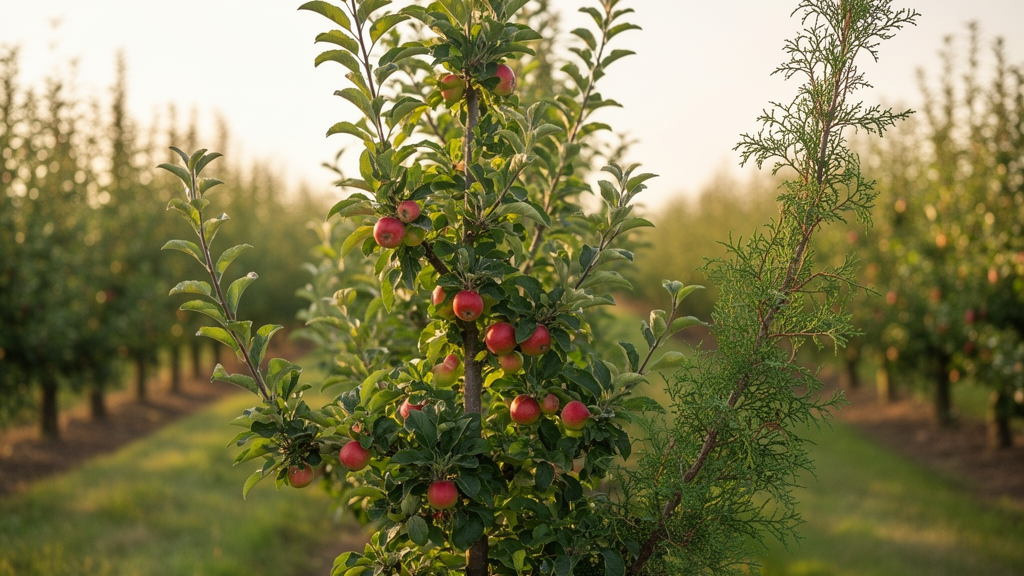
Every apple grower knows that the shape of a tree is destiny. Too many branches and the canopy becomes a tangled, shaded thicket that drains the tree’s energy; too few and the yield per hectare suffers. Now a team of researchers at Northwest A&F University in Yangling, China, has identified a molecular gatekeeper that helps decide how many branches an apple tree will produce. The gene, called MdAGL29, belongs to the large MADS-box family of transcription factors, proteins that bind DNA and switch other genes on or off. According to a study published in Plant Cell Reports, MdAGL29 acts as a brake on shoot branching, and understanding how it works could give breeders a new lever for sculpting apple trees with precision.
The story begins with a familiar horticultural tool: 6-benzylaminopurine, a synthetic cytokinin that growers and researchers use to stimulate bud activity. Cytokinins are plant hormones well known for promoting cell division and for encouraging axillary buds, the dormant embryonic shoots nestled in the angle between leaf and stem, to break out and grow into branches. When the team applied this synthetic cytokinin to apple plants, they noticed that MdAGL29 was consistently downregulated. In other words, the hormone that pushes buds toward growth simultaneously silences a gene that appears to suppress that very growth. That inverse relationship caught the researchers’ attention and became the central thread of their investigation.
To test whether MdAGL29 really influences branching, the team turned to a heterologous expression strategy, meaning they transferred the apple gene into a different organism to see what it would do. Their chosen host was poplar, a fast-growing tree that has long served as a model woody plant for forestry and molecular genetics because it is easy to transform and its architecture is readily quantified. When MdAGL29 was overexpressed in poplar, the effect was striking: the engineered trees produced fewer branches than control plants. The gene, it seemed, was not a passive bystander in the branching process but an active suppressor of it.
The poplar experiments also revealed a hormonal signature. After decapitation treatment, a standard experimental maneuver in which the shoot tip is removed to relieve apical dominance and provoke branching, the MdAGL29-overexpressing poplars contained lower levels of endogenous cytokinins than their non-engineered counterparts. This detail matters because cytokinins are among the primary promoters of bud outgrowth. A plant that makes less cytokinin in response to decapitation has less of the growth signal that normally coaxes axillary buds into shoots. The finding suggests that MdAGL29 may restrain branching partly by dampening the cytokinin pool, adding a hormonal dimension to its transcriptional role.
But where does MdAGL29 act in the genetic hierarchy of branching? To answer that question, the researchers performed yeast one-hybrid assays, a technique used to test whether a protein can physically bind to the regulatory DNA upstream of a target gene. Their results pointed to MdBRC1 and MdBRC2, the apple versions of BRANCHED1, a gene family famous in plant biology as a master inhibitor of bud outgrowth. BRANCHED1 was first characterized in Arabidopsis, where it acts as an integrator of branching signals within axillary buds, receiving inputs from auxin, strigolactone and other pathways and translating them into a decision: stay dormant or grow. In grasses, the equivalent gene TEOSINTE BRANCHED1 shaped crop domestication, and in trees, BRC1 mediates seasonal growth responses. The apple homologs fit this pattern as branch-negative regulators.
The yeast one-hybrid data were corroborated by dual-luciferase reporter assays, a complementary method performed in plant cells in which the promoter of the candidate target gene is wired to a luciferase enzyme. If the transcription factor activates the promoter, the cells glow more brightly. When MdAGL29 was supplied alongside the MdBRC1/2 promoters, luciferase activity rose, confirming that MdAGL29 positively regulates the expression of these branch inhibitors. The logic of the pathway therefore runs cleanly in one direction: MdAGL29 turns up the brakes, and branches stay suppressed. Remove or reduce MdAGL29, as happens when cytokinin is applied, and the brakes ease off, allowing buds to escape dormancy and develop into shoots.
This arrangement is elegant because it connects a hormone cue to a transcriptional switch through a single characterized step. Cytokinin application downregulates MdAGL29; MdAGL29 normally sustains the expression of MdBRC1/2; BRC1 proteins hold axillary buds in check. The new work thus adds a MADS-box link to the well-studied hormonal network of apical dominance, in which auxin flowing down from the shoot tip suppresses cytokinin biosynthesis in the nodes, and strigolactones moving up from the roots reinforce bud dormancy. Previous apple studies from the same research community had implicated cytokinin-responsive regulators such as MdRR9 and the MdWUS2-MdTCP12 module in bud activation, so MdAGL29 extends an emerging picture in which multiple transcription factors interpret hormonal signals at the bud.
Why should a MADS-box gene, a family best known for controlling floral organ identity, be pulling levers in shoot architecture? The answer is that MADS-box factors are versatile. In rice, the MADS-box protein OsMADS57 interacts with the tillering regulator OsTB1 to modulate branching via the strigolactone receptor DWARF14. In tomato, SlMBP11 and the type I factor SlMADS50 both influence plant architecture through hormonal pathways. The apple study fits squarely into this growing recognition that MADS-box transcription factors are recurring components of architectural networks across species, not merely specialists of the flower. That cross-species pattern also hints that similar modules may be waiting to be found in other woody crops, from pear to cherry.
The practical implications are considerable. Apple orchards increasingly rely on high-density planting systems in which tree size, branch number and branch angle determine how quickly a young orchard reaches commercial productivity. Recent horticultural research has quantified how lateral branch number and angle affect early growth and yield in high-density apple plantings, and growers currently manage these traits through labor-intensive pruning and training. A gene that reliably suppresses branching offers two possible routes. Overexpressing MdAGL29, or editing its regulatory regions, could produce naturally compact, low-branching trees that need less pruning. Conversely, suppressing the gene could encourage feathering, the production of well-placed lateral branches in nursery stock, reducing the need for chemical branching agents such as synthetic cytokinins in the nursery.
There are, of course, caveats. The overexpression experiments were carried out in poplar rather than apple, and while heterologous expression is a powerful and widely used dissection tool, the definitive test will be manipulating MdAGL29 in apple itself, whether through stable transformation, CRISPR editing or the identification of natural allelic variation among cultivars. It also remains to be seen how MdAGL29 interacts with the other branching regulators already known in apple, and whether its effect on cytokinin levels is a direct consequence of its transcriptional activity or an indirect downstream effect. Still, the study delivers something the field has lacked: a named, mechanistically supported negative regulator of branching in one of the world’s most valuable fruit crops, verified by binding and reporter assays and consistent across hormonal, molecular and whole-plant levels of analysis. For breeders chasing the ideal tree architecture, MdAGL29 is a target worth watching.
Subject of Research: Molecular regulation of shoot branching in apple by the MADS-box transcription factor MdAGL29
Article Title: MdAGL29 positively regulates MdBRC1/2 and negatively controls shoot branching in apple
Article References: MdAGL29 positively regulates MdBRC1/2 and negatively controls shoot branching in apple. (n.d.). https://doi.org/10.1007/s00299-026-04012-3
Image Credits: AI Generated
DOI: 10.1007/s00299-026-04012-3
Keywords: apple, MdAGL29, MADS-box transcription factor, shoot branching, MdBRC1/2, cytokinin, axillary buds, plant architecture, gene regulation, poplar, apical dominance, Plant Cell Reports
Cite Scienmag News
Juliet Wilcox. (October 14, 2026). Apple gene switch discovered that keeps tree branches in check. Scienmag. https://scienmag.com/apple-gene-switch-discovered-that-keeps-tree-branches-in-check/
Juliet Wilcox. "Apple gene switch discovered that keeps tree branches in check." Scienmag, 14 October 2026, https://scienmag.com/apple-gene-switch-discovered-that-keeps-tree-branches-in-check/. Accessed 14 October 2026.
Juliet Wilcox. "Apple gene switch discovered that keeps tree branches in check." Scienmag. October 14, 2026. https://scienmag.com/apple-gene-switch-discovered-that-keeps-tree-branches-in-check/


