


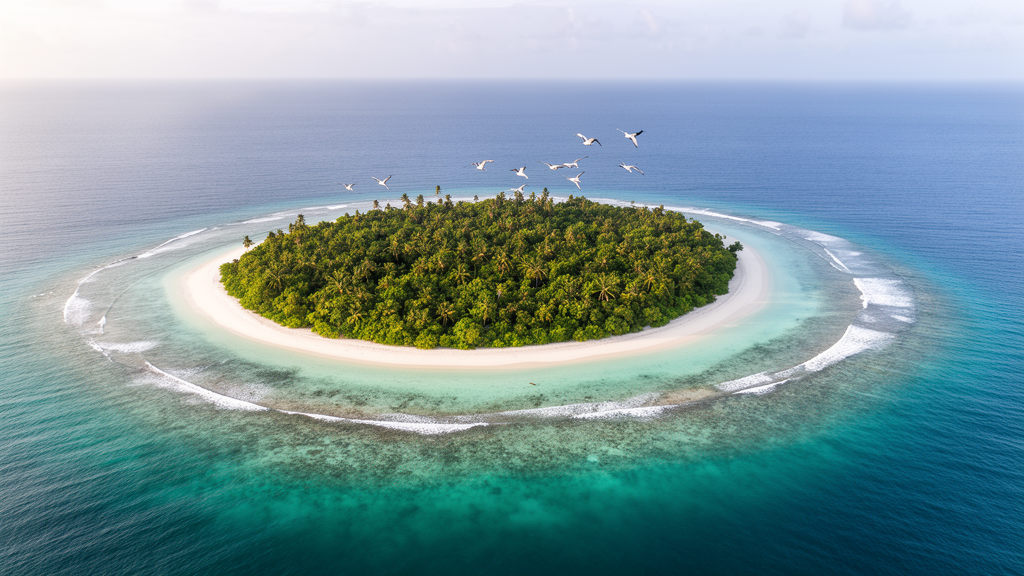
Low-lying coral atoll islands, often imagined as immutable specks of white sand fringed by turquoise water, are in fact dynamic landforms that grow, shrink and reshape themselves in response to the ecological and physical forces acting upon them. A new international study led by marine scientists at Lancaster University, published in the journal Science Advances, demonstrates that two seemingly simple conservation interventions — eradicating invasive rats and replanting native vegetation — can measurably enhance the natural processes that allow atoll islands to keep pace with projected sea-level rise. The findings suggest that ecological restoration, often framed purely as a biodiversity strategy, may also function as a form of natural coastal defence for some of the most vulnerable inhabited and uninhabited landmasses on Earth.
The research team assembled ecological datasets from 28 atoll islands spanning the Seychelles and the Chagos Archipelago in the Indian Ocean and Tetiaroa Atoll in French Polynesia in the Pacific. By combining seabird census data with reef ecological surveys and vegetation measurements, the researchers quantified how the flow of nutrients from the open ocean, transported by seabirds that feed far offshore and then roost and breed on the islands, influences both the terrestrial and marine components of the atoll system. Nutrients deposited in seabird droppings fertilise the surrounding reefs and island soils, setting in motion three interconnected processes that underpin island resilience: coral reef growth, sediment production and soil stabilisation.
The importance of seabirds becomes stark when their absence is considered. Across the tropical oceans, many island seabird populations have collapsed over recent centuries, decimated by invasive rats that arrived as stowaways on ships and by the loss of suitable roosting habitat. At the same time, native vegetation on many atolls has been cleared and replaced, with coconut plantations now estimated to dominate around 60 per cent of Pacific atoll forests. The result is a double degradation: fewer seabirds means fewer nutrients reaching the reefs, and coconut monocultures mean weaker root systems holding the island sediments together. The new study quantifies precisely how these losses translate into reduced capacity for islands to maintain themselves.
Coral reef growth is the first pillar of atoll resilience, because healthy, actively accreting reefs reduce the wave energy that drives coastal erosion. The researchers found that corals on reefs surrounding islands with healthy seabird colonies grew substantially faster than those around bird-free islands, and that these nutrient-enhanced corals calcified more rapidly, laying down more hard reef substrate. From these measurements the team calculated a ‘reef accretion potential’ for each island, allowing them to model how conservation measures such as rat eradication might influence overall reef growth. The results were striking: reef growth rates on lagoonal and ocean-facing reefs around rat-free islands, where seabirds are abundant, were 1.8 and 2.5 times greater respectively than on reefs around rat-infested islands.
Dr Casey Benkwitt of The Nature Conservancy in California, a co-author of the study, explained the implications of these accretion rates for future sea levels. The reef accretion rates for rat-free, bird-populated lagoonal reefs, she noted, would be sufficient to closely keep up with predicted sea-level rises through to the end of the century under a 2°C warming scenario, while also helping to reduce the wave energy reaching the islands. In contrast, reef growth rates without seabird populations are predicted to have only limited ability to keep up with projected sea-level rise. In other words, the presence or absence of a few hundred thousand nesting seabirds may help determine whether a given reef can biologically track the rising ocean surface above it.
The second key process is sediment production, the generation of the carbonate sand and gravel from which atoll islands are literally built. Reefs fertilised by seabird nutrients support greater biomass of parrotfish and other sediment-producing organisms, and the study found that sediment production potential was substantially higher around seabird-populated islands, with estimated rates 2.3 to 2.8 times higher on lagoonal and ocean-facing reefs compared with bird-free counterparts. Professor Chris Perry of the University of Exeter, another co-author, put the figures in tangible terms: for a small island of roughly 14 hectares, this difference translates to approximately 170 cubic metres of additional sediment being produced on the surrounding reefs every year — a sizeable uplift in the raw material available for island maintenance and growth.
The third pillar concerns what happens on the land itself. Native plants and trees on atoll islands possess long, dense root systems that lock sediment in place and resist erosion, whereas coconut palms, historically cultivated across the tropical Pacific for copra plantations, have far less effective root architecture for binding soils. The researchers estimated that fine root length was 4.6 times higher in areas of high native vegetation compared with areas dominated by low amounts of native vegetation, a difference that significantly increases soil-binding potential. Notably, the study also found that where seabirds are present, the root systems of native plants are themselves enhanced, illustrating the coupled nature of the nutrient cycle that links ocean, reef, soil and forest.
Professor Yadvinder Malhi, Director of the Leverhulme Centre for Nature Recovery at the University of Oxford and a co-author of the study, described the work as revealing how atolls function as intimately interconnected island–reef systems, or geo-ecological systems, in which restoring and boosting the wildness of the islands through seabirds and native vegetation helps them adapt to global change. He suggested that these islands provide a model example of how restoration and rewilding can help ecosystems adapt to climate change, offering insights applicable across the natural world. The framing is significant because it positions ecological restoration not as a luxury for wealthy conservation programmes but as a functional climate adaptation tool with measurable geophysical outcomes.
Dr Jennifer Appoo of the University of the Seychelles, also a co-author, emphasised the practical relevance for island nations. The results, she said, provide new evidence that island restoration is not only beneficial for biodiversity conservation but can enhance the resilience of low-lying atoll islands in the face of sea-level rise, particularly where costly engineering solutions are unfeasible or inappropriate — a situation that can arise in countries with uninhabited or sparsely inhabited atolls, such as Seychelles. For such nations, rat eradication and native replanting may represent among the few realistic options for supporting island persistence, given that sea walls and land reclamation at atoll scale are often economically and technically out of reach.
The study, supported by the Bertarelli Foundation and published under the title ‘Seabirds and native vegetation drive ecosystem processes that support atoll island resilience’, arrives at a moment when the fate of atoll nations and atoll ecosystems has become one of the defining questions of climate science. Its central message is one of cautious optimism: atoll islands are not passive victims awaiting inundation, but active systems capable of adaptation when the ecological machinery that builds and maintains them is allowed to function. Replacing abandoned coconut plantations with natural vegetation and restoring seabird populations by removing invasive rats, the authors argue, could be key to the survival of these tiny low-lying islands, giving them a fighting chance to keep pace with the seas of a warming century.
Subject of Research: How seabird nutrient flows and native vegetation restoration enhance the resilience of tropical atoll islands to sea-level rise
Article Title: Culling rats and restoring native vegetation – how rewilding tropical atolls could help them keep pace with rising sea-levels
Article References: Culling rats and restoring native vegetation – how rewilding tropical atolls could help them keep pace with rising sea-levels. (n.d.). Original publication
Image Credits: AI Generated
DOI: Not provided
Keywords: atoll islands, seabirds, rat eradication, native vegetation, sea-level rise, coral reefs, sediment production, soil stabilisation, rewilding, ecosystem restoration, climate change, French Polynesia
Cite Scienmag News
Violet Maxwell. (October 14, 2026). Rat Culls and Native Forests Could Help Tropical Atolls Outpace Rising Seas. Scienmag. https://scienmag.com/rat-culls-and-native-forests-could-help-tropical-atolls-outpace-rising-seas/
Violet Maxwell. "Rat Culls and Native Forests Could Help Tropical Atolls Outpace Rising Seas." Scienmag, 14 October 2026, https://scienmag.com/rat-culls-and-native-forests-could-help-tropical-atolls-outpace-rising-seas/. Accessed 14 October 2026.
Violet Maxwell. "Rat Culls and Native Forests Could Help Tropical Atolls Outpace Rising Seas." Scienmag. October 14, 2026. https://scienmag.com/rat-culls-and-native-forests-could-help-tropical-atolls-outpace-rising-seas/


