


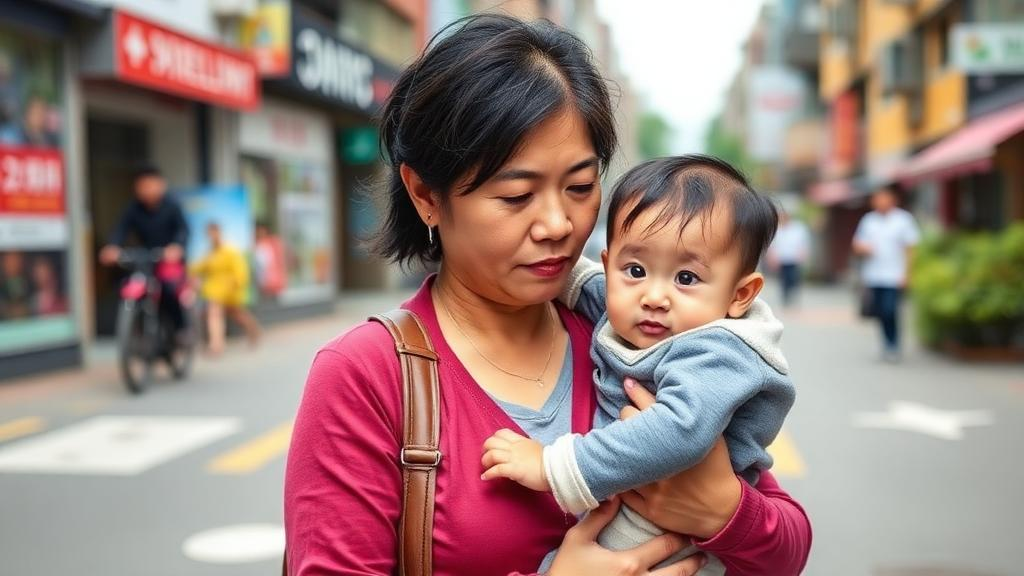
The first three years after childbirth are among the most demanding stretches of any parent’s life, and a new study argues that the difficulties mothers face during this period cannot be understood, or addressed, by looking at any single part of their world. In research published in the International Journal for Equity in Health, a team led by Qi Jiang of the University of California, Berkeley, and Yuyin Xiao of Stanford University set out to map the everyday stressors experienced by mothers of infants and toddlers in urban China, using a multi-level ecological framework that treats maternal wellbeing as the product of overlapping individual, family, social, and structural environments.
The study rests on in-depth interviews with 50 mothers of children aged zero to three years. Participants were recruited from nine community and township health centers in Shanghai, as well as one childcare program serving a migrant community in the same city. Recruitment took place during well-child visits, a routine point of contact with the health system that allowed the researchers to reach mothers across a range of residential and socioeconomic circumstances, including families whose access to urban services is complicated by migration status.
Methodologically, the team paired a guiding ecological framework with thematic analysis, a qualitative technique in which researchers code interview transcripts for recurring patterns and then group those codes into broader themes. The ecological approach, rooted in decades of developmental and public health theory, holds that a person’s experience is shaped at nested levels: the individual body and mind at the center, surrounded by family systems, social networks, institutions such as workplaces and clinics, and finally broad policy and economic structures. Applying this lens to early motherhood means asking not only what a mother feels or suffers, but how her household, her community, and the services around her amplify or buffer those pressures.
What emerged from the interviews was a strikingly consistent architecture of strain. The challenges clustered across distinct ecological levels, beginning with postpartum physical health problems, which the researchers identify as an individual-level burden that many mothers carry well beyond the immediate weeks after delivery. These physical difficulties interacted with a second cluster: the sheer weight of caregiving. Mothers described the daily, often invisible labor of nurturing infants and toddlers, a burden that shaped both their own wellbeing and the environment in which their children developed.
A third cluster pointed outward, toward the family and social sphere. Mothers reported limited support from family members and social networks, a finding that cuts against the stereotype of the densely involved multigenerational Chinese household. Whether because of geographic separation, changing family norms, or competing obligations, many mothers in the sample did not have reliable hands to share the work of early childcare. The absence of that support turned caregiving from a shared family project into a largely solitary one, compounding the physical toll of the postpartum period.
The fourth cluster captured the collision between employment and childcare. Work–childcare tension emerged as a defining stressor, with mothers navigating demands from employers that left little room for the unpredictable rhythms of caring for a child under three. Closely tied to this was a fifth cluster: constrained services. The availability, affordability, and accessibility of formal childcare and maternal health services fell short of what families needed, leaving mothers to fill the gap themselves. In a city as large and fast-moving as Shanghai, the gap between what institutions provide and what families require proved to be a persistent source of stress.
The final cluster concerned information and finances. Mothers described constraints in obtaining trustworthy guidance on childrearing and maternal health, alongside financial pressures that narrowed their choices about work, childcare, and daily life. Taken together, the researchers found that these six clusters were not isolated complaints but common themes that negatively affected maternal wellbeing and, by extension, the nurturing environment available to the child. The ecological framing makes that link explicit: a mother’s exhaustion, anxiety, or isolation does not stay contained within her; it reshapes the developmental context for her child.
The study’s central conclusion is that the challenges of early motherhood extend well beyond the individual level into family and institutional contexts. That may sound obvious, but the authors argue that existing research has often overlooked the multiple everyday stressors mothers experience across ecological domains, tending instead to focus on single factors such as postpartum depression or employment in isolation. By systematically mapping stressors across levels, the study offers a more complete diagnostic picture, and one with clear policy implications. If the burdens are stacked, the authors contend, then interventions must be coordinated across levels as well, ranging from individual support for postpartum recovery to family-level help with caregiving and system-level services that ease the work–childcare collision.
For China, the findings land at a politically sensitive moment. The country faces persistently low fertility rates and has introduced a series of pro-natalist policies, yet the study suggests that the daily experience of early motherhood remains defined by insufficient support rather than insufficient encouragement. Urban mothers, including those in migrant communities, confront a service landscape that has not kept pace with the realities of dual-earner households and shrinking family support networks. The researchers’ recruitment through community health centers and a migrant childcare program underscores that these pressures span socioeconomic lines, even as financial and informational constraints may weigh more heavily on some families than others.
The research was supported by the Cyrus Tang Foundation and approved by the Ethics Committee of the School of Public Health at Shanghai Jiao Tong University, and it was conducted in accordance with the Declaration of Helsinki with informed verbal consent from participants. As a qualitative study of 50 mothers in a single city, it cannot quantify how common each stressor is across China’s urban population, and the authors are careful to frame their results as an exploration of lived experience rather than a statistical estimate. But the value of the work lies precisely in that granularity: it documents, in mothers’ own accounts, how postpartum health, caregiving load, family support, employment, services, information, and money interlock to shape the first thousand days of a child’s life. The authors’ prescription is correspondingly systemic, calling for coordinated interventions that reach from the individual mother to her family and to the institutions and services that surround them both.
Subject of Research: Multi-level ecological analysis of the challenges experienced by mothers of children aged 0–3 in urban China
Article Title: Rethinking support for early motherhood: a multi-level ecological analysis of mothers’ experiences in Urban China
Article References: Rethinking support for early motherhood: a multi-level ecological analysis of mothers’ experiences in Urban China. (n.d.). https://doi.org/10.1186/s12939-026-03049-w
Image Credits: AI Generated
DOI: 10.1186/s12939-026-03049-w
Keywords: early motherhood, maternal wellbeing, ecological framework, urban China, postpartum health, caregiving burden, social support, work–childcare conflict, childcare services, qualitative research, Shanghai, health equity
Cite Scienmag News
Courtney Benton. (October 14, 2026). Urban Chinese Mothers Face Stacked Stressors in the First Three Years, Study Finds. Scienmag. https://scienmag.com/urban-chinese-mothers-face-stacked-stressors-in-the-first-three-years-study-finds/
Courtney Benton. "Urban Chinese Mothers Face Stacked Stressors in the First Three Years, Study Finds." Scienmag, 14 October 2026, https://scienmag.com/urban-chinese-mothers-face-stacked-stressors-in-the-first-three-years-study-finds/. Accessed 14 October 2026.
Courtney Benton. "Urban Chinese Mothers Face Stacked Stressors in the First Three Years, Study Finds." Scienmag. October 14, 2026. https://scienmag.com/urban-chinese-mothers-face-stacked-stressors-in-the-first-three-years-study-finds/


