


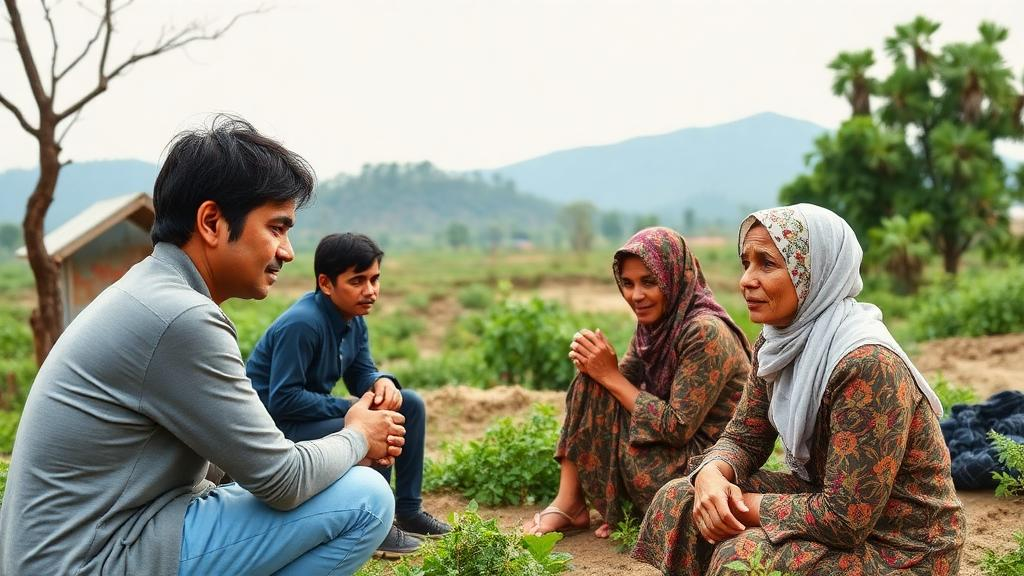
In the remote mountain villages of Honduras, where banks, clinics and courts are often days away, the people you know are the institutions you have. Loans come from neighbours, security from kin, and health advice from older female friends and relatives who have delivered and raised babies themselves. That dependence has long made rural social networks a target for development programmes, which routinely exploit social connections to spread new behaviours. But a large randomized experiment has now revealed a striking and largely hidden consequence of such efforts: the interventions themselves do not merely ride along existing social ties — they rebuild them.
Reporting in Nature, a team led by Marios Papamichalis, Laura Forastiere, Edoardo Airoldi and Nicholas Christakis analysed data from 8,331 people across 110 isolated villages in Honduras’s Copán Department. Between November 2016 and August 2018, trained community health workers delivered a 22-month maternal, neonatal and child health curriculum through home visits covering topics from folic acid and birth planning to breastfeeding and diarrhoeal disease management. Crucially, the researchers varied the fraction of households receiving the programme in each village — from zero to 5, 10, 20, 30, 50, 75 and 100 percent — creating a dosage gradient that allowed them to dissect exactly how the intervention reshaped the social fabric.
The team mapped three distinct layers of each village’s social network — health advice, friendship and financial ties — before the intervention in 2016 and again in 2019, with a follow-up wave in 2022–23 in a subset of 56 villages. At baseline, individuals had on average 2.9 health-advice connections, 5.5 friendship ties and 2.7 financial connections. The headline result is paradoxical: although the overall shape of village-wide networks, including the degree distribution, remained statistically stable, the wiring underneath churned dramatically. Who was connected to whom changed in systematic, treatment-dependent ways.
The direction of change depended on dosage. In low-dosage villages, where only 5 to 30 percent of households were treated, connectivity declined overall by an estimated 6.36 percent relative to untreated villages. Treated individuals themselves lost roughly 13 percent of their health-advice ties, and the losses were sharpest among untreated people directly connected to treated neighbours: their total degree fell by more than 54 percent compared with equivalent villagers in control communities. In high-dosage villages, by contrast, the picture reversed. Average degree rose by 7.21 percent, treated individuals expanded their networks, and even untreated villagers who were only indirectly linked to treated people gained ties.
The link-level analysis explains why. The researchers classified every directed pair of villagers by treatment status — treated–treated, treated–untreated, untreated–treated and untreated–untreated — and tracked which ties persisted, broke or formed. Across both dosage regimes, the same dyadic mechanism operated: ties between two treated individuals were more likely to persist and to form, while ties spanning the treated–untreated divide dissolved. In low-dosage villages, treated–untreated ties in both directions had substantially lower odds of persisting than ties between untreated people in control villages, whereas treated–treated ties had 52.6 percent higher odds of surviving and 63.35 percent higher odds of forming anew. Treated villagers, in effect, cut off the neighbours they once trusted for health advice and clustered with others who shared their new knowledge.
The researchers offer two complementary interpretations. Treated individuals may have become self-reliant, no longer needing the counsel of untreated contacts, or they may have come to view untreated neighbours as less credible sources of health information. Untreated one-hop neighbours lost both incoming and outgoing ties for the same reasons, though untreated–untreated ties within treated villages proved relatively stable — which explains why untreated villagers more than one step away from treated individuals actually gained connections, holding on to their durable untreated ties while adding new ones. The team is careful to note that these are structural inferences: they can observe self-reliance in the network sense, but not how villagers felt about it.
A mediation analysis traced part of the mechanism through learning itself. Using a 62-item health knowledge survey administered midway through the intervention, the researchers found that knowledge gains mediated roughly 20 percent of the rewiring effects in high-dosage villages, with the mediated pathway consistently pushing connectivity upward. In low-dosage villages, where overall effects were negative, the knowledge pathway actually worked against the trend, implying the decline would have been steeper without learning. The remaining 80 percent of the effect presumably flows through channels the study could not measure directly — shifts in perceived trustworthiness, confidence or social identity among the trained.
Perhaps the most consequential finding is that the rewiring was not confined to health advice. Because village networks are multiplex — the same pair of people may share friendship, financial and health ties simultaneously — changes in one layer propagated into the others. In high-dosage villages, villagers who began as health-advice hubs expanded their friendship and financial connectivity the most, consolidating social capital around health-central actors. At low dosage, the pattern inverted: financially central villagers pruned lending and borrowing ties, though health centrality partially buffered the loss. A purely informational public-health programme, in other words, quietly restructured who villagers trusted with money and companionship.
The effects proved durable. When the team re-mapped networks in 2022–23, three to four years after the intervention ended, the low-dosage villages still showed significantly reduced health-advice connectivity, with losses again concentrated among untreated neighbours of the treated. High-dosage villages showed no statistically significant residual changes, though the smaller sample limited statistical power. Throughout, the authors emphasize that their estimates are best read as indicative causal evidence: network rewiring was not a pre-registered primary outcome for the early waves, although it was prospectively planned for the final wave, and the core dyadic mechanism survived stringent family-wise multiple-testing corrections.
The implications reach well beyond Honduras. Interventions that deliberately exploit social contagion — microfinance uptake in India, agricultural technology in Malawi, anti-bullying campaigns in American schools — all presume a stable network to propagate through, yet this study shows such programmes can themselves alter the medium. The researchers describe a treatment-induced phase transition: below roughly 30 percent household saturation, an educational intervention erodes traditional ties and leaves treated individuals isolated; above it, the treated group reaches a critical mass that lets them form cohesive new connections, bolstering community knowledge-sharing. Whether this rewiring ultimately helps or harms villagers remains an open question, and the authors caution that their single setting cannot establish generalizability. But the message for development practice is clear: every intervention that touches a social network also edits it, and beneath the apparent stability of human social structure lies a constant, contestable churn in who is connected to whom.
Subject of Research: How a randomized health-education intervention reshaped social network structure in rural Honduran villages
Article Title: Educational intervention can rewire village social networks
Article References: Educational intervention can rewire village social networks. (n.d.). https://doi.org/10.1038/s41586-026-11154-7
Image Credits: AI Generated
DOI: 10.1038/s41586-026-11154-7
Keywords: social networks, Honduras, randomized controlled trial, health education, network rewiring, public health, social contagion, multiplex networks, causal inference, village sociology, tie formation, knowledge diffusion
Cite Scienmag News
Courtney Benton. (October 14, 2026). Health lessons that rewired a countryside: education reshapes who villagers trust. Scienmag. https://scienmag.com/health-lessons-that-rewired-a-countryside-education-reshapes-who-villagers-trust/
Courtney Benton. "Health lessons that rewired a countryside: education reshapes who villagers trust." Scienmag, 14 October 2026, https://scienmag.com/health-lessons-that-rewired-a-countryside-education-reshapes-who-villagers-trust/. Accessed 14 October 2026.
Courtney Benton. "Health lessons that rewired a countryside: education reshapes who villagers trust." Scienmag. October 14, 2026. https://scienmag.com/health-lessons-that-rewired-a-countryside-education-reshapes-who-villagers-trust/


