


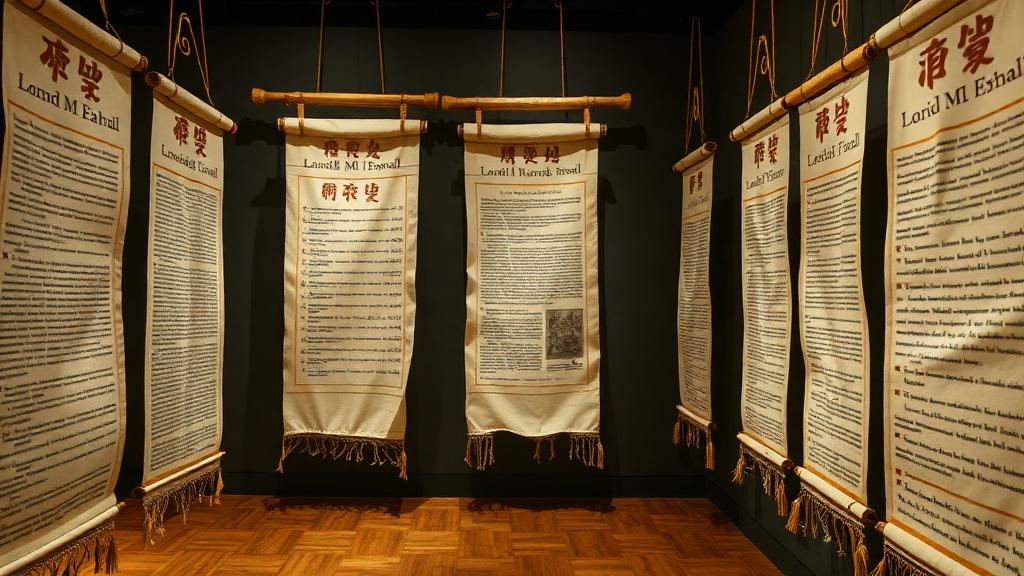
For centuries, Japanese hanging scrolls have been treated with a level of caution that borders on ritual. In Japan, national guidelines limit the annual display of designated paintings and calligraphies to between four and eight weeks, after which the works are rolled up and rested, sometimes for years. Overseas museums, by contrast, frequently keep such works on view for several months or even a full year before granting them an extended period in storage. The discrepancy has long frustrated curators on both sides of the Pacific: Japanese institutions cite tradition and precaution, while Western museums point to the absence of any clear scientific data justifying a strict cap on continuous display. A new study published in npj Heritage Science set out to settle the question with hard numbers, and its findings suggest that both camps may be partly right, depending on one crucial variable: the stability of the exhibition environment.
The research team, led by Rika Kigawa of the Kyushu National Museum and including colleagues from Oka Bokkodo in Kyoto, the Tokyo National Research Institute for Cultural Properties, the National Museum of Japanese History, and the Museum of the Imperial Collections, Sannomaru Shozokan, undertook a direct comparison of two exhibition regimes. The first mimicked the overseas model: continuous display over an extended period. The second followed the Japanese practice of periodic rolling and resting, with the scrolls alternating between hanging and storage across a total of twenty-four weeks. By measuring the three-dimensional shape of the scrolls throughout, the researchers could track how the physical structure of each work responded to the two very different schedules.
The technical challenge at the heart of the study is deceptively simple to state. A hanging scroll is not a flat object. It is a layered composite of paper and silk, joined with paste and glue, mounted onto flexible backing layers and finished with brocade borders and wooden rollers. When hung, gravity pulls the assembly taut; when rolled, the layers are compressed into a tight cylinder with the painted surface facing inward. Every cycle of rolling and unrolling imposes mechanical stress, and every hour on the wall imposes gravitational load. Which regime does more harm has never been quantified, largely because the deformations involved are subtle, three-dimensional, and far below the threshold that conventional two-dimensional photography can detect.
Three-dimensional measurement changed that. By capturing the surface geometry of the scrolls at intervals, the team could detect warping, undulation, and distortion of the mounting that would be invisible to the naked eye or to flat imaging. The painted sections themselves received particular attention, with high-precision photography guided by specialists at the Kyushu National Museum, and the condition of the glue in those areas was assessed by palpation, the trained touch of conservators feeling for changes in the adhesive layer beneath the paint. This combination of quantitative geometry and tactile inspection reflects the reality of scroll conservation, where the health of the mounting structure and the integrity of the painted surface are inseparable concerns.
The first major result concerns the stable environment. Under controlled temperature and relative humidity, the researchers found no significant overall differences in shape or stability between scrolls displayed continuously and those subjected to periodic rolling and resting over the twenty-four-week period. In other words, when the climate is kept steady, the Japanese practice of frequent resting confers no measurable advantage over the longer continuous displays common abroad. The rolling and unrolling cycle, often assumed to be a necessary protection, appears under stable conditions to be roughly neutral, neither rescuing the scroll nor harming it beyond what continuous hanging inflicts.
The second result is more striking, and it is the one likely to reverberate through museum policy discussions. When scrolls were displayed in an environment with fluctuating temperature and humidity, even a short hanging period of just four weeks caused significant alteration in the shape of the scroll and physical damage to the object. The enemy, in other words, is not the duration of display but the instability of the air surrounding the work. Fluctuating humidity causes hygroscopic materials like paper, silk, and paste to swell and shrink repeatedly, and because the layers of a scroll respond at different rates and magnitudes, the assembly develops internal stresses that manifest as warping, creasing, and damage. A scroll hung for a month in a poorly controlled gallery can fare worse than one hung for many months in a climate-stabilized hall.
This finding carries immediate practical implications for the international loan and exhibition of Japanese art. Museums outside Japan often operate galleries with broader environmental swings, whether for reasons of building design, energy costs, or exhibition schedules that expose works to seasonal variation. The study suggests that the relevant question for a borrowing institution is not simply how long the scroll will hang, but how tightly the gallery can hold temperature and relative humidity within a narrow band. A museum capable of near-constant conditions may be able to justify longer exhibitions, while one with volatile galleries should shorten display windows regardless of what generic loan policies recommend. The Japanese guidelines, on this reading, encode an implicit assumption about environmental conditions that deserves to be made explicit.
The work also speaks to a broader methodological shift in heritage science. Conservation decisions have traditionally rested on accumulated craft knowledge, passed from mounter to mounter and conservator to conservator, with little in the way of controlled experiment. The Japanese mounting tradition, in particular, is the product of centuries of empirical refinement, but its rules have rarely been tested against modern instrumentation. By applying three-dimensional measurement to a question that practitioners thought they had already answered, the researchers demonstrated that long-held assumptions can be confirmed, refined, or in this case substantially reframed. The four-week and eight-week limits in the national guidelines may survive, but the reasoning behind them now has an evidentiary foundation, and that foundation points at climate stability rather than display duration alone.
The study emerged from a larger research program funded by the Japan Society for the Promotion of Science, comparing conservation, restoration, and handling practices for Japanese artworks in foreign collections with the aim of improving both presentation and preservation. That framing matters, because the stakes are cultural as much as scientific. Works held in overseas museums are often seen far less frequently by the public in Japan than by audiences abroad, and overly restrictive display rules can render important paintings and calligraphies effectively invisible for decades. Conversely, lax practices can destroy what generations of mounters and conservators have preserved. The research team’s collaboration, which brought together a national museum, a commercial mounting workshop, two research institutes, and the Imperial collection, reflects an attempt to bridge that divide with shared evidence rather than institutional habit.
For the public, the study offers a rare glimpse of the invisible labor behind every scroll on a gallery wall. The painted surface that visitors admire is the visible face of a complex mechanical structure whose response to gravity, moisture, and handling can be mapped in three dimensions down to subtle distortions. The message that emerges is unexpectedly reassuring for museums and unexpectedly demanding at the same time: hang the scrolls longer if you wish, but only if you can keep the air around them steady. Where the climate wavers, even a month on the wall leaves its mark. As institutions worldwide reassess loan policies for fragile works, this study provides the kind of quantitative benchmark that the field has lacked, and it suggests that the future of scroll conservation will be decided less by calendars than by hygrometers.
Subject of Research: Three-dimensional measurement of dimensional changes in Japanese hanging scrolls displayed under different environmental conditions and exhibition durations
Article Title: Three-dimensional measurement of hanging scrolls on display under different environmental conditions and duration
Article References: Three-dimensional measurement of hanging scrolls on display under different environmental conditions and duration. (n.d.). https://doi.org/10.1038/s40494-026-03034-0
Image Credits: AI Generated
DOI: 10.1038/s40494-026-03034-0
Keywords: hanging scrolls, heritage science, conservation, museum display, humidity, temperature fluctuations, three-dimensional measurement, Japanese art, cultural properties, exhibition guidelines, scroll mounting, npj Heritage Science
Cite Scienmag News
Courtney Benton. (October 14, 2026). Hanging Scrolls Under Stress: 3D Scans Reveal When Museum Display Turns Destructive. Scienmag. https://scienmag.com/hanging-scrolls-under-stress-3d-scans-reveal-when-museum-display-turns-destructive/
Courtney Benton. "Hanging Scrolls Under Stress: 3D Scans Reveal When Museum Display Turns Destructive." Scienmag, 14 October 2026, https://scienmag.com/hanging-scrolls-under-stress-3d-scans-reveal-when-museum-display-turns-destructive/. Accessed 14 October 2026.
Courtney Benton. "Hanging Scrolls Under Stress: 3D Scans Reveal When Museum Display Turns Destructive." Scienmag. October 14, 2026. https://scienmag.com/hanging-scrolls-under-stress-3d-scans-reveal-when-museum-display-turns-destructive/


