


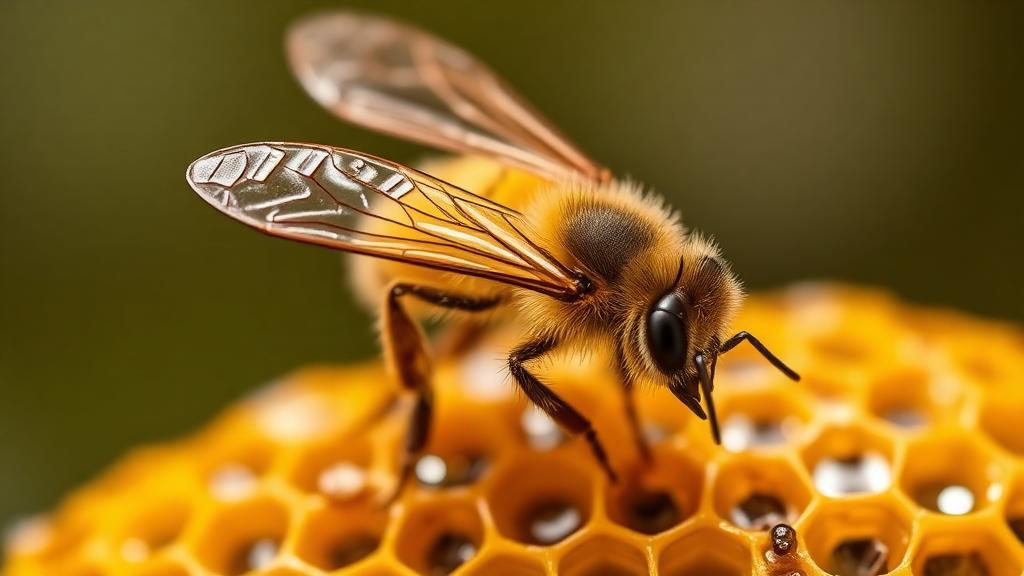
Lithium has quietly become one of the most tantalizing experimental weapons against the honeybee’s deadliest parasite, the mite Varroa destructor. But a new study published in The Science of Nature suggests that the same compound hailed as a potential varroacide may carry a steep physiological price for the bees themselves. A research team led by Hidayet Tutun of Burdur Mehmet Akif Ersoy University and Sedat Sevin of Ankara University set out to answer a deceptively simple question: what does chronic dietary exposure to lithium citrate actually do to the bodies and internal ecosystems of honeybees? Their findings, drawn from survival analysis, microscopic examination of gut tissue, and high-throughput DNA sequencing of the gut microbiome, paint a sobering picture of a compound whose sublethal effects may be as consequential as its lethal ones.
The backdrop to this work is a genuine crisis in apiculture. Varroa destructor, a parasitic mite that feeds on honeybees and vectors debilitating viruses, remains the single most devastating biological threat to managed colonies worldwide. Conventional acaricides have generated resistance and leave chemical residues in hive products, prompting researchers to hunt for alternatives with novel modes of action. In 2018, a study in Scientific Reports demonstrated that lithium chloride could kill Varroa mites through a systemic mode of action, igniting international interest in lithium salts as hive treatments. Subsequent trials confirmed efficacy in the field, but they also began to surface troubling signs: brood damage, lithium accumulation in honey and wax, and disruptions to bee behavior, learning, and even queen egg-laying performance. What remained insufficiently characterized was the fundamental toxicology at the level of the individual bee, particularly the chronic effects of ingesting lithium-laced food over meaningful stretches of adult life.
To fill that gap, the team followed the internationally recognized OECD Test No. 245, a standardized chronic oral toxicity protocol for honeybees involving a 10-day continuous feeding exposure. Newly emerged worker bees were given sugar syrup containing lithium citrate at three concentrations: 12.5, 25, and 50 millimolar, alongside an unexposed control group. Lithium citrate was chosen partly because citrate-based formulations have been explored as potentially less harsh alternatives to chloride salts, making any demonstration of harm especially important for those hoping to develop lithium-based treatments. The design allowed the researchers to track three interlocking dimensions of toxicity simultaneously: how many bees died, what happened to the microscopic architecture of the midgut, and how the community of symbiotic bacteria living in the gut shifted under chemical pressure.
The survival results were stark and strictly dose-dependent. After ten days, 94 percent of control bees were still alive. At the lowest lithium concentration of 12.5 millimolar, survival slipped to 84 percent, a decline that was statistically significant even after the researchers applied rigorous multiple-comparison corrections. At 25 millimolar, the picture collapsed: only 22 percent of bees survived the full exposure period. And at 50 millimolar, not a single bee was alive by day ten. This monotonic dose-response relationship, where each increment in concentration produced a further increment in mortality, is a classic signature of genuine toxicological causation rather than random fluctuation. It means that even concentrations once considered moderate for varroacidal purposes inflict measurable lethality on the very pollinators they are meant to protect.
Perhaps the most striking finding came from the microscope. When the researchers dissected and sectioned the midgut, the central organ of digestion and absorption, they discovered severe epithelial damage even at the lowest dose tested. The midgut epithelium, a single layer of cells responsible for nutrient uptake and a frontline barrier against pathogens, showed pronounced desquamation: cells were detaching and sloughing off into the gut lumen, a process of cellular shedding that compromises the structural integrity of the digestive tract. Intriguingly, the damage was most severe not at the highest concentration the bees could tolerate, but at 12.5 millimolar, with severity at 25 millimolar somewhat lower, a pattern the authors highlight as a non-intuitive dose effect that may reflect complex physiological responses rather than simple chemical corrosivity. Notably, the peritrophic membrane, a chitinous protective sheath that lines the gut and shields the epithelium from mechanical and microbial insult, remained intact in all treatment groups. That distinction matters: it suggests lithium’s damage is targeted at the epithelial cells themselves rather than a wholesale destruction of gut architecture, and it provides a specific mechanistic clue for future work on how lithium acts at the cellular level in insects.
The third axis of the investigation turned inward, to the gut microbiota. The honeybee gut hosts a remarkably simple but functionally essential community of bacteria, dominated by a handful of core genera including Gilliamella, Frischella, Snodgrassella, and Lactobacillus-like species. These symbionts aid digestion of plant polysaccharides, prime the immune system, and help defend against pathogens, which is why any disruption to their balance is a legitimate cause for concern. Using 16S rRNA gene sequencing, the gold-standard method for cataloguing bacterial communities, the team compared microbiome composition across treatment groups. The results were nuanced. Neither alpha-diversity, the richness and evenness of species within individual samples, nor beta-diversity, the overall compositional differences between groups, differed significantly across lithium concentrations. In other words, the microbial community as a whole was not fundamentally restructured by the exposure.
Beneath that overall stability, however, the researchers detected shifts in specific core taxa. At the highest concentration at which sufficient bees survived for sampling, 25 millimolar, the genus Gilliamella showed a markedly lower median relative abundance compared with controls, while Frischella was relatively more abundant. Gilliamella is a dominant, metabolically versatile member of the bee gut that participates in carbohydrate processing, so its apparent depletion could theoretically ripple through digestive function. Frischella perrara, for its part, is known to stimulate the bee immune system and has been associated with gut inflammatory-like responses, making its relative increase an interesting signal. Yet the team is careful to frame these patterns as preliminary: formal differential abundance analysis did not provide statistical support for them, and they did not form a consistent concentration-dependent trend. With only three biological replicates per group, a limitation the authors candidly acknowledge, these compositional hints must be treated as hypotheses for future research rather than conclusions.
Even taken cautiously, the combined evidence reframes the lithium debate. A compound can pass a basic diversity screen while still inflicting real harm: lethal stress at moderate doses, epithelial shedding at doses low enough that most bees initially survive, and directional shifts in keystone symbionts. The 12.5 millimolar result is particularly important for anyone designing field applications. A treatment regime calibrated to kill mites without immediately killing bees may still wound the bees’ digestive lining and nudge their microbiome off balance, producing sublethal effects that accumulate at the individual level and could, in theory, translate into shortened lifespan, reduced foraging capacity, or heightened disease susceptibility at the colony level. The study’s authors emphasize that such colony-level consequences remain untested and represent the critical next step for evaluating whether lithium-based varroacides can ever be deployed responsibly.
The research also slots into a broader and rapidly expanding literature on lithium and bees. Recent studies have documented concentration-dependent brood damage in treated hives, lithium residues in honey and wax following anti-varroa treatment, altered locomotor activity and circadian rhythms, impaired learning performance tracked with automated bee-tracking systems, and effects on queen egg-laying and worker behavior. Together, these findings sketch an emerging consensus that lithium is neither a benign silver bullet nor a rejected candidate, but a physiologically active compound whose risks must be mapped with the same rigor as its efficacy. The new midgut and microbiome data add two previously underexplored dimensions to that risk map, and the authors have deposited their sequencing data in the NCBI Sequence Read Archive under BioProject PRJNA1461832, making the raw evidence openly available for the research community to interrogate and extend.
For beekeepers watching the lithium story unfold, the message is one of tempered patience rather than immediate alarm or enthusiasm. No lithium-based product is currently a standard hive treatment, and this study does not assess field formulations or colony outcomes. What it does establish, with standardized methods and clear statistical discipline, is that lithium citrate acts as a significant physiological stressor in adult honeybees, compromising the structural integrity of the digestive tract and perturbing microbial homeostasis at doses relevant to experimental varroacidal use. As the search for sustainable alternatives to conventional acaricides continues, the study stands as a cautionary benchmark: any candidate compound must be judged not only by how efficiently it kills parasites, but by the full anatomy of what it does to the host, from survival curves to the microscopic lining of the gut to the invisible bacterial partners that keep a bee healthy. The future of lithium in apiculture will depend on whether chemistry can be tuned to thread that needle, and on whether colony-scale trials confirm or refute the warning signs now visible at the scale of the individual bee.
Subject of Research: Chronic oral toxicity of lithium citrate in honeybees and its effects on survival, midgut histopathology and gut microbiota
Article Title: Chronic oral toxicity of lithium citrate in honeybees (Apis mellifera L.): impacts on survival, midgut histopathology and gut microbiota
Article References: Chronic oral toxicity of lithium citrate in honeybees (Apis mellifera L.): impacts on survival, midgut histopathology and gut microbiota. (n.d.). https://doi.org/10.1007/s00114-026-02179-z
Image Credits: AI Generated
DOI: 10.1007/s00114-026-02179-z
Keywords: honeybee, lithium citrate, Varroa destructor, chronic toxicity, midgut histopathology, gut microbiota, 16S rRNA sequencing, Gilliamella, Frischella, Apidology, toxicology, pollinator health
Cite Scienmag News
Morgan Morrow. (October 14, 2026). Lithium Citrate Shows Hidden Toll on Honeybee Guts and Microbiomes. Scienmag. https://scienmag.com/lithium-citrate-shows-hidden-toll-on-honeybee-guts-and-microbiomes/
Morgan Morrow. "Lithium Citrate Shows Hidden Toll on Honeybee Guts and Microbiomes." Scienmag, 14 October 2026, https://scienmag.com/lithium-citrate-shows-hidden-toll-on-honeybee-guts-and-microbiomes/. Accessed 14 October 2026.
Morgan Morrow. "Lithium Citrate Shows Hidden Toll on Honeybee Guts and Microbiomes." Scienmag. October 14, 2026. https://scienmag.com/lithium-citrate-shows-hidden-toll-on-honeybee-guts-and-microbiomes/


