


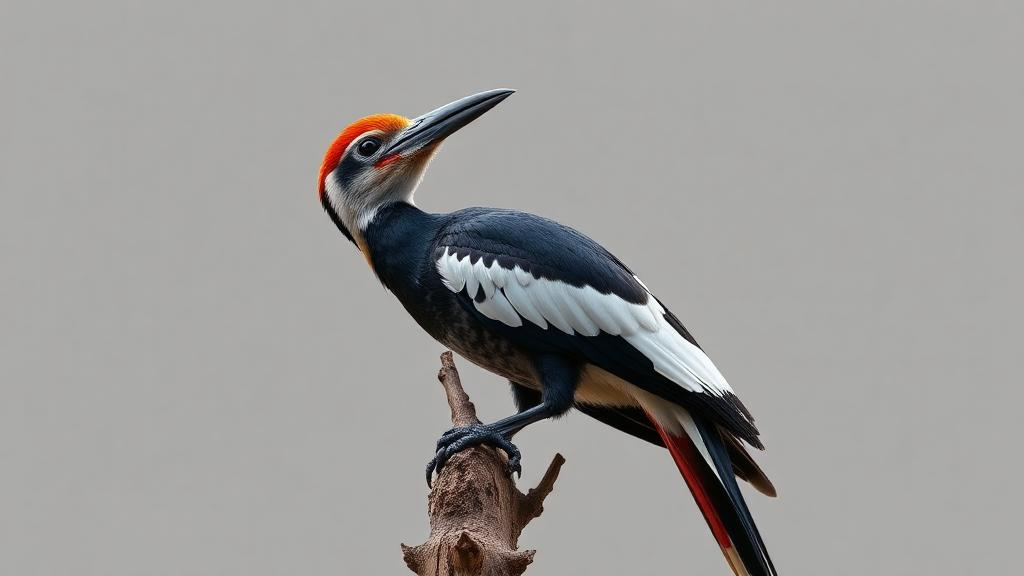
Seventy years after the last confirmed sighting in the wild, the Imperial Woodpecker has been brought back to life — not in a forest, but on a screen. A team of researchers has built a detailed, animated three-dimensional model of the world’s largest woodpecker, a bird that once haunted the old-growth pine forests of Mexico’s Sierra Madre Occidental and has not been verifiably seen since 1956. The model, which combines photogrammetry of a museum specimen with animation grounded in the only known film footage of the living species, is freely available to scientists, educators and anyone curious about what extinction actually erased from the planet. The study, led by Joshua Medina at the University of Massachusetts Amherst and published in the open-access journal Natural History Collections and Museomics, also includes colleagues from the Moore Laboratory of Zoology at Occidental College and Oregon State University.
The scale of the loss is hard to overstate. The Imperial Woodpecker, Campephilus imperialis, was the largest woodpecker on record, stretching more than 60 centimetres from bill to tail tip. It depended on the vast, mature pine forests of northwestern Mexico, a habitat that was largely logged away, and the species is now presumed extinct. Around 100 preserved specimens exist in museums worldwide, and the only moving images of the living bird consist of a few seconds of grainy film shot in 1956. In other words, almost everything the public knows about how this bird looked and moved comes from a handful of static skins and a flicker of archival footage. The new digital specimen aims to change that by translating those fragile remains into a form anyone can access and share.
The reconstruction began, as so many museum science projects do, with a drawer in a collection. The team worked from a female specimen held at the Moore Laboratory of Zoology in Los Angeles, which houses the world’s largest collection of Mexican birds. To capture the bird’s true shape, the researchers photographed the specimen 288 times from every conceivable angle and applied photogrammetry, a technique that converts overlapping photographs into a precise three-dimensional surface. The resulting digital body captured the specimen’s form with sub-millimetre accuracy. Throughout the process, the team took careful measurements of the head, bill, body, wings and tail to make sure the digital bird remained faithful to the physical original rather than drifting into artistic approximation.
The feathers turned out to be the hardest part of the entire project. On a century-old museum skin, individual feathers are difficult to distinguish, let alone digitise. The researchers solved this by modelling individual feather shapes on those of the Pileated Woodpecker, the largest living woodpecker in North America and the Imperial’s closest available analogue, then resizing and adjusting them to match the known proportions of the Imperial Woodpecker. Wing patterning was drawn from scientific illustrations and checked against the available visual record. In the final model, ten primary feathers, ten secondary feathers and twelve tail feathers were each individually modelled and rigged, meaning each one can spread, bend and fold independently in response to the underlying animation.
Once the body and plumage were in place, the team turned to open-source software called Blender to build a digital skeleton that drives the model’s movement. This armature sits beneath the photogrammetric surface and articulates the wings, tail and feathers through space, much as a real skeleton and musculature would. To the team’s knowledge, the result is one of the first open, specimen-based bird reconstructions to combine a photogrammetric body with individually animated feathers — a technical milestone that could set a template for future digital avatars of extinct and rare species. Every component of the workflow, from the scan data to the rigged feathers, was designed to be shared rather than locked away.
Two animations bring the model to life. The first is a looping flight sequence showing the bird with its wings fully extended, the second a short clip of the bird climbing a tree trunk and drumming against the bark, the behaviour for which woodpeckers are best known. Neither animation was invented from thin air. Both are grounded in the 1956 film footage of the living species, supplemented by behavioural video of the Pileated Woodpecker and published data on woodpecker wingbeat timing. That combination of historical film, comparative footage and quantitative data gives the animations a level of scientific grounding that separates this digital specimen from simple artistic reconstructions.
Beyond its visual appeal, the model is designed as a reproducible scientific resource. Researchers can use it to estimate the bird’s body volume and surface area, compare its shape with living relatives, or run simulations of flight and feather movement. The authors also note that such a model could inform the design of bird-inspired flying robots, an emerging field where realistic wing geometry and articulation matter enormously. Because the model is open and downloadable, other scientists can scrutinise it, adapt it and improve it as new evidence emerges, rather than relying on a single frozen visual interpretation of the species.
The team is candid about the limits of the reconstruction. It is based on a single female specimen, which means it cannot capture variation between sexes or among individuals. Aspects such as soft tissue and flight kinematics rely on informed estimation from living relatives, since no Imperial Woodpecker exists to observe directly. The researchers hope that future work will digitise further specimens from museum collections to build a fuller picture of the species as it once was. They also frame the project as a proof of concept: a small team, modest resources and a museum skin proved sufficient to produce a scientifically useful, publicly available digital specimen.
There is also a cultural dimension to the work. The Imperial Woodpecker features in the traditions of Indigenous communities of the Sierra Madre Occidental, yet few, if any, museum specimens of the species are actually held in Mexico. The authors suggest that freely shared digital models may help offset these geographic and institutional barriers, allowing people in the bird’s native range to encounter a faithful representation of a species their landscapes once supported. At the same time, they acknowledge that whether such digital repatriation can genuinely contribute to the return of biological and cultural heritage remains an open question, one that digital specimens alone cannot answer.
Perhaps the most striking point the researchers make is about public memory. The Imperial Woodpecker might be the last bird species to have gone extinct in continental North America, yet by their estimate the overwhelming majority of people have never heard of it. If a digital specimen can raise awareness of extinct species by even a fraction of a percent, they argue, that translates into millions of people gaining a concrete sense of what extinction can erase from the planet. The model, skeleton and animations are available to view and download through Sketchfab, turning a drawer-bound museum skin and a few seconds of 1956 film into a permanent, shareable encounter with one of the most spectacular birds ever to have lived.
Subject of Research: Digital 3D reconstruction of the extinct Imperial Woodpecker from museum specimens and historical film
Article Title: Imperial Woodpecker returns to life as a detailed digital specimen
Article References: Imperial Woodpecker returns to life as a detailed digital specimen. (n.d.). Original publication
Image Credits: AI Generated
DOI: Not provided
Keywords: Imperial Woodpecker, 3D model, photogrammetry, extinct species, museum specimens, Blender, feather articulation, digital specimen, Sierra Madre Occidental, Natural History Collections and Museomics, ornithology, extinction
Cite Scienmag News
Margaret Porter. (October 14, 2026). Digital 3D model resurrects the extinct Imperial Woodpecker in stunning detail. Scienmag. https://scienmag.com/digital-3d-model-resurrects-the-extinct-imperial-woodpecker-in-stunning-detail/
Margaret Porter. "Digital 3D model resurrects the extinct Imperial Woodpecker in stunning detail." Scienmag, 14 October 2026, https://scienmag.com/digital-3d-model-resurrects-the-extinct-imperial-woodpecker-in-stunning-detail/. Accessed 14 October 2026.
Margaret Porter. "Digital 3D model resurrects the extinct Imperial Woodpecker in stunning detail." Scienmag. October 14, 2026. https://scienmag.com/digital-3d-model-resurrects-the-extinct-imperial-woodpecker-in-stunning-detail/


