


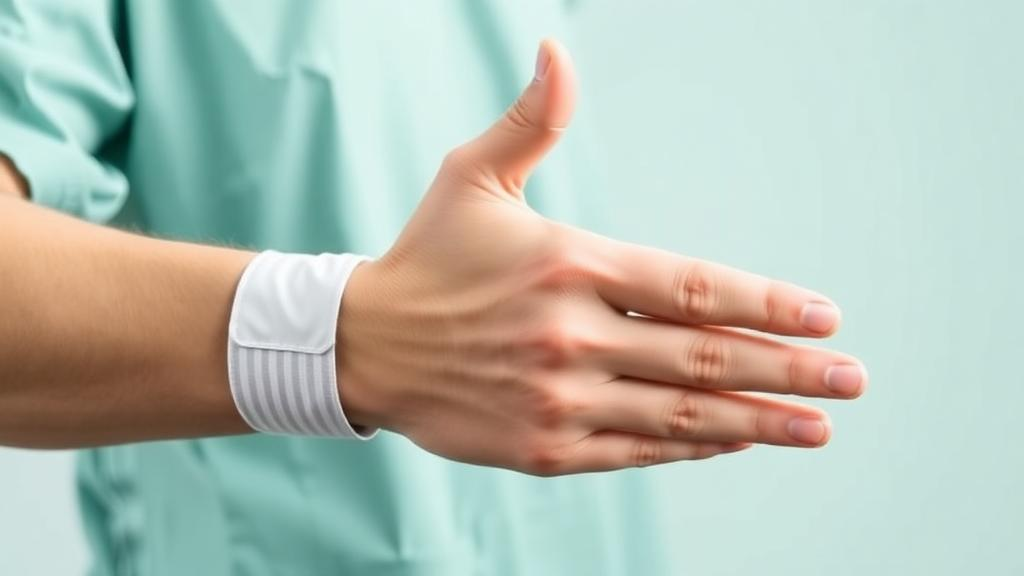
A slim wireless armband that listens to the pressure fingerprints of contracting muscles has achieved one of the most convincing demonstrations yet that old-fashioned statistics can still beat complexity in wearable technology. Engineers and neurosurgeons at the All India Institute of Medical Sciences in New Delhi have built a force myography system that recognizes twenty different hand gestures across twenty-five volunteers with a mean accuracy of 96.1 percent, and they have done it with a lightweight machine learning pipeline that a modest processor could run in real time. The work, published in Biomedical Engineering Letters, suggests that the path to practical gesture-controlled devices may not run through ever-larger neural networks, but through smarter sensor placement and disciplined, computationally frugal classification.
The technology at the heart of the study, force myography or FMG, takes a fundamentally different approach from the surface electromyography that has dominated muscle-sensing research for decades. Instead of detecting the faint electrical potentials that ripple across the skin when muscle fibers fire, FMG measures the mechanical consequence of that activity: the swelling and hardening of muscle bellies as they contract, which pushes outward against anything strapped around the limb. Pressure sensors arranged in a band around the forearm capture this bulging pattern directly, translating each gesture into a characteristic topographic map of force. Because the sensors record physical pressure rather than bioelectrical voltage, they are largely immune to the three chronic headaches of electromyography: electrodes slipping out of place, skin impedance drifting with sweat and temperature, and interference from surrounding electrical noise.
That robustness comes with real advantages for the messy real world. Electromyography-based prosthetic and interaction systems demand careful skin preparation, precise electrode positioning and frequent recalibration, all of which erode the seamlessness that consumers and patients expect. A pressure-based armband can be pulled on like a wristwatch, and its signal quality does not depend on conductive gel or exact anatomical landmarks. Earlier demonstrations of FMG gesture recognition were promising but narrow, typically built around small groups of participants, limited gesture vocabularies and classification schemes heavy enough to strain battery-powered hardware. The New Delhi team set out to close those gaps simultaneously, scaling both the cohort and the gesture set while keeping the computational load deliberately small.
The experimental system consists of an eight-channel FMG armband worn on the forearm of each of twenty-five healthy subjects, who performed twenty distinct upper-limb gestures spanning a functionally diverse repertoire, from individual finger movements to whole-hand grasps and wrist motions. Raw sensor signals first pass through a debounce filter to suppress switch-like artifacts, then through a Butterworth low-pass filter to strip away high-frequency noise, and finally through moving average smoothing to stabilize the envelope of the pressure waveform. From each cleaned channel, the researchers extracted eight time-domain features, statistical descriptors such as mean values and waveform characteristics that capture the shape and magnitude of the pressure response. Eight channels multiplied by eight features produced a 64-dimensional feature vector for every gesture segment, a compact numerical fingerprint on which the classifiers could operate.
Four classical machine learning algorithms competed for the top spot: Random Forest, Support Vector Machine, K-Nearest Neighbours and Linear Discriminant Analysis. Rather than evaluating them on a single convenient data split, the team used a Leave-One-Trial-Out cross-validation scheme, in which every recorded trial is held out in turn as the test case while the remaining trials train the model. This rigorous protocol gives a realistic estimate of how the system would perform on genuinely unseen gestures from the same user. The verdict was striking in its simplicity: Linear Discriminant Analysis, the oldest and mathematically leanest of the four, won with a mean classification accuracy of 96.1 percent plus or minus 2.2, comfortably outperforming Random Forest, K-Nearest Neighbours and the Support Vector Machine. There is a certain elegance in a method developed in the 1930s delivering state-of-the-art results against algorithms with far heavier computational appetites.
Accuracy alone, however, was only half the story. Every additional sensor adds cost, power consumption, wiring complexity and data bandwidth, and the researchers suspected that many of the eight channels were contributing redundant information. They therefore employed a performance-ranked incremental channel selection strategy: channels were ranked by how much they contributed to classification, then added one at a time, with accuracy re-evaluated at each step. The analysis converged on a clear conclusion. Just six of the eight channels were enough to reach 95.6 percent plus or minus 2.4 accuracy, and beyond that configuration the gains flattened into statistical insignificance. In other words, a quarter of the hardware could be discarded for a penalty of roughly half a percentage point, a trade that any product engineer would accept without hesitation.
The implications ripple across several fields that have been waiting for reliable, wearable gesture interfaces. In virtual and augmented reality, where hand tracking currently relies on cameras that fail when hands leave the field of view or lighting degrades, a forearm band that reads muscle pressure directly could offer continuous, lighting-independent control. In rehabilitation, clinicians could use the same platform to monitor how well stroke patients relearn hand function, quantifying gesture quality session after session without a laboratory full of equipment. For powered prosthetics, the FMG approach sidesteps many of the electrode stability problems that have kept myoelectric control frustrating for amputees. The Indian Council of Medical Research funded the project, reflecting its translational ambitions in clinical measurement, and the team’s own earlier work has applied force myography to surgical skills assessment, underscoring the versatility of the sensing principle.
The study’s scale matters as much as its accuracy. With twenty-five participants and twenty gesture classes, it addresses two of the most common criticisms leveled at gesture recognition papers: tiny cohorts that mask inter-individual variability, and toy gesture sets that flatter the classifier. A twenty-way classification problem is hard enough that chance performance sits at five percent, making the 96 percent result meaningful rather than inflated. The authors note that prior FMG studies were limited by exactly these constraints, along with computationally intensive classification strategies that blocked practical deployment. By combining a large cohort, a broad gesture vocabulary and a deliberately light pipeline, the work sketches a credible blueprint for systems that could leave the laboratory. The discipline of the cross-validation design, holding out entire trials rather than individual samples, reduces the risk that the reported accuracy is an artifact of data leakage.
There are, of course, familiar caveats that separate this demonstration from a finished product. All twenty-five subjects were healthy, and the critical test of cross-day and cross-user generalization, whether a band trained on one person or one session works on another without recalibration, lies beyond the current report. Long-term wear introduces its own challenges, including sensor drift, skin adaptation and the nuisance of a device that must stay snugly positioned to keep its pressure map meaningful. Gesture recognition for clinical populations, particularly amputees whose residual musculature produces very different force signatures, will require dedicated validation. None of these caveats undermines the central finding, but they mark the distance between a validated prototype and a consumer or medical device.
What the study ultimately delivers is a lesson about proportionality in biomedical engineering. At a moment when deep learning dominates headlines in gesture recognition, a linear classifier paired with well-chosen pressure channels and careful signal conditioning matched or beat its heavier rivals while fitting comfortably within the power budget of a battery-driven wearable. The six-channel configuration identified by the optimization analysis points toward cheaper, lighter, longer-lasting armbands that sacrifice almost nothing in performance. If the next phase of this research confirms that the system holds up across days, users and clinical populations, the unglamorous marriage of pressure sensors and 1930s statistics may prove to be the technology that finally puts intuitive, muscle-reading gesture control on wrists, in rehabilitation clinics and inside virtual worlds.
Subject of Research: Wireless force myography for multi-class hand gesture recognition using optimized sensor channels and machine learning
Article Title: Wireless force myography system for practical multi-class hand gesture recognition with optimized sensor channels
Article References: Wireless force myography system for practical multi-class hand gesture recognition with optimized sensor channels. (n.d.). https://doi.org/10.1007/s13534-026-00624-6
Image Credits: AI Generated
DOI: 10.1007/s13534-026-00624-6
Keywords: force myography, hand gesture recognition, wearable sensors, machine learning, linear discriminant analysis, biomedical engineering, human-machine interface, rehabilitation, virtual reality, signal processing, sensor optimization, surface electromyography
Cite Scienmag News
Denise Maddox. (October 14, 2026). Simple Armband Reads Hand Gestures With Surgical Precision. Scienmag. https://scienmag.com/simple-armband-reads-hand-gestures-with-surgical-precision/
Denise Maddox. "Simple Armband Reads Hand Gestures With Surgical Precision." Scienmag, 14 October 2026, https://scienmag.com/simple-armband-reads-hand-gestures-with-surgical-precision/. Accessed 14 October 2026.
Denise Maddox. "Simple Armband Reads Hand Gestures With Surgical Precision." Scienmag. October 14, 2026. https://scienmag.com/simple-armband-reads-hand-gestures-with-surgical-precision/


