


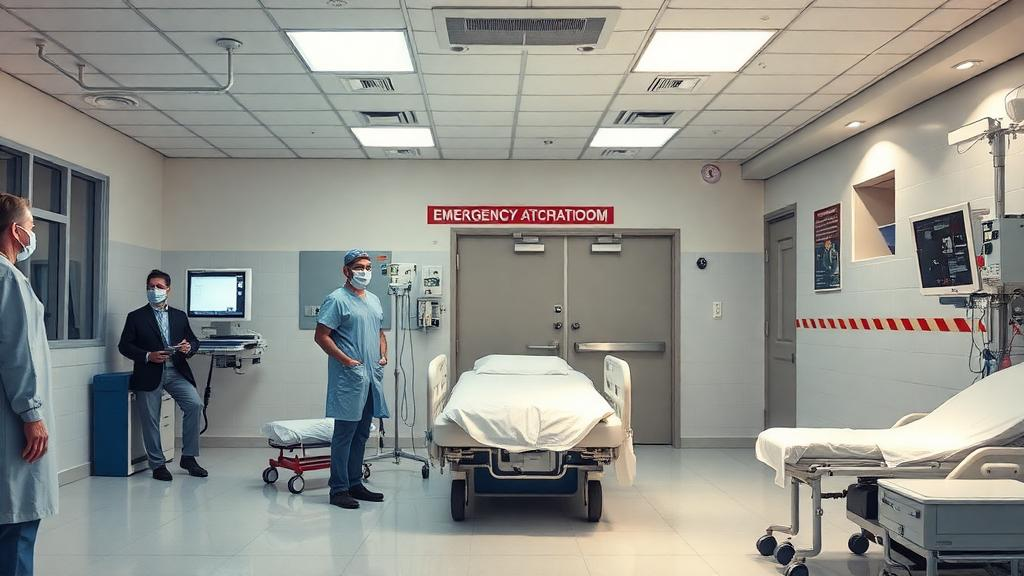
When a disaster strikes, the entire health system compresses into a single, terrifying equation: too many patients, too little time, and resources that were never designed to stretch that far. Emergency departments live in that compressed state every day, and disaster response simply amplifies it. A new scoping review published in BMC Nursing asks a deceptively simple question about that compressed world: where, exactly, is artificial intelligence actually being deployed across the emergency-disaster continuum, and what does the evidence say about its relevance to the largest workforce in healthcare, the nurses?
The review, conducted by a team led by Yang Li and Yumei Peng of the University of Electronic Science and Technology of China together with colleagues from hospitals in Sichuan, introduced what the authors call an emergency-disaster continuum as an analytical lens. Rather than treating routine emergency care and catastrophic disaster response as separate worlds, the framework views them as points on a single spectrum of escalating demand, time pressure and constrained resources. That framing matters, because technologies tested in the relative order of an emergency department may behave very differently when infrastructure collapses, communications fail and surge conditions overwhelm staffing.
Methodologically, the study followed the scoping review methodology recommended by the Joanna Briggs Institute and was reported in line with the PRISMA-ScR reporting guideline. The team searched eight databases from inception to 30 January 2026, with two reviewers independently screening studies and extracting data. Eligible studies had to examine AI applications relevant to functions commonly undertaken or influenced by nurses, including assessment, triage, communication, coordination, training, workflow and clinical decision support, in emergency or disaster contexts. The search was anchored in the standard population, concept and context approach that structures modern scoping reviews, which keeps the mapping honest about what the literature actually covers rather than what researchers wish it covered.
The yield was strikingly small: eighteen studies made it through. Most were published within the past five years, which signals a field that is young, fast-moving and still dominated by early-stage work. The designs were heterogeneous, spanning retrospective model-development studies, simulation studies, quasi-experimental studies, a single randomised controlled trial and one conceptual framework analysis. In other words, the evidence base rests largely on prototypes and simulations, with only one study applying the rigorous randomisation that medicine reserves for its strongest claims. That single trial, and its scarcity, may be the most important number in the entire review.
Despite the small count, the technological breadth was considerable. The included studies deployed AI-based decision-support systems, machine learning, deep learning, natural language processing, large language models and computer vision. The authors grouped these applications into three broad functional areas: management and resource allocation, rapid triage and risk identification, and disaster training and communication. Each of these areas maps directly onto terrain where nurses work at the sharp end of emergency and disaster care, from deciding who is seen first to coordinating scarce beds to rehearsing for events no one hopes will happen.
Triage and risk identification represent the most technologically visible frontier. Machine learning and deep learning models, along with computer vision systems that can analyse imaging or visual data, were examined as tools for rapid assessment and risk detection under conditions where human assessment capacity is stretched thin. The logic is compelling: if an algorithm can flag deterioration or prioritise patients faster than a crowded triage queue allows, it could compress the interval between arrival and appropriate care. But the review’s own findings temper the enthusiasm, because most of this work involves retrospective model development, in which algorithms learn from historical data rather than proving themselves in live, chaotic environments where disaster conditions actually unfold.
The second functional area, management and resource allocation, addresses the arithmetic of scarcity that defines both emergency surges and disasters. Decision-support systems examined in the included studies aimed at coordinating resources and supporting workflow under constrained conditions. For nurses, who frequently serve as the operational hinge of emergency units and disaster response teams, such systems could in principle reshape how staffing, beds and supplies are matched to shifting demand. Yet the review found that these tools have largely been studied as supports for existing workflows, not as replacements or restructurings of them, and evidence about their effects on nursing-specific outcomes is thin.
The third area, disaster training and communication, may be the furthest from the patient but the closest to the profession. Simulation studies in the review explored AI-enabled and, in some cases, virtual reality-supported approaches to preparing responders for disaster scenarios, alongside communication applications including natural language processing and large language models. In a field where genuine disaster experience is rare by definition, simulation-based training offers a controlled way to rehearse triage decisions, coordination and communication before the real thing. The inclusion of large language models also marks the review’s currency, reflecting how rapidly generative AI has entered even the most operationally demanding corners of healthcare literature since 2023.
Herein lies the review’s central and uncomfortable conclusion: direct evidence concerning nurses, nursing workflows and nursing-sensitive outcomes remains limited. AI in this literature is overwhelmingly framed as a means of supporting existing emergency and disaster workflows, which is a cautious and perhaps sensible posture, but it also means the profession that constitutes the majority of the emergency and disaster health workforce is largely absent from the evidence base as a studied population. Tools that reallocate resources, prioritise patients or automate communication inevitably touch nursing practice, whether or not nurses were involved in designing them, and the review makes clear that this involvement has been more assumed than demonstrated.
The authors’ prescription for the field is correspondingly clear. Future research should prioritise implementation research, nurse-involved co-design, workflow integration and validation in real-world disaster settings. Each element addresses a specific weakness the review uncovered: implementation research would move beyond prototype and simulation designs; co-design would put nurses at the table where triage algorithms and communication tools are shaped; workflow integration would test how tools behave inside the messy realities of emergency departments rather than in retrospective datasets; and real-world validation would subject the technology to the collapsed infrastructure and surging demand that define actual disasters. Until those studies arrive, the eighteen-study evidence base offers a map of promising terrain rather than a licence to deploy, and the emergency-disaster continuum framework gives researchers a shared lens for filling it in. For a profession that staffs the front line of every emergency and every disaster, the message of this review is both a warning and an invitation: the algorithms are coming to the triage desk, and nurses have every reason to demand a hand in building them.
Subject of Research: Applications of artificial intelligence in emergency and disaster care and their implications for nursing practice
Article Title: Artificial intelligence across the emergency–disaster continuum: a scoping review and implications for nursing practice
Article References: Li, Y., Peng, Y., Bai, S., Shen, Y., & He, M. (2026). Artificial intelligence across the emergency–disaster continuum: a scoping review and implications for nursing practice. BMC Nursing. https://doi.org/10.1186/s12912-026-05260-0
Image Credits: AI Generated
DOI: 10.1186/s12912-026-05260-0
Keywords: artificial intelligence, emergency care, disaster response, nursing practice, scoping review, triage, machine learning, deep learning, natural language processing, large language models, clinical decision support, simulation training
Cite Scienmag News
Blake Davidson. (October 14, 2026). AI Steps Into the Emergency Room and the Disaster Zone, But Nurses Are Still Waiting. Scienmag. https://scienmag.com/ai-steps-into-the-emergency-room-and-the-disaster-zone-but-nurses-are-still-waiting/
Blake Davidson. "AI Steps Into the Emergency Room and the Disaster Zone, But Nurses Are Still Waiting." Scienmag, 14 October 2026, https://scienmag.com/ai-steps-into-the-emergency-room-and-the-disaster-zone-but-nurses-are-still-waiting/. Accessed 14 October 2026.
Blake Davidson. "AI Steps Into the Emergency Room and the Disaster Zone, But Nurses Are Still Waiting." Scienmag. October 14, 2026. https://scienmag.com/ai-steps-into-the-emergency-room-and-the-disaster-zone-but-nurses-are-still-waiting/


