


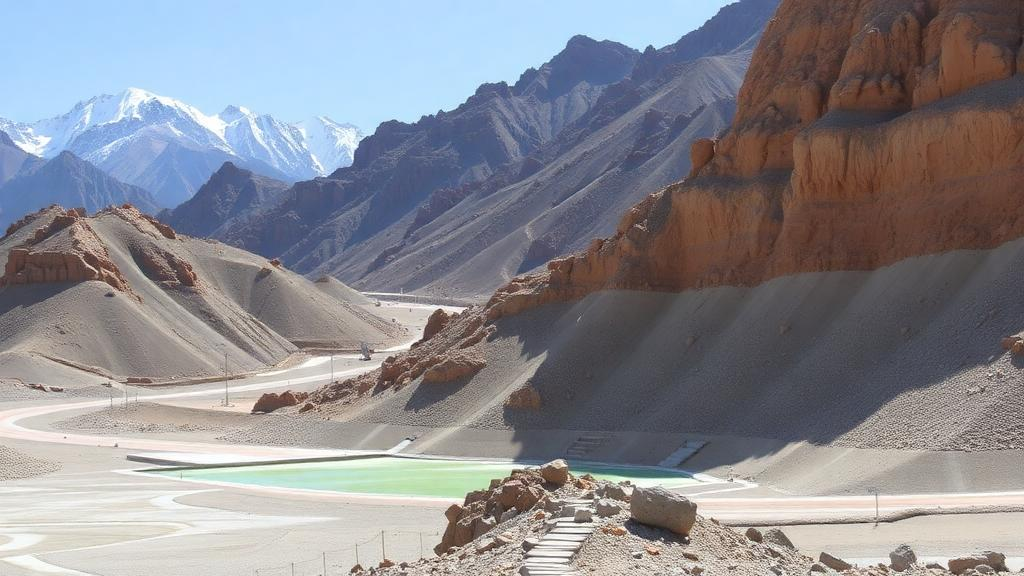
Northern Pakistan is one of the few places on Earth where a towering mountain belt built by colliding continents bubbles with hot springs, yet no volcano feeds them. More than 500 springs dot the Himalaya, Kohistan, and Karakoram terranes, forming part of the roughly 3,000-kilometer-long Himalayan Geothermal Belt that stretches from the western Himalaya toward Tibet. Because no direct heat-flow measurements or deep borehole temperatures exist in the region, the source of all this heat has long been debated. A new modeling study published in Solid Earth by Muhammad Anees of the LIAG Institute for Applied Geophysics and colleagues now provides the most detailed picture yet of the temperatures hidden beneath these peaks, and it points to a surprising conclusion: some of the deepest valleys in the Nanga Parbat and Karakoram regions may sit above rock hot enough to rival established geothermal fields.
The team attacked the problem with a hierarchy of numerical models. One-dimensional steady-state simulations established the baseline conductive temperature profiles, or geotherms, for each terrane, incorporating temperature-dependent thermal conductivity, including a radiative component that kicks in above 1,000 Kelvin. One-dimensional transient models then added the crucial ingredient that pure conduction ignores: the upward transport of hot rock itself as mountains erode and crust rises, a process known as exhumation. Finally, a two-dimensional advective-conductive model built in COMSOL Multiphysics, with a mesh of more than 72,000 finite elements, resolved how rugged topography and laterally contrasting rock types sculpt the shallow temperature field. Because the region lacks calibration data, the models bracket a range of plausible thermal states rather than delivering a single deterministic answer.
The single most influential parameter turned out to be radiogenic heat production, the gentle but persistent warmth released when uranium, thorium, and potassium isotopes decay inside ordinary rock. In the Nanga Parbat Massif, where the team’s field gamma-ray surveys measured enriched gneisses and leucogranites reaching up to about 5.33 microwatts per cubic meter, steady-state models yield surface heat flow of 85 to 120 milliwatts per square meter, with a preferred scenario of about 100. The Kohistan arc, dominated by mafic rocks poor in heat-producing elements, produces markedly lower values of 50 to 85 milliwatts per square meter. The Karakoram terrane falls in between at 65 to 103 milliwatts per square meter, with its radiogenic budget concentrated in the batholith and metamorphic complexes.
The models also delivered a subtle but fundamental insight about how continents are built. When the researchers extended the measured surface heat-production values uniformly down through the crust, the resulting temperatures at the Moho, the crust-mantle boundary, became wildly incompatible with petrological and geophysical constraints, in some scenarios exceeding plausible metamorphic limits by hundreds of degrees. The implication is that heat-producing elements are not distributed evenly with depth. Instead, partial melting and magmatic differentiation during crustal thickening have stripped these elements from the lower crust and concentrated them in the upper layers, a process quantified by a crustal differentiation index. The Nanga Parbat Massif scored about 3 and the Karakoram about 2, comparable to the Appalachians, while the mafic Kohistan arc scored only 1.1, near the level of ancient Indian cratons.
Radiogenic heating alone, however, cannot explain everything happening beneath Nanga Parbat. Thermochronological data show that this massif, which thrusts Proterozoic Indian basement rocks up to roughly 8 kilometers in elevation, has exhumed about 15 kilometers in just the last 3 million years. The transient models show that sustained exhumation rates of 2 to 3 millimeters per year act like a conveyor belt, hauling hot material toward the surface faster than conduction can dissipate the heat. After 10 million years of simulated exhumation at 3 millimeters per year combined with high radiogenic heat production, modeled surface heat flow climbs to an extraordinary 220 to 250 milliwatts per square meter, and the geotherm even inverts at 20 kilometers depth in these exploratory end-member scenarios. The researchers stress these extreme values represent upper bounds applicable only to the localized, rapidly rising core of the syntaxis.
A dimensionless quantity called the Péclet number captures why exhumation matters so much. It compares the rate of heat carried by moving material to the rate of heat lost by conduction. For the 25-kilometer model domain, exhumation rates of 1, 2, and 3 millimeters per year yield Péclet numbers of roughly 0.8, 1.6, and 2.4, meaning that at the faster rates advection equals or overwhelms conduction. In the two-dimensional models covering shallower depths, Péclet numbers range from below unity up to about 1.8 in high-relief areas, confirming that heat transport by rising rock becomes a dominant process precisely where Nanga Parbat and the Karakoram are rising fastest.
Topography adds a final, visually striking twist. The two-dimensional simulations show that shallow isotherms, the contour lines of underground temperature, are compressed beneath deeply incised valleys and pushed deeper beneath towering peaks, a mirror image of the surface relief caused by the elevation correction to the conductive temperature field. Combined with the radiogenic and advective heat sources, this means the hottest rock at the shallowest depths lies not on the summits but in the steep valley floors, exactly where the region’s hot springs discharge. In the more conservative scenarios, modeled isotherms exceeding 100 degrees Celsius lie only 1,200 to 2,500 meters below the surface in major valleys, while in warmer scenarios temperatures above 200 degrees Celsius may be reached at about 3 kilometers depth.
Those numbers place northern Pakistan in the same thermal league as proven geothermal systems elsewhere along the Himalayan belt. At Yangbajing in Tibet, a shallow reservoir reaches 150 to 165 degrees Celsius at a mere 180 to 280 meters depth, and a deeper reservoir attains 250 to 329 degrees Celsius. In the Puga Valley of Ladakh, reservoir temperatures of roughly 200 to 250 degrees Celsius are inferred at 1 to 2 kilometers. The authors are careful to emphasize the distinction: the Tibetan and Ladakhi figures rest on drilling and geophysical surveys, whereas the Pakistani values are uncalibrated, scenario-based model outputs. Still, the modeled heat flow locally exceeding 120 to 180 milliwatts per square meter indicates a thermal regime fully comparable to medium- and high-temperature geothermal fields.
Independent chemical hints support the picture of a crustal heat engine. The low helium-3 to helium-4 ratios measured in hot-spring gases across the belt point to a predominantly crustal rather than mantle origin for the heat, consistent with the models. Radon concentrations in spring waters, reaching 304 becquerels per liter at the Tattapani spring near Raikot Bridge on the western flank of Nanga Parbat, suggest that groundwater interacts with uranium-bearing rocks along its flow path, although such measurements were made for health-risk assessment and say little about deeper heat sources. A dedicated noble-gas survey, particularly of helium isotopes, would provide a sharper test of the model’s crustal heating hypothesis.
The study’s limitations are as instructive as its results. Without any measured surface heat flow or borehole temperatures, the seven scenarios tested per terrane express structural uncertainty rather than statistical confidence, and the preferred models were chosen for geological plausibility, chiefly by requiring Moho temperatures compatible with petrological constraints. Fluid circulation, permeability, and fracture networks, the factors that ultimately control whether hot rock can become a working geothermal reservoir, lie beyond the scope of the regional models. Even so, the work provides a screening-level foundation for exploration in a tectonic setting long overlooked in geothermal assessments. With conventional geothermal development concentrated at volcanic plate boundaries, the demonstration that a collision zone can sustain anomalous heat through radioactive rocks, thickened crust, and rapidly rising mountains opens a genuinely new frontier, and the deep valleys of Nanga Parbat and the Karakoram now top the list of places to look.
Subject of Research: Thermal modeling of the lithosphere's radiogenic heat production and exhumation-driven geothermal potential in northern Pakistan's Nanga Parbat, Kohistan, and Karakoram terranes
Article Title: Geothermal implications of the lithosphere's thermal structure in northern Pakistan
Article References: Anees, M., Hindle, D., Meneses Rioseco, E., Kley, J., Leiss, B., Shah, M. M., & Qureshi, J. A. (2026). Geothermal implications of the lithosphere's thermal structure in northern Pakistan. Solid Earth, 17(10), 1117-1138. https://doi.org/10.5194/se-17-1117-2026
Image Credits: AI Generated
Keywords: geothermal energy, Nanga Parbat, Karakoram, Himalaya, radiogenic heat production, exhumation, thermal modeling, heat flow, crustal differentiation, Kohistan arc, hot springs, lithosphere
Cite Scienmag News
Violet Maxwell. (October 14, 2026). Radioactive Rocks and Rising Crust Could Power Geothermal Energy Beneath Pakistan’s Mountains. Scienmag. https://scienmag.com/radioactive-rocks-and-rising-crust-could-power-geothermal-energy-beneath-pakistans-mountains/
Violet Maxwell. "Radioactive Rocks and Rising Crust Could Power Geothermal Energy Beneath Pakistan’s Mountains." Scienmag, 14 October 2026, https://scienmag.com/radioactive-rocks-and-rising-crust-could-power-geothermal-energy-beneath-pakistans-mountains/. Accessed 14 October 2026.
Violet Maxwell. "Radioactive Rocks and Rising Crust Could Power Geothermal Energy Beneath Pakistan’s Mountains." Scienmag. October 14, 2026. https://scienmag.com/radioactive-rocks-and-rising-crust-could-power-geothermal-energy-beneath-pakistans-mountains/


