


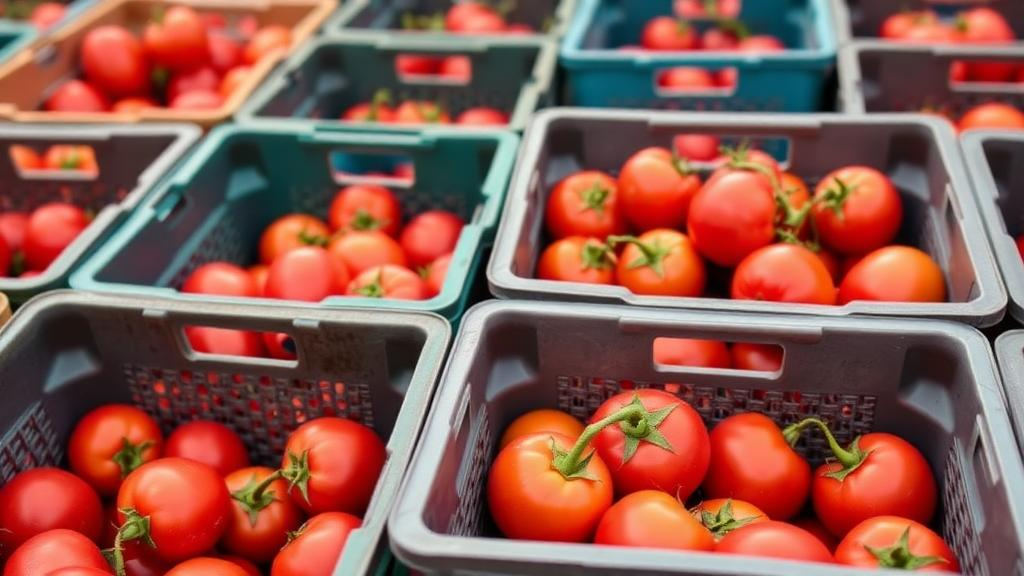
In the tomato fields of Kano State, northern Nigeria’s horticultural heartland, a quiet packaging revolution is delivering some of the most striking loss-reduction numbers yet recorded in African smallholder agriculture. A new study of 209 tomato producers, published in the journal Discover Agriculture, finds that farmers who pack their fruit in reusable plastic crates instead of the traditional raffia woven baskets lose only about 3 percent of their harvest at the packaging stage, while basket users lose roughly a quarter of everything they grow. Adjusting for the fact that farmers who choose crates differ systematically from those who do not, the researchers estimate that switching to crates would cut financial losses by around 74 percent for both current adopters and non-adopters alike.
The scale of the problem the study addresses is enormous. Postharvest losses in Nigeria’s tomato sector are often estimated at up to 45 percent of total production, a figure that ripples through the entire value chain. Lost produce means lost income for the smallholders who dominate the sector, higher prices for consumers, and a paradoxical dependence on imported tomato paste in a country that grows millions of tonnes of fresh fruit each year. Kano State, one of the country’s leading tomato-producing regions, sits at the center of this tension: its irrigated fields and well-developed market linkages supply fresh tomatoes to both northern and southern Nigeria, yet much of that fruit never reaches a buyer in saleable condition.
The chief culprit, according to the research led by Tabeel Yerima Isreal of Landmark University and colleagues, is the humble raffia basket. Woven from palm fronds, these containers have rough interiors, rigid walls, and no standardized shape or ventilation design. Tomatoes stacked inside them are exposed to compression damage and bruising as they are transported over rough roads, and the poor airflow accelerates softening and decay. By contrast, reusable plastic crates, rigid molded containers with smooth surfaces and vented sides, are engineered to protect delicate produce and maintain the airflow that keeps fruit firm. Field measurements in the study bore this out: basket users lost approximately 2,307 kilograms from a total harvest of about 9,179 kilograms, a 25 percent loss rate, while crate users lost around 587 kilograms from roughly 16,683 kilograms harvested, or just 3 percent.
What distinguishes the new analysis from earlier work is its statistical rigor. Many previous studies of postharvest technology adoption have relied on simple comparisons or on methods such as propensity score matching, which can only adjust for characteristics that researchers happen to observe. That leaves a fundamental problem unaddressed: farmers who adopt a new technology may be systematically more educated, wealthier, better connected, or more risk-tolerant than those who do not, so part of any apparent benefit may reflect who adopts rather than what the technology does. The Kano study tackles this with an endogenous switching regression model, estimated under a full information maximum likelihood framework, which jointly models the decision to adopt and the loss outcomes under both adoption and non-adoption regimes, correcting for unobserved heterogeneity through inverse Mills ratio corrections.
The technical machinery matters because it changes the size of the answer. The study computed the average treatment effect on the treated and, in a counterfactual step, what would happen if non-adopters were to switch. In logarithmic terms, adoption reduces financial losses by about 1.35 units, equivalent to roughly a 74 percent decrease, for both groups. The consistency of the estimate across adopters and simulated non-adopters suggests the effect is not an artifact of self-selection, and the authors note that simpler group comparisons could actually understate the technology’s true benefit once selection bias and producer heterogeneity are properly handled.
Who adopts, and who does not, turns out to be a story about resources and institutions. Farming experience and years of formal education both increased the probability of adoption, consistent with the idea that experienced farmers have watched enough produce rot to recognize the value of protection, and that education builds the information-processing capacity that human capital theory identifies as central to innovation uptake. Income from tomato production exerted an even stronger pull, a reminder that even a modest investment in crates can be out of reach for producers living hand to mouth. Membership in cooperative societies and engagement in diversified livelihoods also boosted adoption, pointing to the role of social capital and financial resilience in buffering the risks of trying something new.
Two negative findings carry their own policy weight. Female farmers were significantly less likely to adopt crates, a pattern the authors attribute to persistent gender disparities in access to credit, extension services, and productive resources across Nigerian agriculture. And, perhaps counterintuitively, farmers with larger plots were less likely to adopt. The explanation is logistical rather than financial: a grower with extensive fields needs a very large inventory of crates plus the transport and storage space to move and house them, and without supporting infrastructure, scaling crate-based handling across a big operation becomes cumbersome. Similar dynamics have been observed with solar-powered cold storage, where larger harvest volumes overwhelmed the technology’s capacity.
Equally revealing is how adoption actually happens on the ground. The study found that most producers use plastic crates alongside raffia baskets rather than replacing them entirely, a partial adoption pattern that dilutes the technology’s potential. The sampled farmers averaged about 15 years of farming experience, roughly 10 years of schooling, and small plots averaging 1.19 hectares. Only 13 percent had access to formal credit, and 48 percent belonged to cooperatives, figures that sketch the structural constraints within which adoption decisions are made. In a system where capital is scarce and institutional support thin, a hybrid approach, using crates where they are available and baskets where they are not, is a rational compromise rather than a failure of understanding.
The study’s recommendations follow directly from its evidence. Because income and financial capacity were decisive, the authors argue for targeted subsidy programs, credit schemes, and cooperative-based bulk purchasing to bring crate costs down. Cooperatives emerge as a particularly promising delivery channel, since collective procurement lowers individual costs while creating platforms for knowledge sharing. Extension services, the authors suggest, should run demonstration programs that communicate the technical and economic case for crates, especially to less-educated and less-experienced producers, and should recruit experienced adopters as peer educators. Gender-responsive measures, including women-focused savings groups and deliberate inclusion in extension programs, are flagged as essential to closing the adoption gap for female farmers.
The authors are careful to note the limitations of their approach. The cross-sectional design captures a single moment in time and cannot track how adoption behavior evolves, and even a well-specified switching regression cannot fully account for unobservable factors such as individual risk preferences or shifting market conditions. The focus on Kano State also raises questions about generalizability to other regions and cropping systems. Still, the core message is hard to dispute: for every 100 kilograms of tomatoes harvested in Kano’s fields, raffia basket users lose about 25 kilograms before their produce reaches a market, while crate users lose just 3. In a country where tomatoes are both a dietary staple and a livelihood for hundreds of thousands of smallholders, a simple molded plastic box, backed by credit, cooperatives, and good extension, may be one of the cheapest food-security interventions available.
Subject of Research: Impact of reusable plastic crate adoption on postharvest losses among smallholder tomato producers in Kano State, Nigeria
Article Title: Impact of adopting re-usable plastic crates on postharvest losses among small scale tomato producers in Kano State, Nigeria
Article References: Impact of adopting re-usable plastic crates on postharvest losses among small scale tomato producers in Kano State, Nigeria. (n.d.). https://doi.org/10.1007/s44279-026-00793-z
Image Credits: AI Generated
DOI: 10.1007/s44279-026-00793-z
Keywords: postharvest losses, reusable plastic crates, tomato production, Nigeria, Kano State, smallholder farmers, endogenous switching regression, raffia baskets, food security, agricultural technology adoption, cooperatives, value chain
Cite Scienmag News
Alan Morgan. (October 14, 2026). Plastic crates slash tomato losses by three-quarters for Nigerian smallholders. Scienmag. https://scienmag.com/plastic-crates-slash-tomato-losses-by-three-quarters-for-nigerian-smallholders/
Alan Morgan. "Plastic crates slash tomato losses by three-quarters for Nigerian smallholders." Scienmag, 14 October 2026, https://scienmag.com/plastic-crates-slash-tomato-losses-by-three-quarters-for-nigerian-smallholders/. Accessed 14 October 2026.
Alan Morgan. "Plastic crates slash tomato losses by three-quarters for Nigerian smallholders." Scienmag. October 14, 2026. https://scienmag.com/plastic-crates-slash-tomato-losses-by-three-quarters-for-nigerian-smallholders/


