


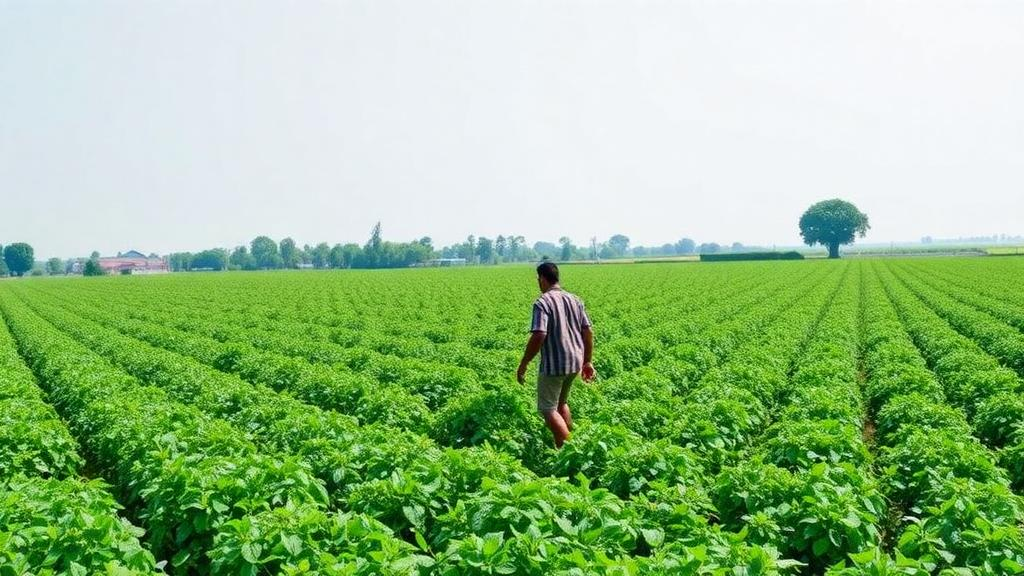
Fresh peas do not wait. In the mountainous municipalities of Guasca and Guatavita, in the Colombian department of Cundinamarca, a delayed collection truck can leave harvested sacks sitting in fields for hours or days, and product quality deteriorates rapidly once the harvest is out of the ground. Small producers in the region typically farm plots of two to eight hectares, yield around ninety 50-kilogram sacks per hectare, and depend on rural roads that vary dramatically with weather, terrain, and maintenance. A new study published in Results in Engineering argues that the way to keep such fragile first-mile networks functioning is not simply to build a better initial plan, but to give the logistics system an adaptive regulatory capacity that responds as disruption damage accumulates, drawing inspiration from how biological immune systems detect, absorb, and remember attacks.
The research team, made up of Andrés Polo, Jeyser Otero-Díaz, Santiago Rodríguez-Albarracín, and John Willmer Escobar, developed a unified decision framework that combines three normally separate ingredients. The first is a unified robust–stochastic programming (URSP) formulation, a mixed-integer linear model that handles two fundamentally different kinds of uncertainty within one structure. Stochastic programming captures so-called known-unknowns, meaning recurrent fluctuations in supply, transportation times, and collection efficiency that historical data can describe probabilistically even if exact timing cannot be predicted. Robust optimization, in contrast, represents unknown-unknowns: severe disruptions that cannot be reliably characterized with probabilities, modeled instead through deliberately adverse configurations that stress-test the network. The model decides which collection centers to activate, which producers to assign to each center, and how product flows are allocated across a multi-period planning horizon, with an objective that balances expected utility from stochastic scenarios against performance under robust configurations and a conditional value-at-risk (CVaR) term that penalizes tail-risk exposure.
The second ingredient is territorial. Rather than treating all locations as interchangeable nodes on a map, the researchers built a Rural Viability Index (RVI), a single number between zero and one that condenses accessibility, road and freight connectivity, market access, precipitation, altitude, terrain slope, rural population density, educational attainment, and agricultural machinery availability. The index was estimated through supervised machine learning using 416 municipality-period observations from 74 pea-producing municipalities in Cundinamarca across six agricultural semesters between 2022 and 2024, drawing on Colombian agricultural records from EVA-UPRA, census data from DANE, and meteorological observations from IDEAM. The response variable was the proportion of planted area actually harvested, and after comparing Random Forest, Gradient Boosting, and K-Nearest Neighbors models, the Random Forest regressor won with the best combination of explained variation and error, achieving an R-squared of 0.921. The trained regional estimator was then applied to the twenty producers in the case-study network.
The spatial results were striking. Neighboring producers did not necessarily share similar viability scores. The highest index values clustered around producers such as P11, with an RVI of 0.9104, and P5, at 0.8216, reflecting favorable connectivity and accessibility, while producers P2, P9, and P14 scored between roughly 0.626 and 0.652, marking zones where local conditions limit consolidation and transport capacity. Because the index enters the optimization model directly, both as a threshold that blocks the activation of collection centers in low-viability locations and as a penalty term in the economic objective, territorial heterogeneity shapes the network design without requiring a long list of separate rural constraints. The authors note that distance-based criteria alone are inadequate: two geographically close farms can face very different operating realities.
The third and most novel ingredient is an adaptive viability regulation layer the authors call a Supply Chain Immune System, or SCIS. Built on an immune-inspired dynamic regulation framework, it borrows functional principles rather than claiming literal biological behavior. When a disruption hits, the existing network acts as a structural barrier, absorbing part of the perturbation through residual capacity, quantified by a structural redundancy coefficient. Damage exceeding a threshold triggers an innate response, a rapid deployment of immediately available regulatory effort. If deterioration persists and crosses a higher threshold, an additional adaptive response activates, whose intensity scales with observed damage. Crucially, the system also carries memory: past adaptive responses accumulate in a memory state that persists across periods and influences subsequent performance, so the network’s regulatory behavior evolves with the observed system state rather than repeating a predetermined correction.
Mathematically, the SCIS layer is embedded directly into the feasibility constraints of the optimization model. Collected volume in each period is bounded by disrupted producer capacity plus surviving backlog plus the aggregate innate and adaptive response available across enabled centers. The strategic configuration, meaning which centers are open and how much capacity they have, remains fixed, but flows and the use of available capacity can be redistributed as conditions worsen. Activation costs are attached to each regulatory layer, so the model weighs the economic price of sustaining responses against the value of preserving continuity. Sequential state updates, computed between optimization runs, track viability loss as the shortfall between delivered volume and a target operating level, update memory from prior adaptive effort, and evolve system performance through recovery and memory contributions offset by accumulated viability losses, all without introducing nonlinearities into the mixed-integer program.
The evaluation compared three formulations: the baseline URSP, a simple rule-based threshold reactive recovery heuristic (TRH) that restores a fixed fraction of lost capacity whenever prior-period deterioration crosses a threshold, and the full URSP-SCIS. Across six disruption scenarios, labeled E0 through E5 and ranging from moderate variability through severe multi-component disruption, logistics-constrained breakdown, persistent degradation, and recovery-relapse dynamics, the differences were modest under mild conditions but widened dramatically under stress. Under robust uncertainty, mean operational viability rose from 0.286 for the baseline to 0.632 with adaptive regulation, while worst-case viability more than tripled, from 0.154 to 0.563. Viability variability, a measure of performance dispersion, fell from 0.258 to 0.107. Under stochastic conditions, the regulated model reached a mean viability of 0.736 with almost no dispersion, compared to 0.604 for the baseline. Output retention under robust conditions climbed from 0.411 to 0.731, and mean system performance from 0.381 to 0.572.
The TRH benchmark showed that simple threshold recovery captures only part of the benefit. It improved mean robust viability to 0.347 and worst-case viability to 0.245, better than doing nothing but far short of the immune-style layer, because its fixed activation and recovery rules leave the lower tail exposed. The authors are candid about a boundary: the adaptive model did not dominate every metric. The maximum robustness gap, which measures the largest single departure between expected and worst-case performance, was slightly higher for URSP-SCIS than for TRH, with greater dispersion. Keeping a network viable across recurrent adverse states, the study suggests, is not the same as minimizing the worst individual loss, and decision-makers must choose which criterion matters more. A two-factor analysis of variance confirmed the pattern statistically, with the uncertainty regime producing the largest effect on viability (F = 97.69), the model formulation a strong effect (F = 81.41), and their interaction significant (F = 26.21), meaning the value of regulation grows precisely when operating conditions deteriorate from routine variability toward severe disruption.
Sensitivity analyses reinforced the findings. Perturbing the structural absorption, innate response, and adaptive response coefficients left headline viability outcomes essentially unchanged at reported precision, while the internal regulatory states, innate response, adaptive response, memory, and sequential performance, shifted measurably with their governing parameters. Across scenarios, lower viability was strongly associated with stronger endogenous responses, with Pearson correlations approaching -1 between mean robust viability and adaptive response, and regulatory effort intensified as deterioration persisted across periods. Risk-parameter variations in the CVaR structure changed the objective value by up to roughly 13 percent but left operational indicators stable, suggesting the solutions are not artifacts of a narrow parameter choice.
The practical implications are concrete. The framework separates decisions that must be locked in before disruption, such as collection-center location, territorial eligibility, and installed capacity, from those that can be adjusted during deterioration, such as flow redistribution and capacity utilization. For producer associations and logistics managers, this means recovery effort can be concentrated where initial configurations and fixed response rules stop being sufficient. For policymakers, the Rural Viability Index offers a data-driven way to prioritize infrastructure and accessibility investments in areas where local conditions impose persistent constraints. The authors caution that results are specific to the pea network, its territory, and its disruption structures, and that transferring the approach elsewhere requires context-specific recalibration of the index, the network parameters, and the regulatory coefficients. Future directions include multi-objective extensions covering resilience and sustainability, real-time implementation through Internet-of-Things sensing and digital twins, and reinforcement learning as a complement to the endogenous memory already built into the model. For now, the study demonstrates a compelling idea: that supply chains for perishable goods can be engineered to fight back, absorbing shocks, escalating their responses, and remembering what hurt them, much as living systems do.
Subject of Research: Adaptive viability regulation in first-mile agricultural supply chains through unified robust–stochastic optimization
Article Title: Adaptive viability regulation in first-mile agricultural supply chains through unified robust–stochastic optimization
Article References: Polo, A., Otero-Díaz, J., Rodríguez-Albarracín, S., & Escobar, J. W. (2026). Adaptive viability regulation in first-mile agricultural supply chains through unified robust–stochastic optimization. Results in Engineering, 32, Article 113395. https://doi.org/10.1016/j.rineng.2026.113395
Image Credits: AI Generated
DOI: 10.1016/j.rineng.2026.113395
Keywords: first-mile logistics, agricultural supply chain, robust optimization, stochastic programming, supply chain viability, adaptive regulation, Rural Viability Index, machine learning, perishable products, disruption scenarios, Random Forest, Colombia
Cite Scienmag News
Alan Morgan. (October 14, 2026). Immune-Inspired Optimization Keeps Rural Farm Supply Chains Alive Under Disruption. Scienmag. https://scienmag.com/immune-inspired-optimization-keeps-rural-farm-supply-chains-alive-under-disruption/
Alan Morgan. "Immune-Inspired Optimization Keeps Rural Farm Supply Chains Alive Under Disruption." Scienmag, 14 October 2026, https://scienmag.com/immune-inspired-optimization-keeps-rural-farm-supply-chains-alive-under-disruption/. Accessed 14 October 2026.
Alan Morgan. "Immune-Inspired Optimization Keeps Rural Farm Supply Chains Alive Under Disruption." Scienmag. October 14, 2026. https://scienmag.com/immune-inspired-optimization-keeps-rural-farm-supply-chains-alive-under-disruption/


