


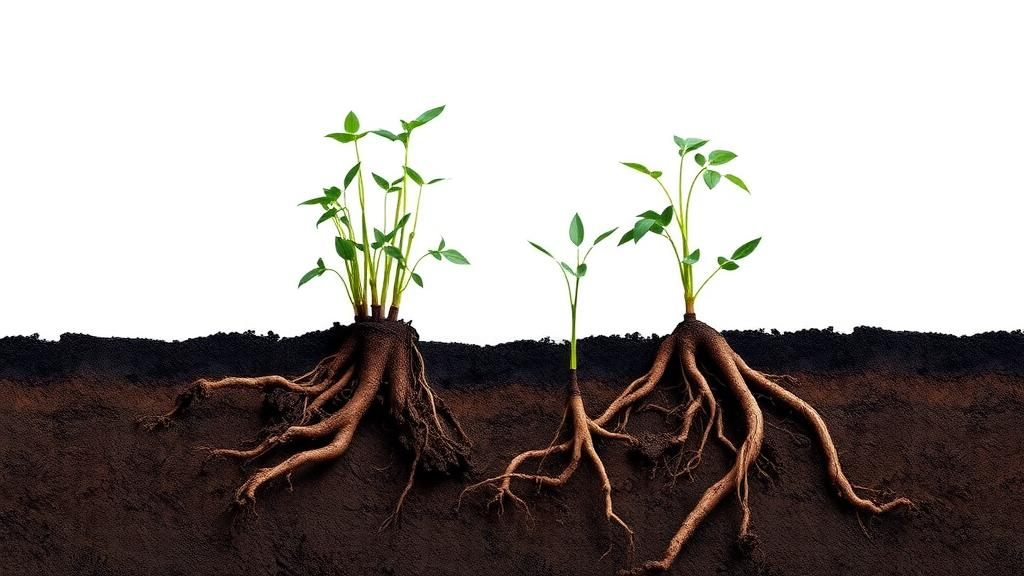
Beneath every meadow lies a hidden economy of death and renewal. Roots and rhizomes die continuously, and their decay releases carbon and nutrients back into the soil, shaping everything from grassland fertility to global carbon budgets. Yet scientists have long struggled with a deceptively simple question: when we want to measure how fast belowground plant material decomposes, which material should we actually collect? A new study published in the journal Plant and Soil by Szilvia Márta Neumann of the University of South Bohemia and colleagues tackles this methodological dilemma head-on, and its findings may change how ecologists design decomposition experiments belowground.
The problem stems from a well-known asymmetry between what we know about leaves and what we know about roots. For leaves, the rules of decomposition research are firmly established. Ecologists almost always use naturally senesced leaf litter, the brown material that falls in autumn, because plants systematically withdraw nutrients such as nitrogen and phosphorus from leaves before shedding them. This nutrient resorption means that green leaves and dead leaves differ dramatically in chemistry, and consequently in how fast microbes and detritivores can break them down. Using green leaves in a leaf decomposition experiment would give misleadingly fast decay rates. But roots do not follow the same script. Roots die underground, often without a visible signal, and researchers cannot simply wait for a root to drop the way a leaf does.
This leaves belowground ecologists with an awkward choice. Some studies use living, healthy root material, assuming it approximates dead roots well enough. Others try to induce senescence artificially, for example by withholding water and letting drought kill the plant, hoping this mimics natural root death. Still others dig up field material and sort senescing from healthy organs by eye. Each approach carries assumptions that have rarely been tested. If the choice of method systematically changes the measured decomposability, then decades of belowground decomposition data may be harder to compare than anyone realized. Neumann and her team set out to test exactly this, using four closely related sedge species from the genus Carex as their experimental subjects.
The experimental design was elegant in its simplicity. The researchers grew the sedges in pots and then applied three different ways of obtaining belowground material. In the first treatment, they induced senescence across the whole plant by imposing a drought, killing both shoots and the entire belowground system together. In the second, they used a split-pot technique: the root system was divided between two connected containers, and drought was applied to only one side, so that part of the belowground system senesced while the rest remained hydrated and healthy. This clever manipulation allowed the researchers to compare senescing and non-senescing organs within the very same individual plants, controlling for genotype and growing conditions. In the third approach, they sampled roots and rhizomes directly from the field, classifying material as senescing or healthy by its appearance, which represents the observational reality most ecologists face.
All of this material, gathered through the three routes, was then subjected to a standardized microcosm decomposition experiment, in which the plant tissues decompose under controlled conditions so that mass loss can be tracked precisely. Alongside decomposition rates, the team measured a suite of underlying tissue traits, including concentrations of carbon, nitrogen, phosphorus and potassium, the carbon-to-nitrogen ratio, and specific root length, a morphological measure of how finely branched and thin the roots are. These traits are the currency of plant ecology, thought to govern how quickly microbes can colonize and consume dead organic matter.
The headline result was surprising: for roots and rhizomes, it may not matter much whether the material is alive or dying. Across the four Carex species, the decomposability of healthy, non-senescing organs was generally comparable to that of senescing organs, for both roots and rhizomes. This stands in sharp contrast to the leaf literature, where green and senesced leaves routinely differ because of heavy nutrient resorption before leaf fall. The implication is that belowground organs may lack the dramatic pre-death chemistry shift that makes aboveground decomposition studies so methodologically sensitive. If this holds more broadly, researchers could use healthy root material as a reasonable proxy for estimating decomposability within Carex species, a considerable practical simplification, since obtaining truly senesced roots is notoriously difficult.
Yet the study also revealed that the devil is in the details of how senescence is induced. Although the overall effect sizes were small, the different senescence methods produced contrasting responses. In the split-pot treatment, where drought struck only part of the root system, senescing roots actually decomposed significantly faster than healthy ones, and they carried higher nutrient contents. The likely explanation is physiological: when only part of a plant’s belowground system is stressed, the plant may abandon that portion, withdrawing little from it or even reallocating nutrients in ways that leave the senescing roots nutrient-rich and palatable to decomposers. In field-collected samples, by contrast, senescing roots generally decomposed the slowest of all. Field senescence may reflect a different, slower process, perhaps involving older organs that have already lost nutrients over time, or material whose appearance-based classification captures a different biological state than experimentally induced drought death.
The trait analysis added a technical layer to the story. When the researchers asked which tissue characteristics best explained variation in root decomposability, potassium content emerged as the strongest single predictor, explaining most of the variability, followed by specific root length and the carbon-to-nitrogen ratio. Potassium is a highly mobile element in plant tissues, involved in osmotic regulation and enzyme activation, and its prominence here suggests that the ionic environment of decaying roots matters more than previously appreciated. The importance of specific root length echoes a growing body of work linking root economics, thin, cheap, fast-turning roots versus thick, persistent ones, to ecosystem processes. Notably, the study also found that the different senescence methods induced contrasting trait responses themselves, meaning that drought-induced senescence and field senescence do not simply produce the same tissue chemistry.
Why does this matter beyond the world of sedge specialists? Belowground organs are major contributors to carbon and nutrient cycling. Fine roots are among the largest sources of soil organic matter, and rhizomes, the horizontal underground stems of clonal plants like Carex, can persist for years before dying in bulk. Estimates of how fast this material decays feed directly into models of soil carbon storage and nutrient supply, which in turn inform predictions about climate change feedbacks and ecosystem management. If the methodological choice of healthy versus senescing material, or drought-induced versus field-collected tissue, shifts measured decomposability, then those model inputs carry hidden uncertainty. By showing that healthy material is a defensible proxy within Carex, while also documenting that senescence methods leave distinct trait fingerprints, the study gives the field both reassurance and a caution.
The authors are careful about the limits of their conclusions. The work was conducted in microcosms with four congeneric species, and the effects of senescence method, while statistically detectable, were of small magnitude. Whether the contrasting responses observed between split-pot and field material translate into meaningful differences in real-world belowground decomposition remains to be tested, and the researchers flag this as an exciting avenue for future research. Still, the study marks a rare direct comparison of experimental and observational approaches to a problem that has quietly undermined belowground ecology for decades. As climate change intensifies droughts across grasslands and wetlands, understanding how drought-induced root death alters the chemistry and decay of the material entering the soil becomes not just a technical question but a predictive one. For now, the underground half of decomposition science has gained a clearer map of its own blind spots, and a hint that, underground, death may be far less transformative than it is above.
Subject of Research: Methodological comparison of experimental and observational approaches for assessing decomposability of senescing versus healthy roots and rhizomes in Carex species
Article Title: Assessing plant belowground decomposability: comparing experimental and observational approaches
Article References: Neumann, S. M., Janíková, E., Konečná, M., Švancárová, T., Applová, M., Blažek, P., Lisner, A., Vörös, A. F., Cornelissen, J. H. C., Götzenberger, L., Lepš, J., & Segrestin, J. (2026). Assessing plant belowground decomposability: comparing experimental and observational approaches. Plant and Soil. https://doi.org/10.1007/s11104-026-09032-2
Image Credits: AI Generated
DOI: 10.1007/s11104-026-09032-2
Keywords: belowground decomposition, root senescence, drought-induced senescence, Carex, rhizomes, root traits, potassium content, specific root length, carbon-to-nitrogen ratio, split-root method, plant and soil, nutrient cycling
Cite Scienmag News
Alan Morgan. (October 14, 2026). What Happens When Roots Die? New Experiment Rethinks How We Measure Underground Decay. Scienmag. https://scienmag.com/what-happens-when-roots-die-new-experiment-rethinks-how-we-measure-underground-decay/
Alan Morgan. "What Happens When Roots Die? New Experiment Rethinks How We Measure Underground Decay." Scienmag, 14 October 2026, https://scienmag.com/what-happens-when-roots-die-new-experiment-rethinks-how-we-measure-underground-decay/. Accessed 14 October 2026.
Alan Morgan. "What Happens When Roots Die? New Experiment Rethinks How We Measure Underground Decay." Scienmag. October 14, 2026. https://scienmag.com/what-happens-when-roots-die-new-experiment-rethinks-how-we-measure-underground-decay/


