


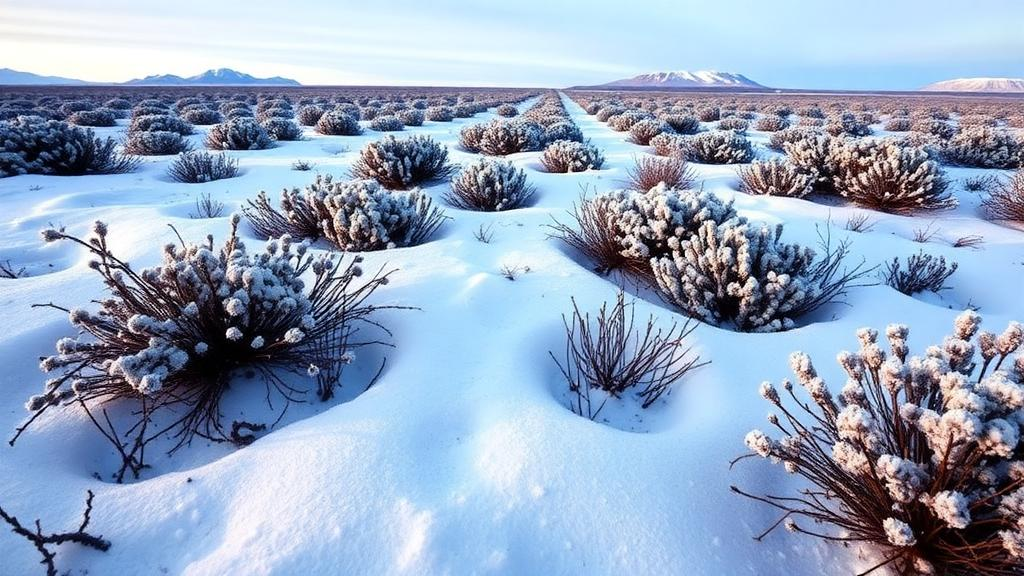
Deep beneath the snow, where Arctic temperatures plunge far below freezing and the tundra appears utterly dormant, a silent biochemical contest is underway. New research from East Greenland shows that tundra ecosystems do not shut down their nitrogen cycling when winter arrives. Instead, soil microbes and plant roots continue to capture and retain nitrogen throughout the dark months, and the outcome of this hidden competition may help decide which plants will dominate the rapidly warming Arctic. The study, published in the journal Plant and Soil, tracked a rare isotope of nitrogen through entire tundra ecosystems collected from four sites spanning roughly 1,500 kilometers of Greenland, from the High Arctic in the northeast to the Subarctic in the south.
Nitrogen is the currency of plant growth, and in the Arctic it is chronically scarce. Because the growing season is short and cold, ecologists have long assumed that nearly all nitrogen uptake happens during the brief summer. But a growing body of evidence has suggested that the long non-growing season is not biologically inert. Microbes can mineralize organic nitrogen at sub-zero temperatures, and the size of the nitrogen pulse released at spring thaw depends on what happens under the snowpack during winter. What remained unclear was whether tundra plants themselves can compete with microbes for winter nitrogen, and whether plants from different climate zones differ in this ability. The new study set out to answer both questions with an unusually direct experimental approach.
The researchers, led by Laura Helene Rasmussen of the University of Tromsø and the University of Copenhagen, together with Louise Rütting and Anders Michelsen, collected 34 intact tundra mesocosms during the summer of 2023. Each mesocosm contained the complete vegetation community, the crust organisms on the soil surface, and the soil down to 20 centimeters, preserving the living root systems of shrubs such as dwarf birch, arctic willow, crowberry, and the cushion-forming Dryas. The blocks were transported to controlled climate chambers in Copenhagen, where the team simulated the autumn freeze-in and the entire winter using light and temperature regimes matched to each site’s climate normals.
The key trick was a stable isotope tracer. Just before the simulated winter began, when soil temperatures had dropped to around 2 degrees Celsius, the team injected a tiny, highly enriched amount of nitrogen-15, in the form of ammonium sulfate, homogeneously throughout each mesocosm at 36 grid points. This labeled pulse mixed with the natural dissolved nitrogen in the soil, allowing the researchers to follow exactly where that nitrogen went. At four time points, from early winter in mid-October to late winter in mid-April, they sampled leaves, stems, fine and coarse roots, microbial biomass, and soil solution, measuring the isotope signature with isotope ratio mass spectrometry. Half of the mesocosms also received a simulated extreme winter warming event: six full days at 4 degrees Celsius in early April, mimicking the thaw episodes that are becoming more frequent across the Nordic Arctic.
The results reveal a stark hierarchy of nitrogen capture. Across all sites and all winter stages, soil microbes were the dominant players, retaining around 50 percent of the tracer nitrogen on average, with peak microbial recovery reaching 58 percent at the eastern Low Arctic site in early winter. Plant roots and aboveground biomass together took up and retained only about 3 to 8 percent of the labeled nitrogen. In total, roughly 40 to 68 percent of the early winter tracer was recovered across the measured ecosystem pools, with the remainder presumably locked in non-microbial soil fractions or lost through leaching and gaseous pathways. Microbes, in other words, are the gatekeepers of winter nitrogen, and plants must compete against them for every gram of this limiting nutrient.
Yet the plant side of the story is far from trivial, and it varies dramatically with climate. The High Arctic ecosystem, adapted to the coldest winters, captured the least nitrogen overall, leaving more of the tracer in soil solution during early winter. The Low Arctic sites kept the most nitrogen in their roots, and at the eastern site, root nitrogen concentrations actually increased steadily as winter progressed, suggesting that plants there are physiologically equipped to keep absorbing nutrients throughout the cold season. Most striking was the Subarctic: plants from the southern site allocated more tracer nitrogen to aboveground biomass than any other site, particularly into the stems of deciduous shrubs, while efficiently depleting nitrogen from the soil solution. This pattern supports the idea that vegetation adapted to milder winters runs a tighter nitrogen cycle and is better positioned to exploit the nitrogen that warmer winters release.
Plant functional type mattered as much as climate. Evergreen shrubs, which hold their leaves through the winter, retained more winter-released nitrogen overall than deciduous shrubs and bryophytes, storing much of it in their leaves. Deciduous shrubs, by contrast, concentrated their winter nitrogen in stems, a strategic placement that could fuel rapid leafing out in spring. When the researchers normalized for biomass, a different picture emerged: arctic willow, Salix arctica, was the most efficient nitrogen scavenger per gram of tissue, followed by dwarf birch and the dwarf willow Salix herbacea. Crowberry, Empetrum nigrum, dominated nitrogen uptake per unit ground area simply because of its sheer biomass, but per unit mass it was actually inferior to most other shrubs. Grasses, though poor competitors per unit area, outperformed several shrubs per gram of biomass, hinting that they too could benefit from nitrogen released in warmer early winters.
The simulated winter warming event delivered a sobering message about climate extremes. At the High Arctic site, the six-day warm spell reduced plant nitrogen uptake while boosting microbial immobilization, leaving less nitrogen available in the soil solution. The same pattern, at larger scale, had been observed in previous field studies, and related work has shown that freeze-thaw cycling can cut root nitrogen uptake dramatically and retard root growth. Because the warming event was imposed without adding snowmelt water, the effect reflects temperature alone, and soil moisture remained essentially unchanged. The implication is that High Arctic vegetation, having evolved under stable, deeply frozen winters, is the most sensitive to the destabilizing thaw events that climate models project will become more common, while Subarctic plants, which already experience such events, appear better buffered.
These findings carry weighty implications for how the Arctic will change. Shrub expansion, the so-called shrubification of the tundra, is one of the most visible signatures of Arctic warming, visible even from satellites. The new results suggest that this expansion is not driven only by longer growing seasons and warmer summers, but also by below-ground competition during winter. Species such as dwarf birch and arctic willow, which can capture nitrogen released during freeze-in and early winter, may gain a competitive edge as winters warm and more nutrients become available in the cold season. Because nitrogen availability ultimately constrains how much carbon the tundra can sequester, the winter nitrogen economy also feeds directly into predictions of the future Arctic carbon sink, a critical uncertainty in global climate models.
The study also underscores that simple measures such as root biomass cannot explain winter nitrogen uptake on their own. The Subarctic sites achieved the highest aboveground nitrogen capture despite relatively low root biomass, pointing to the importance of root efficiency, species-specific traits, and the legacy of adaptation to different winter regimes. The authors conclude that species-level strategies must be built into models of Arctic tundra nitrogen and carbon dynamics, rather than lumping vegetation into broad functional categories. As winters across the Arctic grow milder and more erratic, the invisible contest between roots and microbes under the snow may prove to be one of the decisive forces shaping which plants will green the landscape of the twenty-first century Arctic, and how much carbon that landscape will hold.
Subject of Research: Winter nitrogen uptake by plants and microbes along an Arctic climate gradient in East Greenland
Article Title: Winter climate or plant functional type? Controls on tundra winter nitrogen uptake along an Arctic climate gradient in East Greenland
Article References: Rasmussen, L. H., Rütting, L., & Michelsen, A. (2026). Winter climate or plant functional type? Controls on tundra winter nitrogen uptake along an Arctic climate gradient in East Greenland. Plant and Soil. https://doi.org/10.1007/s11104-026-09022-4
Image Credits: AI Generated
DOI: 10.1007/s11104-026-09022-4
Keywords: Arctic tundra, nitrogen cycling, winter ecology, nitrogen-15 tracer, soil microbes, shrubification, climate gradient, Greenland, plant functional types, winter warming events, dwarf birch, arctic willow
Cite Scienmag News
Gavin Prescott. (October 13, 2026). Arctic plants quietly feed on nitrogen all winter, and microbes grab most of it first. Scienmag. https://scienmag.com/arctic-plants-quietly-feed-on-nitrogen-all-winter-and-microbes-grab-most-of-it-first/
Gavin Prescott. "Arctic plants quietly feed on nitrogen all winter, and microbes grab most of it first." Scienmag, 13 October 2026, https://scienmag.com/arctic-plants-quietly-feed-on-nitrogen-all-winter-and-microbes-grab-most-of-it-first/. Accessed 13 October 2026.
Gavin Prescott. "Arctic plants quietly feed on nitrogen all winter, and microbes grab most of it first." Scienmag. October 13, 2026. https://scienmag.com/arctic-plants-quietly-feed-on-nitrogen-all-winter-and-microbes-grab-most-of-it-first/


