


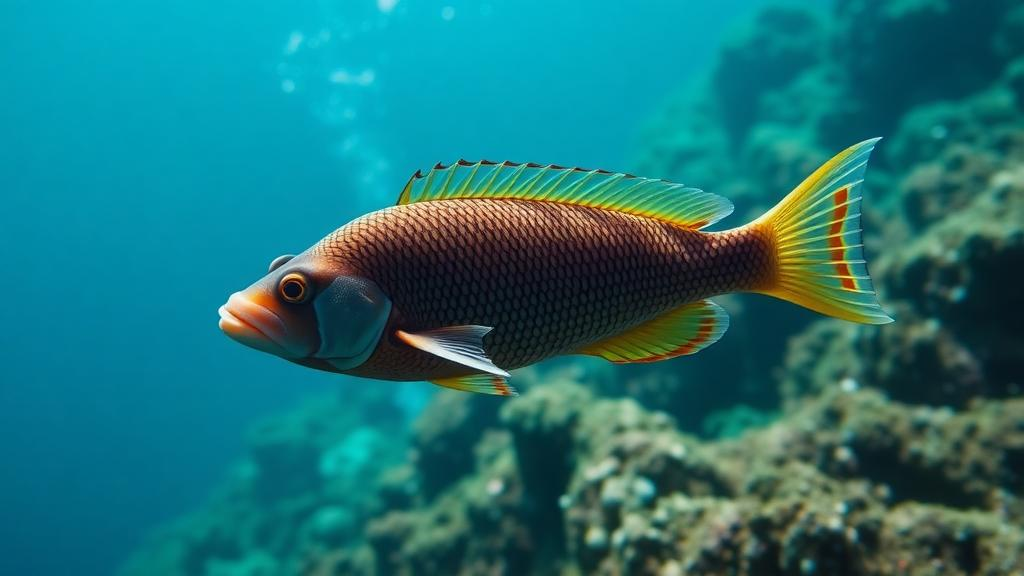
On the subtropical island of Okinawa, Japan, a small blue damselfish has become an unexpected messenger about what it means to live in an urbanised ocean. In a large-scale study published in Nature Communications, researchers led by Emma Gairin and Vincent Laudet of the Okinawa Institute of Science and Technology applied a framework known as landscape transcriptomics to read the molecular diaries of wild fish across a coastline transformed by human activity. By sequencing the gene expression of hundreds of blue damselfish, Chrysiptera cyanea, sampled at eighteen coastal sites spanning a gradient from relatively pristine northern reefs to heavily urbanised southern shores, the team uncovered a striking paradox: fish living near cities appear to be better fed than their rural counterparts, yet they carry the molecular hallmarks of chronic stress, elevated immunity, and inflammation.
The central challenge the researchers set out to address is one that has long frustrated ecologists. Traditional environmental monitoring tracks water quality and community composition, while laboratory toxicology exposes model organisms to one or a few stressors under controlled conditions. Neither approach captures the cocktail of pressures that wild animals actually experience, from chemical pollutants and pharmaceuticals to habitat loss and thermal extremes. Gene expression offers a way through this impasse, because shifts in transcriptomes can precede visible physiological damage, acting as early warning signals of disease, reduced fitness, or population decline. Landscape transcriptomics extends this logic to entire environments, asking how genome-wide expression patterns reflect the dynamic drivers operating across a real landscape.
The choice of study species was deliberate. The blue damselfish is one of the most abundant fish along Okinawa’s coastline, occupying shallow reefs, rubble flats, and tide pools from urban river mouths to isolated beaches. Its territorial habits mean that adults integrate local conditions over long periods, while juveniles offer a snapshot of organism-wide responses. The team collected five juveniles and four to five adults at each of the eighteen sites between May and July 2023, preserving whole bodies of the young fish and livers of the adults for RNA sequencing. Crucially, variant calling on the juvenile transcriptomes revealed no significant population structure across the island, meaning that any differences in gene expression could be attributed to environment rather than underlying genetic divergence.
The scale of the environmental signal was remarkable. Principal component analysis showed that samples from the same site clustered tightly, with site explaining a large share of expression variance in both juveniles and adults. Juveniles displayed broad transcriptional plasticity, with 2,410 genes differentially expressed in more than a quarter of all pairwise site comparisons, while adult livers showed more site-specific, fine-tuned patterns involving 251 genes. This developmental contrast suggests a transition from early flexibility to specialised, long-term molecular programmes as fish mature, with adult livers, the central organ of energy metabolism and detoxification, encoding the accumulated experience of a particular stretch of coast.
To make such high-dimensional data ecologically interpretable, the team developed a visualisation framework based on radar plots, built with their RadarOmics approach. Each plot summarises the status of an individual fish across curated gene sets covering satiety signalling, glycolysis, beta-oxidation, the tricarboxylic acid cycle, fatty acid and cholesterol synthesis, thyroid hormone signalling, the stress axis, heat shock proteins, immunity, reactive oxygen species, and xenobiotic metabolism. Fish from similar environments produced consistent profiles, and the plots captured specific local stories, such as heat shock markers in fish exposed to water above 31.9 degrees Celsius at two sites, and a bimodal phototransduction signature in juveniles depending on whether they were sampled in the morning or afternoon.
The most striking finding emerged when the researchers connected field transcriptomes to a laboratory fasting-feeding experiment. Juveniles were fasted or fed normally for three days, adults for fourteen, and the genes driving the separation between fed and fasted states were enriched in energy balance processes, including lipid and carbohydrate metabolism and glucose homeostasis. Projecting wild fish onto this experimental axis yielded a feeding status proxy for every individual. Adults sampled near urban zones showed significantly higher feeding status, and their livers overexpressed genes such as the insulin receptor beta and ppargc1a, markers of insulin resistance and energy surplus. Metatranscriptomic analysis of non-host reads in juvenile samples reinforced the picture, revealing more tunicates, ctenophores, and algae in the diets of fish predicted to be well fed.
This energy-rich urban diet, however, comes at a price. The researchers propose that urban coastlines function as ecological traps of a kind, attracting fish with abundant food while simultaneously imposing chronic stress. Adults from urbanised sites showed upregulation of genes involved in inflammation, carcinogenesis, reactive oxygen species, and immune signalling, including interleukins, chemokines, and toll-like receptor pathways. Similar patterns have been reported in urban birds, where immune activation was coupled with lipid-rich diets, hinting that the trade-off between nutritional opportunity and physiological cost may be conserved across vertebrate taxa. In juveniles, by contrast, immune and stress responses tracked nutrition rather than human presence, with energetically costly processes such as neurotransmission and immune defence suppressed under low-food conditions even in urban environments.
Perhaps the most consequential result for environmental monitoring is a negative one. Canonical pollution biomarkers, genes of endocrine signalling, xenobiotic metabolism, and stress, failed to show clear associations with urbanisation. Instead, many responded to temperature, feeding status, sampling time, or fish size. Temperature emerged as the strongest single driver overall, with 1,854 genes in juveniles and 1,312 in adult livers responding exclusively to it, and excluding the four warmest sites reduced temperature-associated genes by almost two-thirds. When the team modelled expression against all measured factors, they isolated 425 genes in juveniles and 585 in adult livers associated uniquely with the percentage of natural habitat within one kilometre of each site, a robust set of candidate diagnostic markers of human-related stress that survived sensitivity testing.
The implications reach well beyond Okinawa. The study demonstrates that single-marker, qPCR-based monitoring may capture confounding factors such as food availability or temperature rather than the pollution signals they were designed to detect, and it argues for a transition toward genome-wide, context-aware assessments of organismal condition. The authors frame their approach as a step toward environmental phenotyping, in which transcriptomes of sentinel species, combined with laboratory reference signatures and public toxicogenomic databases, become scalable tools for diagnosing ecosystem health. Because gene expression changes can reveal sublethal stress before populations decline, such molecular baselines could allow managers to detect compensatory effects before they become irreversible consequences.
For now, the blue damselfish of Okinawa offers a vivid lesson in the hidden biology of urban seascapes. The fish crowding city-adjacent reefs are not simply thriving on human subsidies nor simply succumbing to pollution; they are negotiating a complex physiological bargain in which abundant food fuels the very stress responses that urban life demands. Landscape transcriptomics, by making that bargain visible at the level of individual genes and pathways, opens a window onto the invisible constraints that anthropogenic change imposes on wild animals, and provides a template for reading similar molecular stories in ecosystems under pressure around the world.
Subject of Research: Landscape transcriptomics of coral reef fish responses to coastal urbanisation in Okinawa, Japan
Article Title: Landscape transcriptomics reveals ecological constraints on fish under anthropogenic coastal change
Article References: Gairin, E., Miura, S., Chamot, Z., Sautereau, C. A., Zwahlen, J., Takamiyagi, H., Gibert, Y., Herrera, M., & Laudet, V. (2026). Landscape transcriptomics reveals ecological constraints on fish under anthropogenic coastal change. Nature Communications, 17(1), Article 10218. https://doi.org/10.1038/s41467-026-77751-2
Image Credits: AI Generated
DOI: 10.1038/s41467-026-77751-2
Keywords: landscape transcriptomics, coral reef fish, urbanisation, Chrysiptera cyanea, Okinawa, gene expression, ecotoxicology, feeding status, pollution biomarkers, marine ecology, chronic stress, environmental monitoring
Cite Scienmag News
Juliet Wilcox. (October 13, 2026). Urban Coasts Leave Molecular Fingerprints on Reef Fish, Landmark Study Shows. Scienmag. https://scienmag.com/urban-coasts-leave-molecular-fingerprints-on-reef-fish-landmark-study-shows/
Juliet Wilcox. "Urban Coasts Leave Molecular Fingerprints on Reef Fish, Landmark Study Shows." Scienmag, 13 October 2026, https://scienmag.com/urban-coasts-leave-molecular-fingerprints-on-reef-fish-landmark-study-shows/. Accessed 13 October 2026.
Juliet Wilcox. "Urban Coasts Leave Molecular Fingerprints on Reef Fish, Landmark Study Shows." Scienmag. October 13, 2026. https://scienmag.com/urban-coasts-leave-molecular-fingerprints-on-reef-fish-landmark-study-shows/


