


Every autumn, thousands of biomedical engineering students walk across graduation stages clutching degrees that certify their mastery of circuits, biomechanics, and biomaterials. Yet a growing body of evidence suggests that the technical transcript, however impressive, is no longer the deciding factor in whether a young engineer thrives in the medical device and biotechnology sectors. A new teaching-focused study published in Biomedical Engineering Education by Kelly J. Vazquez of Wheaton College and Richard K. P. Benninger of the University of Colorado-Denver argues that the profession has been overlooking a competency that may matter more than any single laboratory technique: professional resiliency, the capacity to absorb setbacks, adapt to ambiguity, and keep performing when real-world projects inevitably go sideways.
The authors frame their argument around a challenge statement that will resonate with anyone who has hired, or been, a first-year engineer. Undergraduate programs pour enormous energy into technical expertise, and rightly so, because employers still expect graduates to read schematics, interpret data, and understand regulatory constraints. But surveys of employer expectations and studies of the school-to-work transition consistently reveal a misalignment between what early-career engineers believe constitutes engineering expertise and what industry actually demands. Engineering work in practice is social, iterative, and frequently interrupted by failure. A design review can demolish months of effort in an afternoon. A regulatory submission can bounce back with a stack of deficiencies. Graduates trained primarily to execute well-defined academic assignments often find that the emotional and professional texture of industrial work was never part of the syllabus.
What makes the new framework notable is that it treats resiliency not as a personality trait students either possess or lack, but as a trainable professional competence that can be scaffolded across an entire undergraduate curriculum. The authors draw on a rich literature spanning resilience engineering in healthcare systems, psychological research on resilience enhancement in adults, and engineering education studies of design thinking. In the resilience engineering tradition, resilience is understood as the ability of a system to anticipate, absorb, and adapt to disturbances while continuing to function. Translated to the individual engineer, that means tolerating failed prototypes, revising assumptions under deadline pressure, and communicating honestly when a project slips. Psychological studies add that resilience can be strengthened through deliberate practice, reflective habits, and graduated exposure to manageable adversity, precisely the structure a well-designed curriculum can provide.
The framework begins in the first year, which the authors identify as the pivotal on-ramp. Rather than deferring design until a senior capstone, students encounter an introductory engineering design course immediately, one that normalizes iteration and failure from the outset. The pedagogical logic is grounded in decades of design education research showing that novice and expert engineers approach design problems in qualitatively different ways, and that early, structured exposure to open-ended problems accelerates the development of expert-like design processes. First-year students learn to define problems, brainstorm without attachment to their first idea, build rough prototypes, test them, and document what broke. Each cycle is a low-stakes rehearsal for the high-stakes failures of professional practice, and each recovery builds what education researchers call self-efficacy, the belief in one’s own capability to organize and execute the actions required to manage a task.
Self-efficacy is the study’s central measurable outcome, and the authors report that their data suggest introductory design courses, exposure to research opportunities, and team-based design projects led to improved self-efficacy and industry preparation among undergraduate biomedical engineers. This matters because self-efficacy is not mere confidence; it is a well-characterized psychological construct that predicts persistence in the face of difficulty. A student who has watched a fluidic device clog, diagnosed the failure, and rebuilt it is measurably more likely to persist through an industrial project crisis than a student who has only ever seen successful demonstrations. The framework deliberately engineers these experiences, sequencing them so that difficulty escalates as competence grows, following the scaffolded approach that has become standard in evidence-based curriculum design.
The second pillar of the framework is the transition from bench research at the student’s home institution to internships in industry, a pathway the authors describe as increasingly competitive. Internships have become the de facto gatekeepers of biomedical engineering careers, yet the skills that win a research assistantship in a university laboratory overlap only partially with those that secure a position at a medical device firm. The framework therefore treats the internship search itself as a design problem to be taught: students learn to translate academic project experience into industry-relevant narratives, to articulate teamwork and communication competencies alongside technical ones, and to present failed experiments as evidence of problem-solving rather than as liabilities. The authors outline a progression in which hands-on experience is layered deliberately, so that by the time students apply for industrial placements they have already practiced the professional behaviors those placements demand.
Teamwork receives particular emphasis, and for good reason. Biomedical products are built by cross-disciplinary teams of engineers, biologists, clinicians, regulatory specialists, and business strategists, and studies of workplace data on twenty-first-century STEM competencies consistently rank collaboration and communication among the most valued skills. The framework embeds team design projects throughout the curriculum, requiring students to navigate the same interpersonal frictions, unequal workloads, and conflicting technical opinions they will encounter professionally. The authors also address what education scholars call the hidden curriculum, the unwritten norms and professionalization pressures that shape how students learn to behave as engineers, arguing that making these norms explicit, including ethical reasoning and reflection, produces graduates who are not only skilled practitioners but thoughtful leaders committed to serving society with integrity and purpose.
Assessment in the framework relies on tools familiar to education researchers but underused in engineering programs. The authors describe the use of reflective instruments, including minute-paper style exercises in which students briefly record what they learned and where they struggled, allowing instructors to track the evolution of student perspectives across the academic journey from cornerstone to capstone. This longitudinal view is essential because research comparing freshman and senior design processes shows that growth in design thinking is gradual and uneven, and because studies of capstone courses alone suggest that a single culminating experience cannot compensate for four years without embedded professional skill development. By measuring self-efficacy repeatedly, the framework can identify which curricular interventions actually move the needle, rather than relying on end-of-program surveys that capture only a snapshot.
The broader significance of the work lies in its reframing of what biomedical engineering education owes its students. Accreditation bodies such as ABET have long required design content, and debates within the field have clarified why research experience cannot substitute for design experience in preparing students for clinical and industrial realities. But the Wheaton and Colorado-Denver framework goes further, arguing that design courses are not merely a vehicle for technical competence but the ideal training ground for professional resilience, because design is inherently a cycle of proposal, failure, revision, and persistence. In an industry where products take years to clear development and regulatory hurdles, and where the first prototype almost never ships, graduates who can metabolize failure quickly may be the single most valuable asset a company can hire.
The authors distill their aspiration into two postgraduation outcomes: that students will be prepared for professional endeavors and will demonstrate readiness for real-world challenges. Achieving those outcomes, they suggest, requires the kind of deliberate, scaffolded, four-year architecture their framework describes, one that starts with a first-year design course, weaves in research exposure and team projects, and treats resilience as a competency to be built rather than assumed. For faculty designing curricula, the message is that the path from bench to business runs not only through technical mastery but through the accumulated experience of failing, recovering, and trying again in an environment engineered to make that practice safe. For students, the message is equally direct: the setbacks you encounter in your first-year design course are not obstacles to your education. They are the education.
Subject of Research: Professional resilience training in undergraduate biomedical engineering curricula
Article Title: Bench to Business? Preparing Undergraduate Engineers for Careers in Biomedical Industry
Article References: Bench to Business? Preparing Undergraduate Engineers for Careers in Biomedical Industry. (n.d.). https://doi.org/10.1007/s43683-026-00253-6
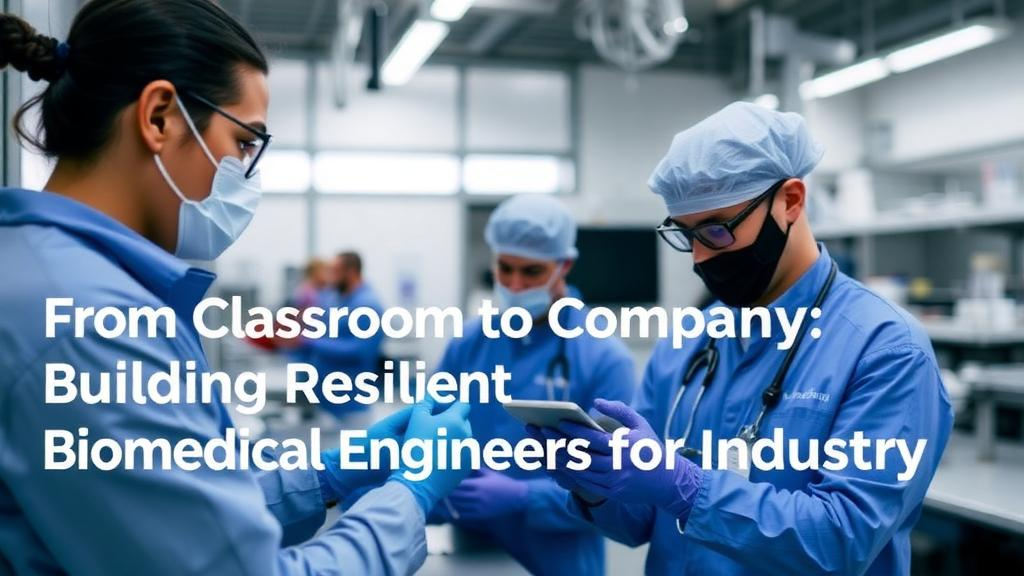
Image Credits: AI Generated
DOI: 10.1007/s43683-026-00253-6
Keywords: biomedical engineering, engineering education, professional resilience, self-efficacy, design curriculum, undergraduate, internships, scaffolding, team-based learning, ABET accreditation, capstone design, industry readiness
Cite Scienmag News
Ophelia Keating. (October 13, 2026). From Classroom to Company: Building Resilient Biomedical Engineers for Industry. Scienmag. https://scienmag.com/from-classroom-to-company-building-resilient-biomedical-engineers-for-industry/
Ophelia Keating. "From Classroom to Company: Building Resilient Biomedical Engineers for Industry." Scienmag, 13 October 2026, https://scienmag.com/from-classroom-to-company-building-resilient-biomedical-engineers-for-industry/. Accessed 13 October 2026.
Ophelia Keating. "From Classroom to Company: Building Resilient Biomedical Engineers for Industry." Scienmag. October 13, 2026. https://scienmag.com/from-classroom-to-company-building-resilient-biomedical-engineers-for-industry/


