


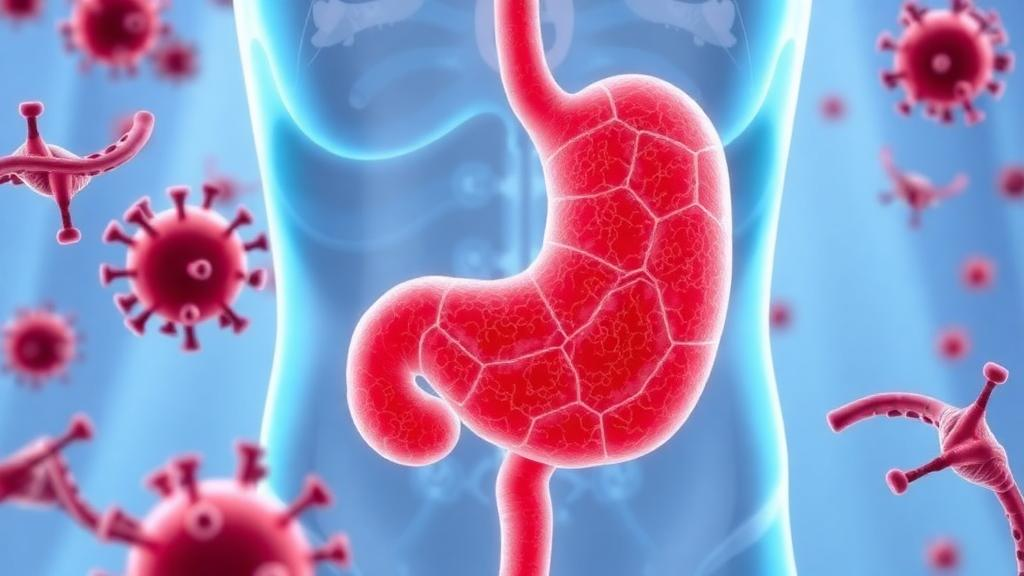
Gastric cancer remains one of the most frequently diagnosed malignancies and a leading cause of cancer-related death worldwide, and for decades the bacterium Helicobacter pylori has dominated the conversation about what drives it. Now a team of Japanese researchers has added a striking new dimension to that picture, showing that the risk of developing stomach cancer does not simply add up from separate factors—it multiplies when a person’s inherited genetic makeup collides with a particular community of non-H. pylori stomach bacteria. In a study published in the Journal of Translational Medicine, investigators led by Tsubasa Shimogama and Tomomitsu Tahara of Kansai Medical University report that individuals who carry both a high-risk gastric microbiome signature and two well-known genetic risk variants face an odds ratio of 23.55 for gastric cancer compared with non-cancer controls, a figure far exceeding the risk conferred by either factor alone.
The research draws on a cohort of 620 subjects, including 219 patients with gastric cancer and more than 400 non-cancer individuals, among them 103 peptic ulcer patients and 299 controls without ulcers. From this group, the team defined a microbiome-based cancer risk using 47 specific bacterial taxa that they had previously shown to be significantly altered between gastric cancer patients and non-ulcer controls. A microbiome index above 0.25 classified a subject as carrying the high-risk microbial signature. In parallel, genetic risk was defined by the presence of two single nucleotide polymorphisms that genome-wide association studies in the Japanese population had linked to gastric cancer susceptibility: rs2294008 in the PSCA gene and rs4072037 in the MUC1 gene. Individuals carrying both the PSCA T/T and MUC1 A/A risk genotypes were classified as genetically predisposed.
The results were unambiguous. People whose gastric microbiomes carried the high-risk signature alone showed an odds ratio of 11.16 for gastric cancer, while those with the high-risk genotype alone showed an odds ratio of 2.76. But when both factors were present, the odds ratio climbed to 23.55—a synergistic leap that suggests the two risk factors interact biologically rather than acting independently. Crucially, the researchers found no association between the prevalence of the high-risk genotypes and the microbiome index itself, which argues against the possibility that one factor simply confounds the other. Instead, the data point to a genuine functional interplay between host genetics and the microbial ecosystem lining the stomach.
The synergy extended beyond cancer diagnosis to specific disease subtypes. The combination of risk genotypes and high-risk microbiome was associated with an odds ratio of 29.67 for intestinal-type gastric cancer and an even higher odds ratio of 30.72 for advanced-stage disease, compared with non-cancer controls. These are among the strongest risk signals ever reported for combined host-microbiome profiling in gastric carcinogenesis, and they suggest that the interaction between inherited susceptibility and bacterial community structure may be particularly consequential for the slower, inflammation-driven pathway that produces the intestinal type of the disease.
To probe the biology behind these statistics, the researchers examined somatic changes in the gastric mucosa—alterations that accumulate in stomach tissue itself over years of injury and repair. Three markers stood out: the histological severity of intestinal metaplasia, a precancerous transformation of the stomach lining; the accumulation of DNA methylation, an epigenetic change long associated with H. pylori infection and cancer risk; and telomere shortening, an indicator of rapid cell turnover and oxidative stress that has been implicated in tumor development. Across all three measures, the team observed a stepwise increase in severity according to the combined burden of genetic and microbial risk. Individuals with both risk factors showed the highest degrees of intestinal metaplasia and DNA methylation and the shortest telomeres, painting a molecular portrait of a stomach pushed progressively toward malignancy.
These findings suggest a plausible mechanistic narrative. The PSCA rs2294008 T allele and the MUC1 rs4072037 A allele both alter upstream promoter activity of their respective genes—PSCA encodes a glycosylphosphatidylinositol-anchored cell surface antigen, while MUC1 encodes a membrane-bound mucin protein—and both variants have been shown to confer susceptibility to gastric cancer, particularly the diffuse type. The new work implies that when these genetic variants are present, the cancer-predisposing microbial community may sustain or amplify the genotoxic changes that H. pylori infection initiates, promoting long-term tumorigenesis even as the initial infection evolves. In other words, the bacteria may not merely be passengers in an inflamed stomach; they may be active collaborators with the host genome in driving cells toward cancer.
Support for this idea comes from the team’s earlier work, which characterized gastric microbiome signatures across a large Japanese cohort and identified community-wide bacterial networks tied to cancer risk and progression. That study found that the cancer-predisposing microbiome signature is significantly associated with decreased levels of superoxide reductase and superoxide dismutase, enzymes that protect cells from oxidative damage. The suppression of these antioxidant defenses would leave the gastric epithelium exposed to heightened oxidative stress, creating exactly the kind of environment in which DNA methylation errors accumulate and telomeres erode. The authors caution, however, that the precise mechanisms by which the predisposing microbiome promotes tumorigenesis in the presence of PSCA and MUC1 risk genotypes remain to be fully elucidated, and they call for well-designed in vivo and ex vivo studies to clarify these host-microbe interactions.
The clinical implications are considerable, particularly for East Asian populations. More than half of the Japanese population carries both risk genotypes, which means that genetic testing alone would flag a large swath of people without meaningfully narrowing down who is truly at risk. The new findings suggest that layering microbiome profiling on top of the two SNPs could dramatically improve risk stratification, identifying a much smaller subpopulation in which the two risk factors converge and whose members might benefit from intensified endoscopic surveillance or targeted eradication strategies. Because gastric cancer is frequently diagnosed at advanced stages, when survival rates plummet, any tool that reliably identifies high-risk individuals before symptoms appear could translate into earlier detection and saved lives.
The study also reframes the role of the non-H. pylori gastric microbiota in cancer biology. While H. pylori infection remains the dominant established risk factor for gastric tumorigenesis, metagenomic studies in recent years have revealed that a diverse community of other bacteria resides in the gastric mucosa and that dysbiotic, cancer-associated microbial communities exist independently of the famous pathogen. What has been missing is evidence that this broader ecosystem interacts with host genetics to shape disease outcomes. The Japanese cohort now provides that evidence in quantitative form, demonstrating that the microbiome is not a passive bystander but a partner in a synergistic relationship that can multiply cancer risk more than twentyfold.
Limitations and open questions remain. The study was conducted in a Japanese cohort, and the two SNPs examined were identified through genome-wide association studies in that population, so generalization to other ethnic groups will require replication. The microbiome index was built from 47 bacterial taxa whose functional roles in carcinogenesis are only beginning to be understood, and the cross-sectional design cannot fully disentangle whether the predisposing microbiome is a cause or a consequence of the mucosal changes it accompanies. Still, the convergence of microbial signatures, host genotypes, and somatic molecular markers—methylation, telomere attrition, and metaplasia—into a single coherent risk model marks a significant advance. If larger prospective studies confirm the synergy reported here, the combination of a simple genetic test with gastric microbiome profiling could become a practical diagnostic tool, ushering in an era in which stomach cancer prevention is tailored not just to who patients are, but to what lives inside them.
Subject of Research: Interaction between gastric microbiome composition and host PSCA/MUC1 genetic variants in predisposition to gastric cancer
Article Title: Synergistic effect of gastric microbiome and host genetic factor predispose to gastric cancer
Article References: Synergistic effect of gastric microbiome and host genetic factor predispose to gastric cancer. (n.d.). https://doi.org/10.1186/s12967-026-09009-w
Image Credits: AI Generated
DOI: 10.1186/s12967-026-09009-w
Keywords: gastric cancer, gastric microbiome, Helicobacter pylori, PSCA, MUC1, single nucleotide polymorphisms, DNA methylation, telomere shortening, intestinal metaplasia, risk stratification, host-microbe interaction, oxidative stress
Cite Scienmag News
Juliet Wilcox. (October 13, 2026). Stomach Microbes and Genes Team Up to Skyrocket Gastric Cancer Risk. Scienmag. https://scienmag.com/stomach-microbes-and-genes-team-up-to-skyrocket-gastric-cancer-risk/
Juliet Wilcox. "Stomach Microbes and Genes Team Up to Skyrocket Gastric Cancer Risk." Scienmag, 13 October 2026, https://scienmag.com/stomach-microbes-and-genes-team-up-to-skyrocket-gastric-cancer-risk/. Accessed 13 October 2026.
Juliet Wilcox. "Stomach Microbes and Genes Team Up to Skyrocket Gastric Cancer Risk." Scienmag. October 13, 2026. https://scienmag.com/stomach-microbes-and-genes-team-up-to-skyrocket-gastric-cancer-risk/


