


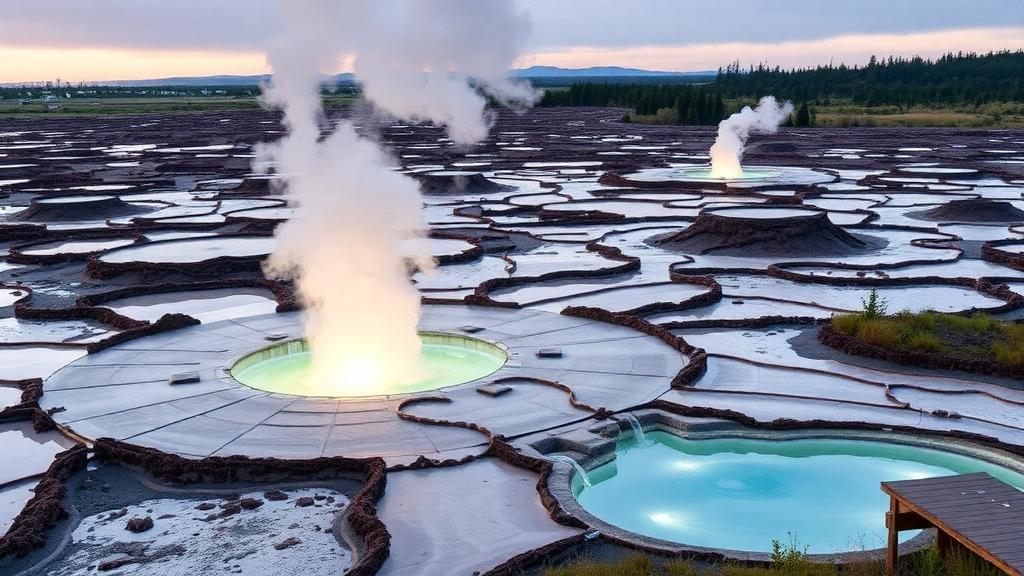
Geothermal energy occupies a paradoxical position in the clean energy transition. It is one of the few renewable sources that delivers electricity around the clock, independent of weather, with global installed capacity of roughly 18 gigawatts electrical and capacity factors that most solar and wind farms can only envy. Yet after decades of development, geothermal remains a rounding error in world electricity supply, held back by punishing capital costs, exploration failures and the operational hazards of managing reservoirs kilometres underground. Artificial intelligence has been pitched as the technology that could finally break this logjam, and a new systematic evidence map published in Earth Science Informatics has now subjected that pitch to the most rigorous audit to date. The verdict is sobering: the field is awash with algorithms, but starved of proof.
Researchers Füsun S. Tut Haklidir of Istanbul Bilgi University and Mehmet Haklidir of TÜBİTAK BİLGEM’s Artificial Intelligence Institute conducted a PRISMA-guided systematic review that began with 8,113 records from Scopus and Web of Science. After screening, 874 reports were assessed at full text, and 626 peer-reviewed journal articles published between 1987 and 2026 made the final cut, resolving to 620 independent evidence units. What distinguishes this effort from the many narrative reviews that have preceded it is the discipline of the data extraction. Every included article received a full-text-grounded coding record produced under rules frozen before production use, and every quantitative value was tied to a page or section locator. Readiness ratings were not assigned by a reader’s judgement but derived deterministically from the coded fields, meaning anyone can reproduce every assignment from the supplementary data, which the authors have archived openly on Zenodo.
The headline finding is a stark gap between enthusiasm and evidence. Two thirds of the classifiable corpus is evaluated on simulation data, synthetic data, laboratory experiments, or field data without a meaningful held-out design. In practical terms, most published AI models for geothermal applications have never been tested on data they were not built on. Evaluation on data external to the development set, the gold standard for demonstrating that a model generalises beyond its training conditions, is reported in just 42 of the 614 articles where the question could be determined. Only three articles report a controlled pilot in a real plant, and not a single study documents shadow operation, where an algorithm runs alongside live plant control without acting on it, or routine deployment. After nearly four decades of research, the pipeline from paper to power plant remains essentially empty.
The maturity picture is far from uniform, however, and this is where the evidence map delivers its most actionable insights. The authors split the literature into use cases spanning the full geothermal lifecycle, from exploration through drilling to surface conversion and reservoir management. Exploration, with 183 articles, is the most advanced: more than half of those studies reach field evaluation, because exploration datasets such as geochemistry, geophysics and remote sensing are comparatively accessible and the cost of a wrong prediction is a dry hole rather than a damaged plant. Surface conversion, covering power cycle modelling, optimisation and control, contributes 179 articles but only four reach field evaluation, since these models are typically trained and tested on thermodynamic simulations of organic Rankine or Kalina cycles rather than on live plant telemetry.
This stage-specific pattern has a clear technical logic. Exploration problems are often static prediction tasks, such as estimating reservoir temperature from hydrogeochemical composition, where neural networks can be trained on databases of well measurements and validated against wells withheld from training. Studies from Western Anatolia in Turkey, the Great Basin in the United States and northern Morocco exemplify this genre, using machine learning to predict reservoir temperatures and map geothermal prospects. The inputs are tabular, the targets are measurable, and the validation is straightforward in principle. By contrast, operational problems such as scale management, wellbore flow prediction and plant control involve dynamic, safety-critical systems where a model error carries immediate physical consequences, and where operators are understandably reluctant to hand control to an unvalidated algorithm.
One of the review’s most striking findings concerns the divergence between two dimensions of progress that are often conflated. Transferability, meaning demonstrated performance on data external to the development set, and operational integration, meaning pilots and deployment, do not advance together. The few controlled pilots and the handful of external validations sit in different use cases, so neither axis can be read as a proxy for the other. A model can be rigorously validated on external data yet never tested in a plant, or trialled in a plant without ever having been validated on independent data. The authors therefore report these two dimensions on separate axes rather than collapsing them into a single readiness score, a methodological choice that owes something to the technology readiness level frameworks developed by NASA and standardised by the International Organization for Standardization, but adapted to the specific evidentiary demands of machine learning systems.
The temporal trends reveal a subtle and somewhat troubling dynamic. The share of articles reaching field evaluation rose from 13 per cent in 2018 to 43 per cent in 2025, which sounds like a success story. But externally validated work remained in single figures each year over the same period. In other words, access to field data is spreading faster than demonstrated transfer. More researchers are getting their hands on real plant and reservoir data, and more are labelling their work as field-based, yet the proportion who can show their models work on data they never saw has barely moved. This pattern suggests that the field-evaluation label is being applied to studies that use field data for training and testing on the same wells or the same plant, a practice that inflates apparent performance and masks overfitting to site-specific conditions.
The technical reasons for this validation deficit are worth unpacking. Geothermal datasets are small, proprietary and heterogeneous. A single field might yield a few dozen wells with complete geochemical and geophysical characterisation, and neighbouring fields can differ profoundly in geology, fluid chemistry and reservoir behaviour. Models trained on Western Anatolia data may fail on the Salton Sea, not because the algorithms are weak but because the underlying physics and chemistry differ. Techniques such as generative adversarial networks for synthesising hydrogeochemical data, explored by the same research group at Stanford geothermal workshops, attempt to address the data scarcity problem, but synthetic data cannot substitute for genuine external validation. The review’s authors point to reporting frameworks developed in other domains, including the TRIPOD+AI and PROBAST+AI statements from clinical prediction modelling, as templates that geothermal researchers could adopt to make validation claims transparent and auditable.
What would genuine deployment readiness look like? The evidence map implies a ladder: external validation on data from a different field or time period, then a controlled pilot where the model’s recommendations are compared against actual operations, then shadow operation where the model runs in parallel with existing control systems, and finally routine deployment with monitored performance. Only three studies in 620 have reached the second rung. The gap is not merely academic. Investors and operators weighing whether to trust an AI-driven reservoir management tool currently have almost no basis for that trust beyond simulation benchmarks, and the International Energy Agency’s recent reports on geothermal’s future make clear that cost reduction and risk mitigation are the sector’s central challenges. If AI is to contribute, the evidence must be commensurate with the stakes.
The study’s own infrastructure offers a path forward. By publishing the record-level coding dataset, the data dictionary, the derivation rules and the reproducibility scripts under open licences, the authors have created a baseline that future studies can be measured against. The deterministic readiness derivation means that a new paper reporting external validation or a pilot can be slotted into the map without subjective re-assessment. For a field that has produced 626 papers in four decades but not one documented routine deployment, that kind of accountability may prove more transformative than any individual algorithm. Geothermal energy’s promise of always-on clean power is too important to rest on unvalidated models, and this evidence map has, for the first time, drawn the line between what the field knows and what it merely believes.
Subject of Research: A systematic evidence map assessing the validation, transferability and deployment readiness of artificial intelligence applications in geothermal energy systems.
Article Title: Artificial intelligence for geothermal energy systems: a systematic evidence map of validation, transferability and deployment readiness
Article References: Haklidir, F. S. T., & Haklidir, M. (2026). Artificial intelligence for geothermal energy systems: a systematic evidence map of validation, transferability and deployment readiness. Earth Science Informatics, 19(12), Article 211. https://doi.org/10.1007/s12145-026-02268-7
Image Credits: AI Generated
DOI: 10.1007/s12145-026-02268-7
Keywords: geothermal energy, artificial intelligence, machine learning, systematic review, evidence map, deployment readiness, external validation, reservoir management, geothermal exploration, power plant operations, Earth Science Informatics, renewable energy
Cite Scienmag News
Violet Maxwell. (October 13, 2026). AI Powers Geothermal Hype, But Almost Nothing Has Been Proven in the Field. Scienmag. https://scienmag.com/ai-powers-geothermal-hype-but-almost-nothing-has-been-proven-in-the-field/
Violet Maxwell. "AI Powers Geothermal Hype, But Almost Nothing Has Been Proven in the Field." Scienmag, 13 October 2026, https://scienmag.com/ai-powers-geothermal-hype-but-almost-nothing-has-been-proven-in-the-field/. Accessed 13 October 2026.
Violet Maxwell. "AI Powers Geothermal Hype, But Almost Nothing Has Been Proven in the Field." Scienmag. October 13, 2026. https://scienmag.com/ai-powers-geothermal-hype-but-almost-nothing-has-been-proven-in-the-field/


