


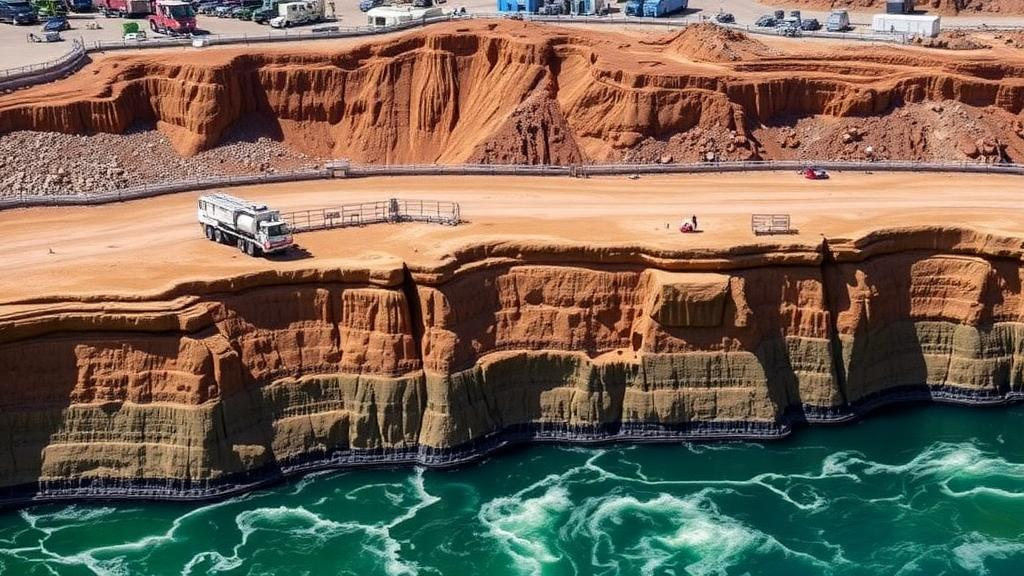
In the high steppe of northern Mongolia, one of the world’s largest copper-molybdenum mines has been quietly reshaping the chemistry of the water around it. At Erdenet, dissolved sulfate is the dominant contaminant in both groundwater and surface water, and for decades the standard explanation has been straightforward: sulfide minerals such as pyrite, exposed to air and water by mining, are oxidized, and sulfate is the end product. But a new study published in Environmental Geochemistry and Health shows that the story of who is doing the oxidizing, and how fast, is far more subtle than a simple reaction with air. By reading the isotopic fingerprints of sulfate dissolved in the region’s waters, researchers have uncovered evidence that ferric iron, not molecular oxygen, may be the true engine behind the highest sulfate loads.
The distinction matters because the two candidate oxidants behave very differently. Molecular oxygen, the O2 that diffuses into water and weathered rock, attacks sulfide minerals slowly, particularly under acidic conditions. Ferric iron, Fe(III), by contrast, is a far more aggressive oxidizing agent, capable of stripping electrons from pyrite at rates that can dwarf direct oxygen attack. Where Fe(III) dominates, sulfide destruction accelerates, and sulfate concentrations climb rapidly. That makes the relative contributions of the two oxidants a critical variable for anyone trying to predict, monitor, or remediate acid mine drainage. Yet in a real aquifer or river, the oxidants are invisible; only their chemical handiwork can be measured.
The research team, led by Duk-Min Kim of Sangji University together with colleagues at Korea University and Mongolian partner institutions, turned to stable isotopes to make the invisible visible. They measured the sulfur isotope composition of dissolved sulfate, expressed as δ34S, along with the oxygen isotope composition of the same sulfate, δ18O(SO4), and the oxygen and hydrogen isotope compositions of the host water itself, δ18O(H2O) and δ2H. The logic of the approach rests on a simple but powerful fact: the oxygen atoms locked into sulfate must come from somewhere, and there are only two realistic sources. They either derive from the water in which the oxidation occurred, or from molecular oxygen dissolved in that water. Ferric iron, crucially, contributes no oxygen of its own.
That asymmetry is what turns sulfate into a geochemical recorder. When molecular oxygen oxidizes pyrite, a predictable fraction of the sulfate’s oxygen budget is inherited from the O2 molecule, whose isotopic composition differs from that of water. When Fe(III) does the oxidizing, the oxygen in the resulting sulfate comes overwhelmingly from water molecules. By comparing the measured δ18O of sulfate with the measured δ18O of the surrounding water, and applying established fractionation factors from laboratory oxidation experiments, the researchers could calculate a potential fraction of pyrite oxidation attributable to Fe(III) at each sampling site. The method had been validated in experimental systems for years; what this study delivered was a systematic field application across an entire mining region.
Erdenet is an ideal natural laboratory. The Erdenetiin Ovoo deposit is a porphyry copper-molybdenum system hosted in granitoid rocks, where pyrite and other sulfides are abundant in the ore and in altered wall rocks. Mining has exposed these minerals to oxygenated water on a vast scale, and the semi-arid continental climate of northern Mongolia imposes strong seasonal controls on recharge and evaporation. The team sampled groundwater and surface water across the mining region and analyzed the full suite of sulfur, oxygen, and hydrogen isotope ratios, building a dataset that spans the hydrological and geochemical diversity of the area.
The raw results, however, did not tell a clean story on their own. The calculated Fe(III) fractions in some samples appeared implausibly low, and the researchers recognized that other geochemical processes were muddying the signal. Sulfate reduction, in which microbes consume sulfate in anoxic zones and preferentially remove the lighter sulfur isotope, can shift isotope ratios and mask the original oxidation signature. Gypsum dissolution can add sulfate to the water with an entirely different isotope composition, diluting the oxidation-derived signal. On the other side of the ledger, the precipitation of gypsum from solution can cap sulfate concentrations, while the dissolution of efflorescent salts, the crusty sulfate minerals that form on mine waste during dry periods and dissolve during wet ones, can push concentrations upward without any new sulfide oxidation at all.
The breakthrough came from treating these confounding processes explicitly rather than ignoring them. The researchers identified samples whose isotope and chemical characteristics suggested influence by sulfate reduction, gypsum dissolution, gypsum precipitation, or efflorescent salt dissolution, and excluded them from the central analysis. What remained was a dataset in which a clear, positive relationship emerged between the potential fraction of Fe(III) as the pyrite oxidant and the concentration of dissolved sulfate. In other words, where the isotopic evidence pointed to ferric iron doing more of the oxidative work, sulfate levels were systematically higher. The theoretical minimum fractions of Fe(III) contribution, derived from laboratory studies and isotope mass balance, appeared to constrain the lower bound of the true contributions, giving the relationship a defensible quantitative footing.
This finding carries real weight for environmental management. Sulfate itself is a major but often under-regulated contaminant, and the pathways that generate it determine how quickly it will continue to be produced long after mining ceases. If Fe(III)-mediated oxidation is the dominant driver of high sulfate concentrations, then the geochemical cycles of iron and sulfur are tightly coupled in the affected aquifers, and remediation strategies that focus solely on limiting oxygen ingress may underestimate the persistence of the problem. Ferric iron can be regenerated within the system as long as ferrous iron and oxygen are available, creating a self-sustaining oxidation loop. Understanding whether that loop is active at a given site is therefore essential for forecasting long-term water quality.
Beyond the immediate findings at Erdenet, the study offers something more general: a framework. The combined use of δ18O of sulfate and δ18O of water, once additional geochemical processes are properly accounted for, provides a systematic method for dissecting sulfide oxidation mechanisms in any mining environment. The authors also point out that variations in the relationship between the Fe(III) fraction and sulfate concentration across different sites can serve as diagnostic evidence for site-specific processes such as gypsum dissolution or sulfate reduction. In effect, the method does not just quantify one reaction; it exposes the full network of reactions that shape sulfate in mining-affected water.
The work also fits into a broader movement in environmental geochemistry, in which multi-isotope toolkits are used to trace contamination from source to sink. The same research group has previously applied multimetal isotope models, combining copper, molybdenum, sulfur-oxygen, and zinc isotopes, to map contamination pathways at a regional scale in mining cities. The Erdenet study extends that logic to the fundamental question of oxidation mechanism, showing that even a single contaminant like sulfate can carry layered information about the conditions of its formation. For a mining region that supplies a substantial share of Mongolia’s export economy, and whose water resources sustain both the city of Erdenet and surrounding herding communities, the ability to read those layers accurately is not an academic luxury. It is the foundation for decisions about water treatment, waste management, and the long-term stewardship of a landscape where the chemistry of pyrite, iron, and oxygen will keep interacting for generations.
Subject of Research: Sulfur and oxygen isotopic tracing of sulfide oxidation mechanisms controlling dissolved sulfate in mining-affected water
Article Title: Sulfur and oxygen isotopic systematics of dissolved sulfate and relative contributions of sulfide oxidants in the Erdenet mining region, Mongolia
Article References: Kim, D.-M., Batsaikhan, B., Im, D.-G., Choi, J.-H., Seo, H.-S., Buyankhishig, B., & Yun, S.-T. (2026). Sulfur and oxygen isotopic systematics of dissolved sulfate and relative contributions of sulfide oxidants in the Erdenet mining region, Mongolia. Environmental Geochemistry and Health, 48(16), Article 636. https://doi.org/10.1007/s10653-026-03531-y
Image Credits: AI Generated
DOI: 10.1007/s10653-026-03531-y
Keywords: sulfate, sulfide oxidation, Fe(III), pyrite, stable isotopes, acid mine drainage, Erdenet, Mongolia, groundwater contamination, gypsum dissolution, sulfate reduction, mining geochemistry
Cite Scienmag News
Sloane Callahan. (October 13, 2026). Hidden Oxygen Fingerprints Reveal What Really Drives Toxic Sulfate in Mining Water. Scienmag. https://scienmag.com/hidden-oxygen-fingerprints-reveal-what-really-drives-toxic-sulfate-in-mining-water/
Sloane Callahan. "Hidden Oxygen Fingerprints Reveal What Really Drives Toxic Sulfate in Mining Water." Scienmag, 13 October 2026, https://scienmag.com/hidden-oxygen-fingerprints-reveal-what-really-drives-toxic-sulfate-in-mining-water/. Accessed 13 October 2026.
Sloane Callahan. "Hidden Oxygen Fingerprints Reveal What Really Drives Toxic Sulfate in Mining Water." Scienmag. October 13, 2026. https://scienmag.com/hidden-oxygen-fingerprints-reveal-what-really-drives-toxic-sulfate-in-mining-water/


