


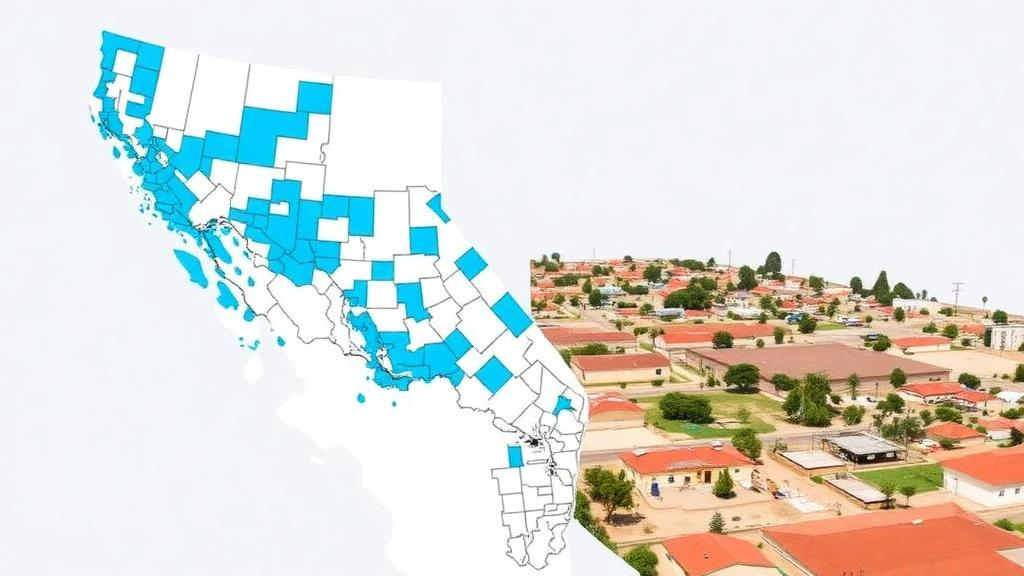
Along the U.S.-Mexico border, thousands of families living in unincorporated settlements known as colonias face a daily reality that most Americans never encounter: unreliable, insufficient, or unsafe water. A new study published in the Journal of Environmental Studies and Sciences offers the most systematic look yet at how these communities cope, documenting water insecurity responses across 64 colonias spanning all four U.S. border states. The research, led by Laura Castro-Diaz of the University of Massachusetts Boston together with Dylan Diaz-Infante and Amber Wutich of Arizona State University and the Arizona Water for All Consortium, reveals that coping with water scarcity is not a single behavior but a layered repertoire that operates simultaneously at the individual, household, and community levels.
The study arrives at a moment when water insecurity is increasingly recognized as a problem of the Global North, not only of developing regions. Scholars have documented household water hardship in the United States for years, including hotspots of racial and geographic inequality in plumbing access and the particular vulnerabilities of border communities. Yet most research has focused on a single scale, typically the household. By explicitly examining coping strategies across multiple levels, the new work fills a persistent gap in the literature and challenges the assumption that water insecurity is solved, or even primarily experienced, one household at a time.
The scale of the effort is notable. In each of the 64 colonias, a key informant conducted community-based participant observation, an ethnographic method in which researchers embedded in a community document everyday practices as they unfold. Following a structured protocol, these informants then facilitated interviews with up to three respondents per site, yielding a total of 175 interviews across the four border states. This design allowed the team to capture both the texture of daily water struggles and the broader patterns that recur from Texas to California. The work was supported by the Arizona Water Innovation Initiative and multiple grants from the U.S. National Science Foundation.
When the researchers analyzed the interview and observation data, the coping responses clustered into four distinct categories: reducing consumption, increasing availability, psychosocial coping, and accepting shortfall. The first category, reducing consumption, encompasses the ways people ration what little water they have, cutting back on bathing, cooking, cleaning, or other uses when supply runs short. Such rationing is far from benign; prior research has linked water insecurity to compromised hygiene, dietary changes, and downstream health consequences, particularly for infants and children whose feeding practices depend on reliable water access.
The second category, increasing availability, includes strategies that bring more water into reach. These range from purchasing bottled or trucked water to borrowing from neighbors, a practice documented globally as one of the most consistent responses to water system failure. Water sharing, gifts, and exchanges have been shown across cultures to function as an informal safety net when piped systems break down. In colonias, where infrastructure may be absent, aging, or privately maintained at household expense, securing additional water often carries real costs, both financial and physical, including the labor of hauling water and the injuries and chronic stress that researchers have tied to the embodiment of water insecurity.
The third category, psychosocial coping, addresses the emotional and mental burden of living without dependable water. Water insecurity is increasingly understood as a driver of emotional distress, and studies from Bolivia to island nations affected by climate change have documented worry, shame, and anger tied to water shortages. By including psychosocial responses as a formal coping category, the study underscores that the harm of water insecurity extends beyond dehydration and disease into the realm of mental health and dignity, dimensions that purely engineering-focused interventions often overlook.
The fourth category, accepting shortfall, is perhaps the most sobering. It describes situations in which residents, having exhausted other options, simply go without. Acceptance of a water deficit is not resignation in a passive sense; the researchers treat it as a coping response in its own right, one that signals the limits of individual and household capacity. Its presence across the colonias studied suggests that for some families, no combination of rationing, purchasing, borrowing, or emotional adjustment fully closes the gap between water needed and water available.
Crucially, the analysis found that all four categories of coping occur across multiple levels, from individuals and households up to entire communities. This multilevel finding matters for theory and for practice. In resilience scholarship, coping capacity is often distinguished from adaptive capacity, with institutions and collective action playing a key role in transforming short-term coping into sustainable adaptation. By showing that community-level strategies mirror and reinforce household-level ones, the study suggests that interventions targeting only one scale are likely to miss important dynamics. A community that organizes collectively to secure water deliveries, for example, changes the options available to each household within it.
The colonias themselves are a distinctive American landscape. These unincorporated settlements, concentrated in the Lower Rio Grande Valley of Texas and scattered across New Mexico, Arizona, and California, have historically developed outside municipal boundaries, leaving residents with limited access to public services and, in some cases, subject to what researchers describe as selective underbounding, the exclusion of communities from annexation and the infrastructure that comes with it. Previous studies have documented inadequate sanitation, arsenic contamination risks in comparable underserved regions, and the privatized burden of ensuring drinking water quality at the household level. The new research situates coping strategies within this structural context of environmental injustice.
The methodological approach also deserves attention. Community-based participant observation, the technique deployed by the key informants in each colonia, has been developed as a participatory method for ethnographic research that trains community members themselves to document local conditions. This approach not only builds trust but also produces data grounded in lived experience rather than outsider assumption. The authors note that the study’s data include identifiers and cannot be shared publicly due to institutional review board protections, though codebooks for the analysis are included in the published manuscript.
The findings carry direct implications for policy. The authors state that identifying how colonia residents manage water insecurity provides insights to inform policy and guide interventions aimed at reducing vulnerabilities and strengthening resilience in marginalized border communities. Because coping strategies span scales, effective interventions may need to do the same: pairing household-level support, such as assistance with water costs and storage, with community-level infrastructure improvements and recognition of the psychosocial toll of insecurity. The study also contributes to ongoing efforts, including the development of a water insecurity coping strategies index drawing on data from eleven global sites, to build standardized ways of measuring how people respond when water systems fail.
As extreme weather events intensify under global environmental pressures, researchers expect water insecurity to worsen, including in wealthy nations that have long assumed their water problems were solved. The colonias of the U.S.-Mexico border offer an early warning and a test case. What the new study demonstrates is that the people living with the least reliable water are not passive victims; they are active managers of scarcity, deploying strategies of restraint, acquisition, emotional endurance, and, at times, painful acceptance. Understanding that repertoire, in all its scale and complexity, may be the first step toward ensuring that the burden of coping no longer falls so heavily on those least equipped to bear it.
Subject of Research: Water insecurity coping strategies in colonias along the U.S.-Mexico border
Article Title: Exploring the scale of water insecurity coping strategies: Findings from 64 colonias on the U.S.-Mexico border
Article References: Castro-Diaz, L., Diaz-Infante, D., Wutich, A., Arizona Water for All Consortium, Westerhoff, P., Voth-Gaeddert, L., Brewis, A., Salcedo, D., Tian, Y., Hossain, M. J., Lucero, R., Beresford, M., Landes, L., Thomson, P., Tsai, Y., Li, W., Yerman, A., Jankovic-Rankovic, J., Sabo, J. L., … Hanemann, M. (2026). Exploring the scale of water insecurity coping strategies: Findings from 64 colonias on the U.S.-Mexico border. Journal of Environmental Studies and Sciences. https://doi.org/10.1007/s13412-026-01152-6
Image Credits: AI Generated
DOI: 10.1007/s13412-026-01152-6
Keywords: water insecurity, coping strategies, colonias, U.S.-Mexico border, environmental justice, household water, community resilience, water policy, Global North, participatory research, psychosocial distress, water access
Cite Scienmag News
Sloane Callahan. (October 12, 2026). Water Insecurity Coping Strategies Mapped Across 64 Colonias on the U.S.-Mexico Border. Scienmag. https://scienmag.com/water-insecurity-coping-strategies-mapped-across-64-colonias-on-the-u-s-mexico-border/
Sloane Callahan. "Water Insecurity Coping Strategies Mapped Across 64 Colonias on the U.S.-Mexico Border." Scienmag, 12 October 2026, https://scienmag.com/water-insecurity-coping-strategies-mapped-across-64-colonias-on-the-u-s-mexico-border/. Accessed 12 October 2026.
Sloane Callahan. "Water Insecurity Coping Strategies Mapped Across 64 Colonias on the U.S.-Mexico Border." Scienmag. October 12, 2026. https://scienmag.com/water-insecurity-coping-strategies-mapped-across-64-colonias-on-the-u-s-mexico-border/


