


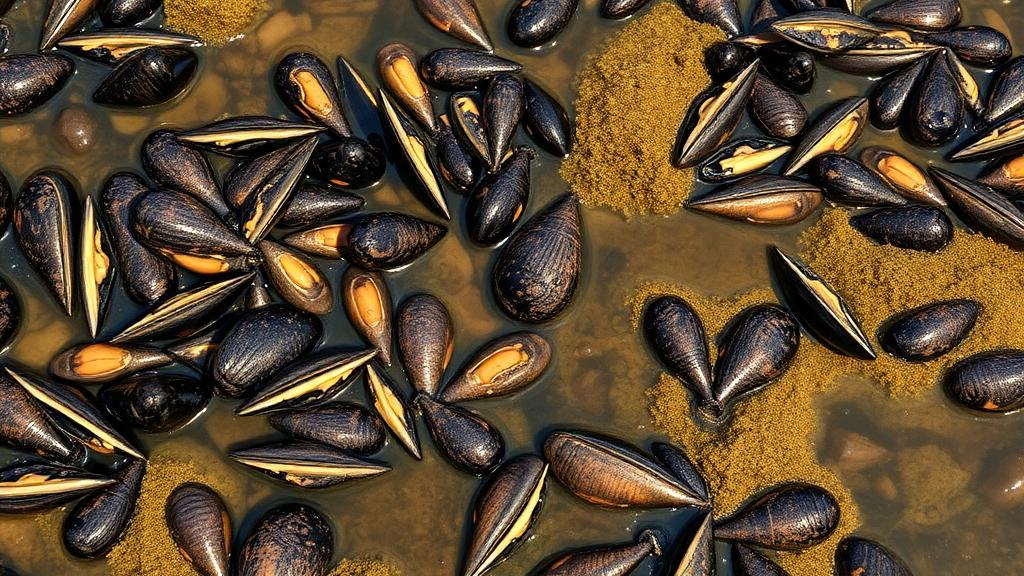
When a massive oil slick began washing up on Brazilian beaches in 2019, it stained more than 3,000 kilometers of coastline across nine states and left scientists scrambling to understand how long the contamination would linger in marine food webs. Now, researchers have unveiled a streamlined laboratory technique that can detect the most dangerous petroleum-derived pollutants in mussels faster and more cheaply than before, offering coastal communities a practical new tool for keeping an eye on the seafood they eat every day. The method, developed for the brown mussel Perna perna harvested around Guanabara Bay in Rio de Janeiro, combines well-established extraction chemistry with gas chromatography-mass spectrometry in a way that ordinary laboratories can replicate without exotic instrumentation or prohibitive costs.
The study, published in Environmental Monitoring and Assessment, arrives at a moment when the legacy of the 2019 spill remains uncertain. Tar balls chemically linked to that disaster continued to reach Brazilian beaches years afterward, echoing the pattern seen after the Prestige spill off Spain, where polycyclic aromatic hydrocarbons persisted in coastal ecosystems long after the acute emergency ended. PAHs are among the most worrying compounds released in oil spills because they are persistent, they bioaccumulate in fatty tissues, and several members of the family carry mutagenic and carcinogenic potential. Humans encounter them continuously through airborne particles, polluted water, and contaminated food, which makes reliable monitoring of seafood a genuine public health concern rather than an abstract environmental exercise.
Guanabara Bay is arguably the most challenging possible proving ground for such a method. The estuary, the second-largest bay on the Brazilian coast at roughly 384 square kilometers, is ringed by a metropolitan region of more than 16 million people and hosts a dense concentration of petrochemical infrastructure, including refineries and oil-storage terminals in its northwestern sector. Its sediments carry PAH burdens reflecting both chronic petrogenic inputs from oil handling and pyrogenic inputs from urban and vehicular combustion. Yet the bay also sustains artisanal mussel fisheries that provide an important protein source for local communities, creating an urgent need for affordable, routine contamination surveillance in exactly the kind of resource-limited setting where sophisticated analytical infrastructure is often unavailable.
Mussels are ideal sentinels for this task. As filter feeders, they ingest contaminants suspended in the water column and accumulate lipophilic pollutants in their tissues, and they tolerate a broad range of environmental conditions. Their track record in Guanabara Bay is well documented: after a fuel oil spill in 2000, PAH burdens in mussels collected from the pillars of the Rio-Niterói Bridge rose two to fivefold, tracking changes in the surrounding water closely. But extracting PAHs from lipid- and protein-rich mussel tissue has always been analytically awkward. Conventional approaches such as matrix solid-phase dispersion, accelerated solvent extraction with gel-permeation clean-up, or supercritical fluid extraction work, but they demand expensive equipment, large volumes of hazardous solvent, and considerable time per sample.
The new method borrows a trick from food safety chemistry. The QuEChERS approach, whose name stands for Quick, Easy, Cheap, Effective, Rugged and Safe, was originally devised in 2003 for extracting pesticide residues from produce. It relies on simple salting-out chemistry: homogenized tissue is vortexed with a mixture of acetonitrile and dichloromethane, then magnesium sulfate and sodium chloride are added to drive analytes into the organic layer. The researchers adapted this for mussel tissue and added a solid-phase extraction clean-up step using Florisil, silica gel, and alumina columns to strip out co-extracted lipids before instrumental analysis. The combination proved remarkably effective at minimizing the matrix interference that normally plagues PAH analysis in fatty biological samples.
The analytical team collected 210 mussels from four artisanal fishing communities around the bay, including Itaipu, Copacabana, Barra da Tijuca, and Recreio dos Bandeirantes, across four seasonal campaigns between September 2021 and June 2022, roughly two to three years after the spill. Each pooled sample of about twenty individuals was homogenized and analyzed in triplicate. The validated method achieved strong linearity, with coefficients of determination exceeding 0.995 for most compounds, and acceptable recoveries between 51.1 and 109.0 percent for 15 of the 18 target PAHs. Detection limits ranged from 0.009 nanograms per gram for naphthalene to just over one nanogram per gram for the most problematic analytes, figures comparable to those reported for far more expensive tandem mass spectrometry setups.
Not every target compound cooperated. Benzo(j)fluoranthene and benzo(k)fluoranthene share an identical retention time of 40.944 minutes on the DB-5MS capillary column used, a documented limitation of five-percent phenyl methylpolysiloxane phases that even laboratories running triple quadrupole instruments encounter. Both isomers were excluded from quantitative interpretation, a decision the authors note does not disadvantage the dataset because regulatory indices such as the EFSA-endorsed PAH4 already omit benzo(j)fluoranthene. Indeno(1,2,3-cd)pyrene yielded no quantifiable signal at any fortification level and was likewise excluded. Benzo(a)pyrene, the single most notorious carcinogenic PAH, showed precision marginally above the 20 percent threshold but was retained for reporting given its environmental significance. This transparent accounting of limitations, the researchers argue, is what makes the method genuinely useful for future monitoring programs.
The environmental findings were as instructive as the analytical ones. Only five PAHs were quantified above the limit of quantification across all 210 samples: naphthalene, phenanthrene, 5-methylchrysene, benzo(a)anthracene, and benzo(a)pyrene. Concentrations were low and statistically homogeneous across sites and seasons, with benzo(a)pyrene reaching the highest mean at just 0.308 nanograms per gram, far below the European Union maximum of 5 nanograms per gram for bivalve molluscs. Crucially, the compositional pattern told a story: the total PAH burden of 4.27 nanograms per gram was dominated almost entirely by high-molecular-weight, combustion-derived compounds rather than the light petrogenic compounds, such as naphthalene and phenanthrene, that would signal lingering petroleum from the spill. The contamination signature points instead to diffuse, continuous pyrogenic inputs from vehicle emissions, industrial combustion, and atmospheric deposition.
That counterintuitive result carries a sobering implication. Benzo(a)pyrene is classified by the International Agency for Research on Cancer as a Group 1 confirmed human carcinogen, acting through reactive diol-epoxide metabolites that form covalent DNA adducts, while benzo(a)anthracene and 5-methylchrysene are Group 2B possible carcinogens. None of these genotoxic compounds has a recognized safe exposure threshold, and mussels remain a staple protein for the fishing communities surrounding the bay. The authors caution that without pre-spill baseline data or an uncontaminated reference site, low burdens cannot be read as recovery from the 2019 disaster, nor can the spill be disentangled from chronic urban-industrial pollution. What the study does establish is that the threat to these communities comes less from dramatic spill events than from the quiet, ceaseless combustion chemistry of a megacity.
The broader significance of the work lies in accessibility. Compared with pressurized solvent extraction, QuEChERS-based workflows have been shown to cut per-sample costs roughly fivefold while increasing throughput tenfold, and other studies report cost reductions approaching 97 percent relative to Soxhlet extraction. Because the new method uses matrix-matched calibration rather than costly isotope-dilution standards and relies on a single quadrupole mass spectrometer, it can be adopted by laboratories that could never afford tandem instrumentation. For oil-impacted tropical estuaries worldwide, from Jakarta Bay to the Gulf of Guinea, the message is that meaningful PAH biomonitoring no longer requires a flagship budget, only mussels, modest solvents, and a well-validated protocol.
Subject of Research: Development and validation of a QuEChERS-SPE-GC-MS method for PAH biomonitoring in Perna perna mussels from an oil-impacted tropical estuary
Article Title: Development of a short and sensitive QuEChERS-SPE-GC-MS method for polycyclic aromatic hydrocarbon (PAH) biomonitoring in Perna perna (Linnaeus, 1758) mussels from an oil-impacted tropical estuary
Article References: de Pinho, J. V., Tessaro, L., Silva Melo, P. T., de Andrade, J. C., Celano, M. R., de Almeida Rodrigues, P., Castro Cardoso de Almeida, A. E., Hauser-Davis, R. A., & Conte-Junior, C. A. (2026). Development of a short and sensitive QuEChERS-SPE-GC-MS method for polycyclic aromatic hydrocarbon (PAH) biomonitoring in Perna perna (Linnaeus, 1758) mussels from an oil-impacted tropical estuary. Environmental Monitoring and Assessment, 198(11), Article 1184. https://doi.org/10.1007/s10661-026-15980-0
Image Credits: AI Generated
DOI: 10.1007/s10661-026-15980-0
Keywords: polycyclic aromatic hydrocarbons, QuEChERS, GC-MS, Perna perna, Guanabara Bay, biomonitoring, oil spill, mussels, benzo(a)pyrene, pyrogenic contamination, solid-phase extraction, environmental monitoring
Cite Scienmag News
Reese Ellison. (October 13, 2026). Cheap, Fast Mussel Test Tracks Toxic Oil Spill Chemicals in Brazil’s Most Polluted Bay. Scienmag. https://scienmag.com/cheap-fast-mussel-test-tracks-toxic-oil-spill-chemicals-in-brazils-most-polluted-bay/
Reese Ellison. "Cheap, Fast Mussel Test Tracks Toxic Oil Spill Chemicals in Brazil’s Most Polluted Bay." Scienmag, 13 October 2026, https://scienmag.com/cheap-fast-mussel-test-tracks-toxic-oil-spill-chemicals-in-brazils-most-polluted-bay/. Accessed 13 October 2026.
Reese Ellison. "Cheap, Fast Mussel Test Tracks Toxic Oil Spill Chemicals in Brazil’s Most Polluted Bay." Scienmag. October 13, 2026. https://scienmag.com/cheap-fast-mussel-test-tracks-toxic-oil-spill-chemicals-in-brazils-most-polluted-bay/


