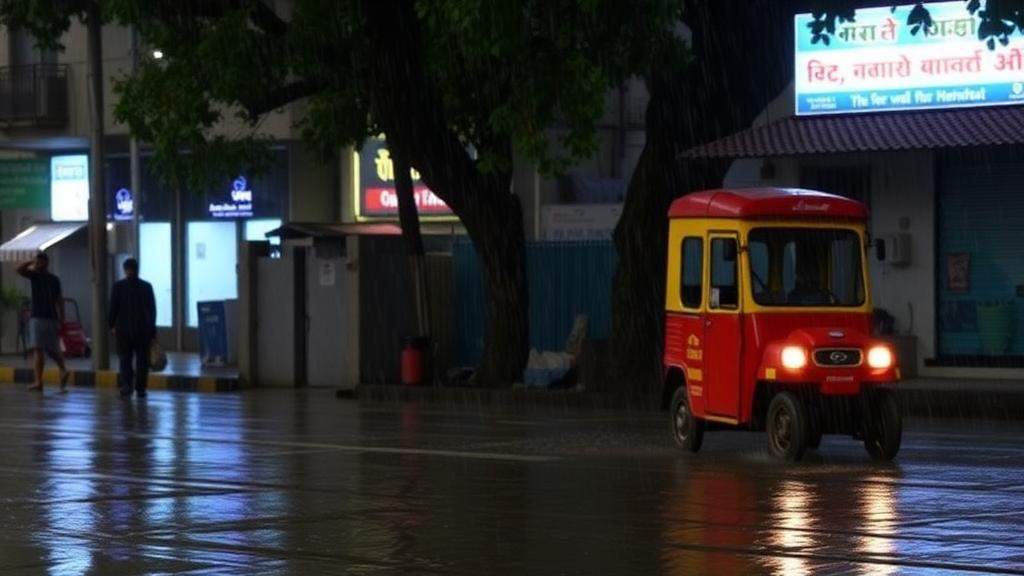
On the night of 22 September 2025, the city of Kolkata and its surrounding neighbourhoods in the Indian state of West Bengal were struck by an extraordinary rainfall episode that lasted only a few hours but delivered a volume of water the city had never before experienced in such a compressed window. The downpour, concentrated at an almost micro scale over Kolkata and its immediate vicinity, triggered massive flooding across streets, homes and transport networks, paralyzing one of India’s largest metropolitan areas well into the following morning. A new case study published in the journal Theoretical and Applied Climatology by Sourish Bondyopadhyay and Habibur Rahaman Biswas of the Regional Meteorological Centre Kolkata, part of the India Meteorological Department, dissects exactly what happened in the atmosphere that night and, crucially, whether the atmosphere had been signalling the disaster in advance.
The central finding of the study is sobering for forecasters: none of the numerical weather prediction models available at the time could anticipate the severity of the rainfall intensity. Numerical weather prediction, or NWP, relies on physics-based simulations of the atmosphere run on supercomputers, and while these models have become remarkably skilled at forecasting synoptic-scale systems such as monsoon depressions and cyclones, they routinely struggle with localized, short-lived convective extremes. The Kolkata event fell squarely into that blind spot. The rain was not produced by a large, well-organized weather system that models could track for days in advance; instead, it emerged from intense convection confined to a small area, persisting in nearly the same location for hours and stacking up rainfall totals that overwhelmed urban drainage.
To understand the event, the authors assembled an unusually comprehensive set of observations. They drew on radiosonde and radio wind soundings, known as RSRW, which are balloon-borne instruments launched from meteorological stations that profile temperature, humidity and wind from the surface up through the depth of the troposphere. They complemented these in-situ measurements with ERA5, the fifth-generation reanalysis dataset produced by the European Centre for Medium-Range Weather Forecasts, which blends historical observations with model physics to create a physically consistent picture of the atmosphere. On top of that, the researchers examined radar and satellite observations, which captured the storm’s structure and evolution in real time. This multi-instrument approach allowed them to reconstruct both the thermodynamic environment, meaning the temperature and moisture conditions that fuelled the storm, and the dynamic behaviour of the convection itself.
What emerged from the RSRW and ERA5 analysis was a set of meteorological parameters with significantly elevated values over the affected area, and, importantly, those elevated values coincided closely with the spatial and temporal distribution of the rainfall. In other words, the atmosphere over Kolkata and its surroundings displayed a distinctive thermodynamic fingerprint before and during the deluge: extreme instability, abundant moisture through a deep column of air, and the kind of profile that strongly favours vigorous, sustained convection. The authors argue that these parameters can serve as precursors for extreme rainfall conditions of short duration, offering a way to anticipate such events even when conventional NWP rainfall forecasts fail to capture their localized, high-impact nature.
This precursor-based approach matters because thermodynamic indices have a long history in severe weather forecasting. Classic indices such as the K index, the Total Totals index and various convective available potential energy measures, developed by researchers including George, Miller, and Litynska and colleagues in the mid-twentieth century, condense complex sounding data into single numbers that indicate whether the atmosphere is primed for thunderstorms. Bondyopadhyay has previously worked on determining suitable thermodynamic indices for predicting thunderstorm events over eastern India, and the new study extends that line of thinking from ordinary thunderstorms to the extreme tail of short-period rainfall. Rather than asking simply whether storms will form, the precursor framework asks whether the environment is loaded with enough moisture and instability to produce rainfall of exceptional intensity if convection does fire.
The radar and satellite component of the analysis added a second, equally important layer of insight. The observations revealed strong convection prevailing over the Kolkata area in an almost stagnant state for several hours. This persistence is the key to understanding why the event was so destructive. Convective storms often move with the prevailing winds, spreading their rainfall across a swath of territory; when a storm instead remains anchored over the same small area, its rainfall accumulates on one spot, and the hydrological consequences multiply. The nearly stationary character of the Kolkata convection meant that a few hours of intense rain fell on a single urban basin, producing flooding that the city’s infrastructure had no capacity to absorb. The authors emphasize that this kind of near-stagnant convective signature, visible in real-time radar and satellite data, provides highly useful information for nowcasting, the short-range forecasting discipline concerned with conditions over the next few hours.
To place the Kolkata event in context and to generalize their methodology, the researchers also analysed two secondary cases in which high amounts of rainfall were reported within very short periods. This comparative strategy is essential for distinguishing a genuine precursor signal from a one-off coincidence. If the same constellation of elevated thermodynamic parameters appears across multiple short-duration extreme rainfall events, then the parameters can plausibly be used as operational warning indicators rather than merely as diagnostic curiosities examined after the fact. The study’s framing also connects to a broader scientific debate about terminology: as recent work on cloudburst disambiguation has pointed out, not every extreme short-term rainfall event constitutes a cloudburst in the strict sense, and careful case-by-case analysis of the kind performed here helps refine how meteorologists classify and communicate these hazards.
The broader climatic backdrop gives the study additional urgency. Research over the past decade has documented a striking rise in extreme precipitation across India, including a threefold increase in widespread extreme rain events over central India and a strengthening of summer monsoon precipitation extremes linked to long-term climatic and anthropogenic factors. Dense cities are particularly exposed to this trend because short-duration rainfall extremes translate almost directly into urban flooding: impervious surfaces prevent infiltration, drainage systems are designed for historical rainfall statistics, and millions of residents and assets are packed into low-lying areas. An event like the September 2025 Kolkata deluge, unprecedented in intensity for the city, illustrates how quickly the tail of the rainfall distribution can outpace the assumptions embedded in urban planning and emergency response.
It is notable that much of the existing literature on short-duration extreme rainfall in India focuses on the Himalayan region, where cloudbursts and the flash floods and debris flows they trigger have been studied extensively in places such as Kedarnath, Uttarkashi and Nainital, often using reanalysis datasets like ERA5 and the India Meteorological Department’s high-resolution reanalysis. The Kolkata event demonstrates that the same analytical toolkit, sounding-based thermodynamic diagnostics combined with reanalysis and remote sensing, applies equally to a sprawling tropical delta city far from the mountains. The authors acknowledge the India Meteorological Department for providing the data and support that made the research possible, and their institutional position inside the Regional Meteorological Centre Kolkata underscores the operational motivation behind the work: finding practical, computationally light indicators that duty forecasters can monitor alongside model guidance.
The practical takeaway is a two-track strategy for anticipating and managing short-duration rainfall extremes. Before an event, elevated values of key thermodynamic parameters derived from soundings and reanalysis can flag environments capable of producing extreme localized rainfall, compensating for the known inability of NWP models to resolve the precise intensity and placement of such convection. During an event, radar and satellite monitoring of convective motion becomes decisive: if strong convection is detected and it is nearly stationary, forecasters can warn of accumulating rainfall and escalating flood risk in real time. Neither track alone would have been sufficient for Kolkata in September 2025, but together they form a coherent nowcasting and early-warning framework. As extreme short-period rainfall grows more frequent in a warming climate, the identification of reliable meteorological precursors of the kind documented in this study may prove to be one of the most valuable tools available for protecting densely populated cities from the next unprecedented night of rain.
Subject of Research: Meteorological precursors of an extreme short-duration rainfall and flooding event over Kolkata, India
Article Title: Analysis of extreme rainfall episode in short period over Kolkata & neighbourhood, India and identification of meteorological precursors
Article References: Bondyopadhyay, S., & Biswas, H. R. (2026). Analysis of extreme rainfall episode in short period over Kolkata & neighbourhood, India and identification of meteorological precursors. Theoretical and Applied Climatology, 157(11), Article 708. https://doi.org/10.1007/s00704-026-06630-z
Image Credits: AI Generated
DOI: 10.1007/s00704-026-06630-z
Keywords: Kolkata, extreme rainfall, flash flooding, nowcasting, numerical weather prediction, ERA5 reanalysis, radiosonde, thermodynamic indices, convection, India Meteorological Department, urban flooding, monsoon extremes
Cite Scienmag News
Violet Maxwell. (October 12, 2026). Kolkata’s Unprecedented Night of Rain: Scientists Identify Warning Signs of Extreme Short-Deluge Events. Scienmag. https://scienmag.com/kolkatas-unprecedented-night-of-rain-scientists-identify-warning-signs-of-extreme-short-deluge-events/
Violet Maxwell. "Kolkata’s Unprecedented Night of Rain: Scientists Identify Warning Signs of Extreme Short-Deluge Events." Scienmag, 12 October 2026, https://scienmag.com/kolkatas-unprecedented-night-of-rain-scientists-identify-warning-signs-of-extreme-short-deluge-events/. Accessed 12 October 2026.
Violet Maxwell. "Kolkata’s Unprecedented Night of Rain: Scientists Identify Warning Signs of Extreme Short-Deluge Events." Scienmag. October 12, 2026. https://scienmag.com/kolkatas-unprecedented-night-of-rain-scientists-identify-warning-signs-of-extreme-short-deluge-events/