


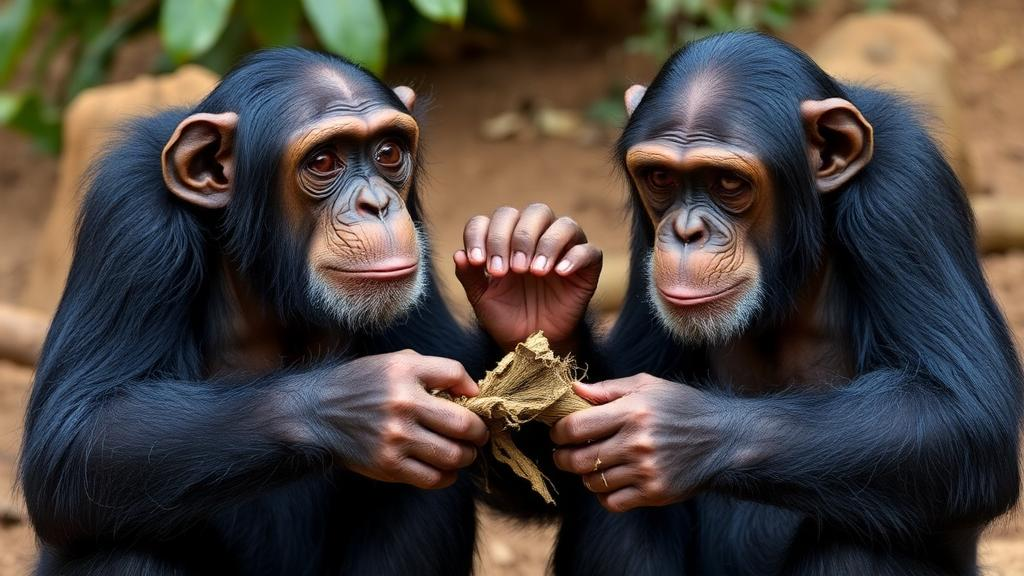
In the dry savannah forests of Dindefelo, Senegal, wild chimpanzees are quietly rewriting what scientists thought they knew about the origins of teaching. A new observational study, published in Frontiers in Psychology by researchers at the University of Barcelona and the Jane Goodall Institute Spain, documents how adult chimpanzees — above all mothers — actively help their offspring master some of the most demanding skills in the animal kingdom: fishing for algae with sticks, extracting army ants from their nests, catching termites, and cracking open hard baobab fruits against stone or wooden anvils. The findings, gathered from eight years of camera-trap footage, offer some of the clearest evidence yet that tool transfer in wild apes is not mere opportunism but a deliberate form of instruction that shapes how technological knowledge passes between generations.
Chimpanzees display the widest repertoire of tool-use strategies of any non-human animal. Across their African range, they crack nuts with hammerstones, fish for termites with slender probes, and fashion sticks to harvest ants and algae. These behaviours vary from community to community, a pattern long interpreted as evidence of cultural transmission — knowledge that is learned socially rather than inherited genetically. But the precise mechanisms by which a young chimpanzee actually acquires these skills have remained surprisingly difficult to pin down. Young apes spend years watching their mothers, yet observation alone seemed insufficient to explain how they eventually handle fragile tools and dangerous prey with such competence. The new study addresses that gap by focusing on the moments when tools and food physically change hands.
The research team, led by Andreu Sánchez-Megías and R. Adriana Hernandez-Aguilar of the University of Barcelona’s Faculty of Psychology and the Jane Goodall Institute Spain, with contributions from Laia Dotras, Jordi Galbany, Adrián Arroyo and colleagues at the Max Planck Institute for Evolutionary Anthropology, studied western chimpanzees (Pan troglodytes verus) at Dindefelo, a savannah habitat in southeastern Senegal. Between 2017 and 2025, the researchers deployed camera traps at 14 sites where the chimpanzees used tools or proto-tools, capturing footage of four distinct technological behaviours. This non-invasive method allowed the team to record natural interactions without disturbing the animals, building a long-term video archive of social exchanges centred on tools and food.
The most striking pattern to emerge concerns the transfer of objects. At Dindefelo, chimpanzees pass wooden sticks to one another for fishing algae, extracting ants and catching termites, and they also share baobab fruits, which must be cracked open by striking them against stone or wooden anvils. According to Sánchez-Megías, first author of the article and a doctoral researcher in the Department of Social and Quantitative Psychology at the University of Barcelona, this transfer of tools and fruits represents a form of teaching that mothers appear to use to help their offspring learn tool-use behaviours. In other words, the mother does not simply tolerate her child’s presence; she supplies the very objects the child needs to practise, effectively lowering the barrier to entry for skills that would otherwise take years to develop through trial and error alone.
The footage also captured rarer and more remarkable episodes. In one case, a mother carried her offspring to a tool she had previously left inserted in an ant nest, so that the young chimpanzee could pull it out covered in ants — a moment that combines tool provision, guided access to the task, and an immediate edible reward. In another, a young chimpanzee apparently accompanied, encouraged and helped another immature individual that was attempting to crack open a hard baobab fruit by striking it against a rocky surface. Such episodes suggest that facilitation is not confined to mothers: juveniles, too, may play a role in supporting the learning efforts of their peers, hinting at a broader social scaffolding around technological learning than researchers had previously documented in this population.
Most opportunities for tool transfer among the Dindefelo chimpanzees arise when one individual takes a tool from another, with the owner tolerating the taking or simply leaving the tool behind. This passive tolerance is itself significant, because it creates a learning environment in which inexperienced individuals can handle the exact implements used for a task without competition or interference. But the study reveals that experienced individuals sometimes go further, actively facilitating tool use. Notably, females at Dindefelo may receive tools more frequently than males, and tool facilitation — carried out particularly by adult females but also by juveniles — contributes directly to the acquisition of tool-use behaviours in young chimpanzees. The researchers interpret this asymmetry as consistent with the central role mothers play in their offspring’s technological education.
From a technical standpoint, the study distinguishes several social learning mechanisms operating in parallel. Tool and fruit transfers constitute one mechanism, effectively a form of active teaching in which a knowledgeable individual provides materials or opportunities to a learner. Alongside this, the authors describe observation and supervised practice as additional mechanisms mediating the acquisition of technological behaviours. R. Adriana Hernández-Aguilar, Serra Húnter Professor at the University of Barcelona and co-research director at the Jane Goodall Institute Spain, notes that these cases suggest other social learning mechanisms are involved beyond simple transfer, mediating how young chimpanzees come to master complex foraging techniques. Supervised practice, in particular, implies that adults monitor and support immature individuals as they attempt tasks, rather than leaving learning entirely to independent exploration.
The evolutionary implications are considerable. Teaching has long been considered rare in the animal kingdom, with well-documented examples limited to a handful of species such as meerkats and some birds of prey. Evidence for teaching in our closest living relatives bears directly on questions about the origins of human pedagogy. If wild chimpanzees routinely facilitate learning through tool provision, guided access and encouragement, then the roots of instructional behaviour may predate the split between the human and chimpanzee lineages millions of years ago. The Dindefelo findings also carry weight for debates about chimpanzee culture, because active facilitation would accelerate the transmission of techniques and help stabilise behavioural traditions within communities, much as formal and informal teaching does in human societies.
The savannah setting adds another layer of interest. Unlike the lush rainforests where most chimpanzee studies have been conducted, Dindefelo is a mosaic of savannah and woodland, an environment often compared to the habitats in which early hominins evolved. Documenting teaching and facilitation in such a setting suggests that these behaviours are not confined to one ecological context and may be flexible responses to the demands of different habitats. The baobab fruit cracking documented at the site, involving stone and wooden anvils, echoes the nut-cracking traditions of West African chimpanzees and provides a comparable window into how percussive technology — a precursor to some of the earliest archaeological stone tool behaviours — might be learned and passed on.
The authors are careful to note that further research at Dindefelo will be needed to determine whether the chimpanzees there exhibit teaching and facilitation patterns different from those observed elsewhere. Expanding studies to other locations, they conclude, will allow comparisons across habitats, chimpanzee communities and technological behaviours of varying degrees of complexity, clarifying the role that teaching and facilitation play in each. For now, the video record from Senegal stands as a vivid demonstration that the line between watching and teaching is thinner than once believed — and that in the forests of Dindefelo, a mother’s decision to hand her child a stick may be one of the oldest classrooms on Earth.
Subject of Research: Teaching and tool-facilitation behaviour in wild savanna chimpanzees at Dindefelo, Senegal
Article Title: How adult chimpanzees teach young ones to use tools
Article References: How adult chimpanzees teach young ones to use tools. (n.d.). Original publication
Image Credits: AI Generated
DOI: Not provided
Keywords: chimpanzees, tool use, social learning, teaching, animal culture, Pan troglodytes verus, Senegal, savanna chimpanzees, primatology, behavioral ecology, Frontiers in Psychology, University of Barcelona
Cite Scienmag News
Courtney Benton. (October 12, 2026). Wild chimpanzee mothers actively teach tool skills to their young, study finds. Scienmag. https://scienmag.com/wild-chimpanzee-mothers-actively-teach-tool-skills-to-their-young-study-finds/
Courtney Benton. "Wild chimpanzee mothers actively teach tool skills to their young, study finds." Scienmag, 12 October 2026, https://scienmag.com/wild-chimpanzee-mothers-actively-teach-tool-skills-to-their-young-study-finds/. Accessed 12 October 2026.
Courtney Benton. "Wild chimpanzee mothers actively teach tool skills to their young, study finds." Scienmag. October 12, 2026. https://scienmag.com/wild-chimpanzee-mothers-actively-teach-tool-skills-to-their-young-study-finds/


