


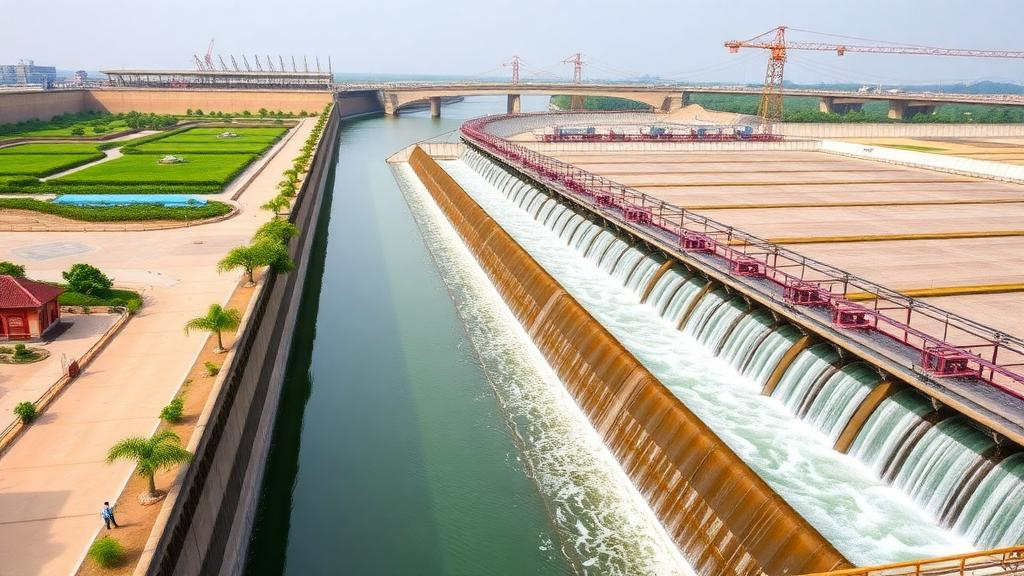
China operates the largest centralized wastewater treatment system on Earth, a sprawling network of more than ten thousand plants built over four decades to clean the country’s rivers and, increasingly, to manufacture a new water supply. A sweeping national assessment published in Nature Water now delivers an uncomfortable verdict: the centralized model, for all its engineering triumphs, has reached its efficiency limits as a weapon against water scarcity. Only about 0.45 billion people live in areas where reusing treated wastewater can simultaneously pay for itself and meaningfully reduce local water stress, according to the study led by Jijie Shen and Lei Shen of the Institute of Geographic Sciences and Natural Resources Research at the Chinese Academy of Sciences.
The finding matters far beyond China’s borders. Developing regions across Asia, Africa and Latin America are now pouring capital into centralized treatment infrastructure, often copying the Chinese template of large plants connected by extensive sewer networks. If the world’s most ambitious wastewater build-out cannot make water reuse economically viable in most of the territory it serves, the assumption that centralization is the default path to water security deserves scrutiny. The new analysis suggests it does, and it quantifies precisely where and why the model breaks down.
The research team assembled an extraordinary evidence base to reach that conclusion. They compiled an inventory of 10,826 wastewater treatment plants across China, recording plant locations, design capacities and annual treatment volumes, and reconstructed the service areas each facility actually supplies. They then layered on data describing wastewater generation, demand for reclaimed water, and a set of socioeconomic scenarios projecting population and urbanization forward in time. A process-based simulation chain traced how wastewater collection, treatment and reuse evolved from 1980 to 2020, allowing the researchers to separate what the system has achieved from what it can realistically achieve next.
The economics turn out to be brutally scale-dependent. Under prevailing reclaimed water fees of roughly 0.9 to 1.1 Chinese yuan per cubic meter, a treatment plant must process between 6,793 and 49,744 cubic meters per day simply to break even on its reuse operation. That range reflects the fixed costs of advanced treatment, distribution pipelines and monitoring, which must be spread across enough sold water to cover them. Plants below that threshold, which describes the overwhelming majority of facilities outside China’s densest urban cores, cannot recover their costs at current prices no matter how efficiently they run.
When the researchers mapped that break-even logic across the country, the spatial bounds of the centralized model became stark. Reclaimed water reuse is viable only where three conditions coincide: enough wastewater flows through the pipes, enough local demand exists for the treated product, and water stress is severe enough that reuse delivers real benefit. Those conditions overlap for roughly 0.45 billion people. For everyone else, either the water is not scarce enough to justify reuse, or the population is too dispersed to generate the flows that make a large plant economic. The study’s projections of future urbanization offer little relief, leaving 95 to 99 percent of prospective new plants in areas that would sit below break-even scale.
This is the central paradox the paper exposes. Centralization excels at aggregation: big plants capture economies of scale in treatment technology, energy use and professional operation. But aggregation requires sewers, and sewers require density. In China’s vast interior, where water stress is often most acute but settlement is sparse, the cost of collecting wastewater and piping reclaimed water back to users overwhelms any treatment economies. The very geography that makes water scarce also makes the centralized solution expensive. Meanwhile, in the dense coastal megacities where centralization works well, alternative supplies are often less constrained, muting the water-security payoff of reuse.
The authors’ proposed escape from this trap is a hybrid architecture that pairs centralized plants where they make sense with decentralized treatment and reuse units where they do not. Small-scale, modular systems serving towns, villages and peri-urban settlements can treat water close to where it is generated and reused, eliminating the costly collection and distribution networks that sink the economics of remote centralized facilities. When the team modeled a coordinated hybrid pathway for the whole country, they found it could meet China’s national water reuse targets at 25 to 37 percent lower cost than continued reliance on purely centralized expansion.
The cost savings translate into a fundamentally different investment map. Rather than chasing uniform national coverage with identical large plants, a hybrid strategy concentrates centralized investment in the urban clusters where break-even scale is achievable and directs decentralized capacity toward the fragmented demand landscape elsewhere. The study’s regional allocation analysis shows that this rebalancing generates annual net-benefit gains precisely in the areas where water stress reduction has historically been hardest to buy. In effect, the paper converts a philosophical debate about centralization versus decentralization into a solvable optimization problem with explicit geographic answers.
China’s policy trajectory makes the timing significant. The country’s current Five-Year Plan and its rural revitalization programs are pushing treatment infrastructure deeper into the countryside, where the new analysis suggests conventional centralized designs will struggle most. Provincial technical standards for rural domestic sewage treatment have proliferated in recent years, an implicit acknowledgment that the urban template does not transplant cleanly. The Nature Water study gives that intuition quantitative teeth, and its authors argue explicitly for a transition from purely centralized systems to coordinated hybrid ones, not only in China but across developing regions facing similar combinations of scarcity and dispersal.
The broader lesson resonates with a growing body of infrastructure research arguing that the twentieth century’s grand centralized networks, from power grids to sewer systems, need twenty-first-century complements rather than extensions. Water scarcity is intensifying under climate change and population growth, and reused wastewater is one of the few supply options that grows rather than shrinks with urbanization. The Chinese analysis shows that unlocking that potential requires matching the infrastructure to the geography: large plants where density rewards them, distributed systems where it does not, and a pricing and policy framework honest about the break-even thresholds that separate viable reuse from expensive symbolism. For a country that built the world’s largest wastewater network in a single generation, admitting its limits may prove to be the most consequential engineering decision yet.
Subject of Research: Economic viability of centralized wastewater treatment and water reuse for alleviating water scarcity in China
Article Title: China’s centralized wastewater treatment system reaches efficiency limits in tackling water scarcity
Article References: China’s centralized wastewater treatment system reaches efficiency limits in tackling water scarcity. (n.d.). https://doi.org/10.1038/s44221-026-00727-5
Image Credits: AI Generated
DOI: 10.1038/s44221-026-00727-5
Keywords: wastewater treatment, water scarcity, water reuse, decentralized systems, China, Nature Water, cost recovery, water infrastructure, urbanization, hybrid systems, reclaimed water, water security
Cite Scienmag News
Violet Maxwell. (October 12, 2026). China’s giant wastewater network hits a cost wall, and hybrid systems may be the way out. Scienmag. https://scienmag.com/chinas-giant-wastewater-network-hits-a-cost-wall-and-hybrid-systems-may-be-the-way-out/
Violet Maxwell. "China’s giant wastewater network hits a cost wall, and hybrid systems may be the way out." Scienmag, 12 October 2026, https://scienmag.com/chinas-giant-wastewater-network-hits-a-cost-wall-and-hybrid-systems-may-be-the-way-out/. Accessed 12 October 2026.
Violet Maxwell. "China’s giant wastewater network hits a cost wall, and hybrid systems may be the way out." Scienmag. October 12, 2026. https://scienmag.com/chinas-giant-wastewater-network-hits-a-cost-wall-and-hybrid-systems-may-be-the-way-out/


