


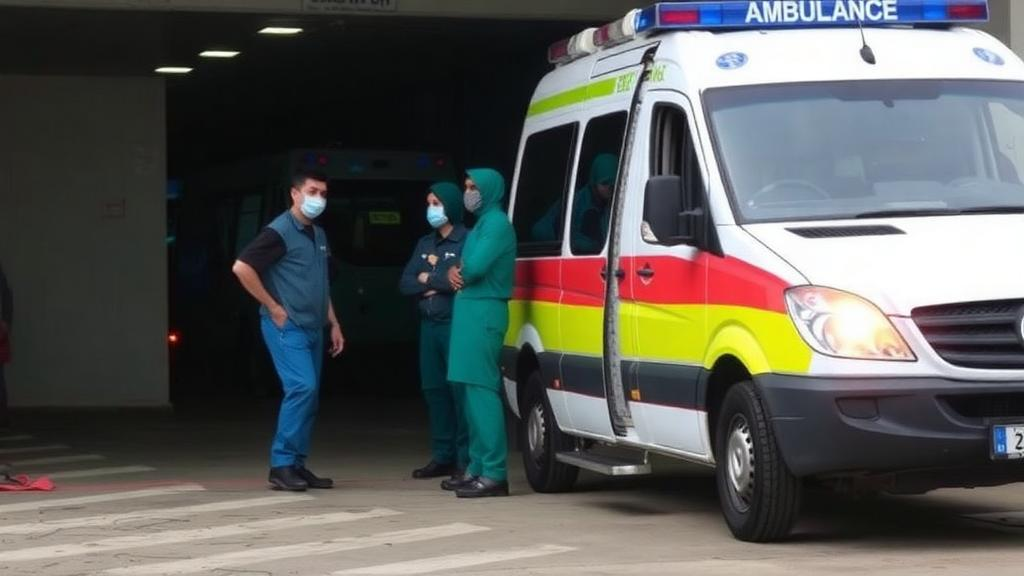
Emergency medical technicians work at one of the sharpest edges of modern healthcare, delivering urgent care to patients in ambulances, on roadsides, and in homes long before any hospital door opens. A new cross-sectional study from Sindh, Pakistan, has now quantified just how heavy that psychological burden is, finding that occupational stress is common among prehospital emergency medical technicians and closely tied to workload, call volume, and gender. The research, published in Discover Psychology, surveyed 252 emergency medical technicians working for Sindh Integrated Emergency & Health Services Rescue 1122 between July and September 2025, and offers one of the clearest portraits yet of the mental strain carried by frontline responders in the province.
The study team, led by Sanaullah of Liaquat University of Medical and Health Sciences together with colleagues from the research and development education department of Sindh Integrated Emergency and Health Services, set out to measure three things: how prevalent occupational stress is among these technicians, what drives it, and how it relates to the stress that workers themselves perceive. Prehospital emergency medical services are described in the paper as a highly stressful and unpredictable environment, one in which technicians must make rapid clinical decisions amid sirens, traffic, distressed families, and patients whose conditions can deteriorate without warning. Constant exposure to such conditions, the authors note, can lead to emotional exhaustion, anxiety, and burnout, with consequences not only for the mental health of the workforce but also for job performance and, ultimately, the quality of patient care.
Methodologically, the researchers used a cross-sectional descriptive design, drawing their sample through convenience sampling from technicians employed by the Rescue 1122 service. Each participant completed two well-established psychometric instruments: the Workplace Stress Scale, which assesses stress arising from the work environment itself, and the Perceived Stress Scale, which captures the degree to which individuals appraise their lives as unpredictable, uncontrollable, and overloaded. The use of both measures allowed the team to examine the relationship between externally generated workplace stress and the internal, subjective experience of stress, a distinction that matters for anyone designing interventions to protect responder wellbeing.
The numbers that emerged are striking. The average Workplace Stress Scale score was 21.4, with a standard deviation of 3.67, while the average Perceived Stress Scale score was 22.8, with a standard deviation of 4.1. More telling still was the relationship between the two: the study found a high positive correlation between workplace stress and perceived stress, with a Pearson correlation coefficient of 0.62 and a p-value below 0.001. In practical terms, this means that technicians who reported more stressors on the job were substantially more likely to feel stressed in their own appraisal of their lives, suggesting that the strain of prehospital work does not stay neatly confined to the ambulance.
Gender emerged as a significant differentiator. Female emergency medical technicians scored higher on the Workplace Stress Scale than their male colleagues, a difference that reached statistical significance with a t-value of 2.34 and a p-value of 0.02. The study also found that younger technicians and those with less experience reported higher levels of stress, a pattern consistent with the idea that familiarity and accumulated coping strategies may buffer some of the pressures of emergency work. Age itself, however, told a more complicated story when the researchers moved from simple group comparisons to multivariable modelling.
That modelling came in the form of multiple linear regression, a statistical technique that allows researchers to estimate the independent contribution of each factor while holding the others constant. The regression analysis revealed that the number of work hours per week, the number of calls handled per shift, and female sex all significantly influenced occupational stress. By contrast, age and marital status were not significant predictors once the other variables were accounted for. This is an important nuance: while younger and less experienced technicians reported more stress in the descriptive comparisons, the regression suggests that what really drives stress in this workforce is the sheer volume and intensity of the work itself, along with gender-related differences in how that work is experienced.
The finding that weekly working hours and per-shift call volume are significant predictors of occupational stress carries obvious operational implications. Emergency services around the world face chronic staffing pressures, and the temptation to stretch existing crews across more hours and more calls is universal. But this study provides quantitative evidence that such stretching has a measurable psychological cost. In a system like Sindh’s Rescue 1122, which serves a large and densely populated province with a high burden of road traffic injuries, medical emergencies, and disaster events, the cumulative stress load on technicians is not an abstract concern. It is a workforce health issue with direct consequences for response quality, staff retention, and the sustainability of the service itself.
The gender gap in reported workplace stress also deserves careful attention. Women working in prehospital care may face a combination of the same acute stressors as their male colleagues and additional pressures related to workplace environment, role expectations, and support structures, although the study did not dissect the mechanisms behind the difference. What the data establish is that female technicians in this sample systematically reported higher workplace stress, and that sex remained a significant predictor even after controlling for hours worked and call volume. For emergency service administrators, this points to the need for gender-sensitive occupational health policies rather than one-size-fits-all wellness programs.
The authors are explicit about the practical takeaway. The results, they write, highlight the importance of organizational interventions, stress management practices, and supportive policies in improving the wellbeing of emergency medical technicians and the quality of emergency care provision. In other words, the problem is framed not as individual weakness or poor coping, but as an organizational and structural challenge. That framing matters, because it shifts responsibility toward the systems that schedule the shifts, set the call loads, and shape the working culture, rather than toward the technicians who absorb the consequences.
The study was approved by the Institutional Human Ethics Committee of Liaquat University of Medical and Health Sciences in Jamshoro, Pakistan, under approval number 128-H33/2019 UOJ, LUMHS, and all participants gave written informed consent, with the option to withdraw at any time without penalty. The authors declared no competing interests and received no external funding for the work. As with any cross-sectional study using convenience sampling, the findings capture a snapshot of one workforce at one moment and cannot establish causal direction; it remains possible, for example, that highly stressed technicians perceive their workload differently rather than workload alone producing stress. Still, the convergence of two validated scales, a meaningful sample size, and a regression model that isolates the strongest predictors gives the findings real weight. For a profession that runs toward crises while the rest of society moves away, the study is a reminder that the people inside the ambulance carry a burden that can be measured, predicted, and, with the right policies, reduced.
Subject of Research: Occupational stress prevalence and risk factors among prehospital emergency medical technicians in Sindh, Pakistan
Article Title: Prevalence and risk factors for occupational stress among emergency medical technicians working in prehospital emergency settings in Sindh Pakistan
Article References: Prevalence and risk factors for occupational stress among emergency medical technicians working in prehospital emergency settings in Sindh Pakistan. (n.d.). https://doi.org/10.1007/s44202-026-00834-0
Image Credits: AI Generated
DOI: 10.1007/s44202-026-00834-0
Keywords: occupational stress, emergency medical technicians, prehospital emergency care, emergency medical services, perceived stress, burnout, Pakistan, Sindh, Rescue 1122, workload, workplace stress, occupational health
Cite Scienmag News
Glenn Wilkins. (October 12, 2026). Ambulance Crews Under Pressure: Study Maps Occupational Stress Among Pakistan’s Emergency Technicians. Scienmag. https://scienmag.com/ambulance-crews-under-pressure-study-maps-occupational-stress-among-pakistans-emergency-technicians/
Glenn Wilkins. "Ambulance Crews Under Pressure: Study Maps Occupational Stress Among Pakistan’s Emergency Technicians." Scienmag, 12 October 2026, https://scienmag.com/ambulance-crews-under-pressure-study-maps-occupational-stress-among-pakistans-emergency-technicians/. Accessed 12 October 2026.
Glenn Wilkins. "Ambulance Crews Under Pressure: Study Maps Occupational Stress Among Pakistan’s Emergency Technicians." Scienmag. October 12, 2026. https://scienmag.com/ambulance-crews-under-pressure-study-maps-occupational-stress-among-pakistans-emergency-technicians/


