


One of the most urgent questions in climate science is what sustained global warming does to the productivity of the ocean, the vast engine that converts sunlight and nutrients into the food that underpins nearly all marine life. Today, satellite records show that productivity in the open ocean has been slipping for roughly three decades, a decline attributed largely to warming-driven stratification that traps nutrients away from the sunlit surface. Yet climate models disagree sharply about where things are headed, projecting everything from further declines to modest gains by the end of this century. A new study of an ancient global warming catastrophe now suggests that over long timescales, the ocean may respond in a fundamentally different way than the short-term trends we observe today.
The research, published in Nature Communications, turns to the Paleocene-Eocene Thermal Maximum, or PETM, a hyperthermal event about 55.9 million years ago that is widely regarded as the best deep-time analog for modern climate change. During the PETM, between 3,000 and 10,000 gigatons of isotopically light carbon were injected into the ocean-atmosphere system within roughly 10,000 years, producing a negative carbon isotope excursion of 3 to 5 per mil. Seawater temperatures climbed by 5 to 8 degrees Celsius, and the ocean suffered acidification, deoxygenation, and major turnovers among bottom-dwelling foraminifera and calcareous nannoplankton. Although the carbon release rate was about an order of magnitude slower than today’s fossil fuel emissions, the total amount of carbon released is comparable to what high-emission scenarios project for 2100. That makes the PETM a rare natural experiment in what happens to marine ecosystems under sustained greenhouse forcing.
The team, led by Xiuwen Zhou and Weiqi Yao of the Southern University of Science and Technology in Shenzhen, tackled a long-standing contradiction in the PETM literature. Marine barite accumulation rates, considered a reliable tracer of carbon export from the surface ocean, show an average threefold increase in export productivity during the event, likely driven by enhanced nutrient input from land. But evidence from benthic foraminifera and nannofossil assemblages suggests nutrient supply declined in the South Atlantic, Southern Ocean, and North Pacific after the PETM onset, and Earth system models indicate a warmer, more stratified ocean should have suppressed productivity in the tropics. To resolve the puzzle, the researchers needed an independent record of productivity higher up the food chain, and they found one in an unlikely place: fossilized fish teeth.
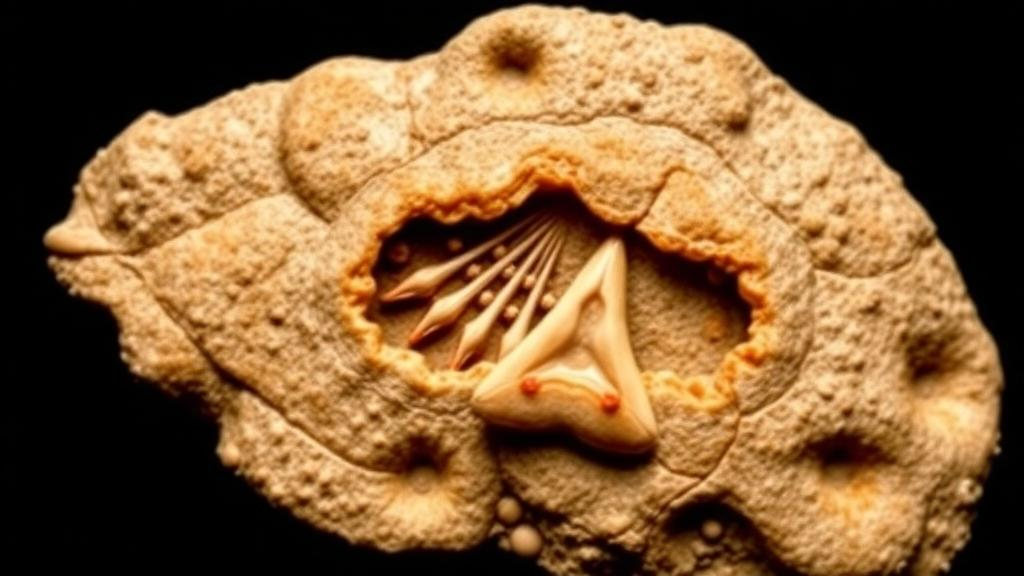
Ichthyoliths, the microscopic remains of fish teeth and shark dermal denticles, rain down onto the seafloor as fish naturally shed teeth or as predators excrete the indigestible parts of their prey. Most ichthyoliths in marine sediments come from small pelagic species, including juvenile fishes and shark taxa, which sit at mid-trophic levels and whose abundance is sensitive to both productivity and the efficiency with which energy moves through the food web. By measuring ichthyolith accumulation rates, the researchers could reconstruct fish productivity directly. They analyzed 105 samples from five sediment cores spanning the North Pacific, Eastern Equatorial Pacific, North Atlantic, South Atlantic, and Southeast Indian Ocean, and combined these with previously published data from a sixth equatorial Pacific site.
The results were striking. At the Pacific and North Atlantic sites, ichthyolith accumulation rates rose dramatically during the PETM, with peak values five to eleven times higher than background levels. The highest rates appeared in the Eastern Equatorial Pacific, reaching 121 ichthyoliths per square centimeter per thousand years at Site 1221, while the North Pacific and North Atlantic sites peaked at 51 and 64 respectively. Crucially, the rise was not an artifact of sedimentation rates, since ichthyolith abundance showed negligible correlation with the total mass of sediment accumulating. Nor was it a sign of a community shift: most ichthyoliths were smaller than 63 micrometers, tooth-type diversity remained stable across the event, and rare tooth types were evenly distributed throughout the sequence, all pointing to persistent fish communities dominated by the same conical and triangular tooth morphotypes before, during, and after the warming.
With community composition ruled out as the driver, the evidence converged on a genuine increase in fish productivity. Warmer waters can accelerate fish growth and shorten generation times, which might boost tooth flux on its own, but the researchers found a nonlinear relationship between ichthyolith rates and temperature or latitude, suggesting trophic effects alone could not explain the geographic pattern. The missing piece came from the paired barite records. At the equatorial Pacific sites, barite-derived carbon export climbed to 187 grams of carbon per square meter per year within the main carbon isotope excursion, and its two prominent peaks, one at the onset of the event and another roughly 45,000 years later, coincided precisely with the two peaks in the fish record. In the North Atlantic, export reached 166 grams of carbon per square meter per year, far above what the region supports today.
Globally, the correlation between the two proxies was statistically robust: pooled carbon export data from all sites showed a significant positive relationship with ichthyolith accumulation, with a Pearson correlation coefficient of 0.55 and a Spearman coefficient of 0.61, both significant at the 0.001 level. The spatial pattern matched too, with the strongest responses in the Eastern Equatorial Pacific and North Atlantic, regions close to upwelling zones where nutrient-rich deep waters reach the surface, and the weakest in the mid- to high-latitude Southern Hemisphere, where both export and fish productivity remained low. The implication is that enhanced carbon export from the surface ocean fueled the boom in fish productivity, delivering more food to the mid-trophic-level consumers whose teeth preserve the signal.
To understand why export productivity rose despite the stratifying effects of warming, the team ran a series of simulations with the cGENIE Earth system model, using early Eocene paleogeography and progressively switching on individual mechanisms. Doubling atmospheric carbon dioxide from 1,112 to 2,224 parts per million on its own produced only a negligible long-term increase in organic carbon export, far smaller than the proxy records demand. The decisive factor was enhanced weathering on land. Lithium isotope evidence indicates terrestrial weathering intensified globally by 50 to 60 percent during the PETM, and when the model incorporated temperature-dependent phosphorus weathering, the ocean-wide average export flux rose from 0.7 to 1.2 moles per square meter per year, with a 1.9-fold weathering enhancement pushing the flux to about 1.6 moles, consistent with the two- to threefold rise inferred from the barite records. Regional iron fertilization from volcanic ash of the North Atlantic Igneous Province and enhanced dust production in North America likely amplified productivity near those sources, which the model, lacking regional iron input, underestimates. Notably, adding redox-dependent phosphorus recycling under low-oxygen conditions contributed almost nothing, because a deeper thermocline in the warmer, more stratified ocean limited the upward transport of recycled nutrients into the sunlit zone.
The findings carry a provocative message for the future. The fertilizing effect of terrestrial nutrient input operates on longer timescales than the decadal trends captured by satellites, and the PETM record shows it can outweigh the suppressive effects of stratification, sustaining higher ocean productivity under sustained greenhouse warming. Rising export productivity may even have helped the Earth system recover from the hyperthermal by burying organic carbon and drawing down carbon dioxide, a negative feedback visible in the elevated organic carbon contents of equatorial Pacific and North Atlantic sediments from the event. The researchers caution that higher export in the water column does not necessarily mean more organic matter reaches the seafloor, since warmer, acidified waters accelerate microbial degradation of sinking particles, and that PETM dynamics cannot be applied directly to decadal forecasts. Still, the study raises the possibility that today’s declining productivity trends could be moderated, or even reversed, over the long arc of a warming century and beyond, a nuance that current climate models, with their divergent projections, have yet to fully capture.
Subject of Research: Marine productivity and fish abundance during the Paleocene-Eocene Thermal Maximum
Article Title: Coupled increases in pelagic fish productivity and export productivity during the Paleocene-Eocene Thermal Maximum
Article References: Zhou, X., Zhang, R., Tsang, M.-Y., Li, M., & Yao, W. (2026). Coupled increases in pelagic fish productivity and export productivity during the Paleocene-Eocene Thermal Maximum. Nature Communications, 17(1), Article 10030. https://doi.org/10.1038/s41467-026-77863-9
Image Credits: AI Generated
DOI: 10.1038/s41467-026-77863-9
Keywords: Paleocene-Eocene Thermal Maximum, marine productivity, ichthyoliths, marine barite, carbon export, paleoceanography, ocean warming, nutrient supply, cGENIE model, fish fossils, ocean stratification, climate change
Cite Scienmag News
Violet Maxwell. (October 12, 2026). Fossil Fish Teeth Reveal Ocean Life Boomed During an Ancient Global Warming Event. Scienmag. https://scienmag.com/fossil-fish-teeth-reveal-ocean-life-boomed-during-an-ancient-global-warming-event/
Violet Maxwell. "Fossil Fish Teeth Reveal Ocean Life Boomed During an Ancient Global Warming Event." Scienmag, 12 October 2026, https://scienmag.com/fossil-fish-teeth-reveal-ocean-life-boomed-during-an-ancient-global-warming-event/. Accessed 12 October 2026.
Violet Maxwell. "Fossil Fish Teeth Reveal Ocean Life Boomed During an Ancient Global Warming Event." Scienmag. October 12, 2026. https://scienmag.com/fossil-fish-teeth-reveal-ocean-life-boomed-during-an-ancient-global-warming-event/


