


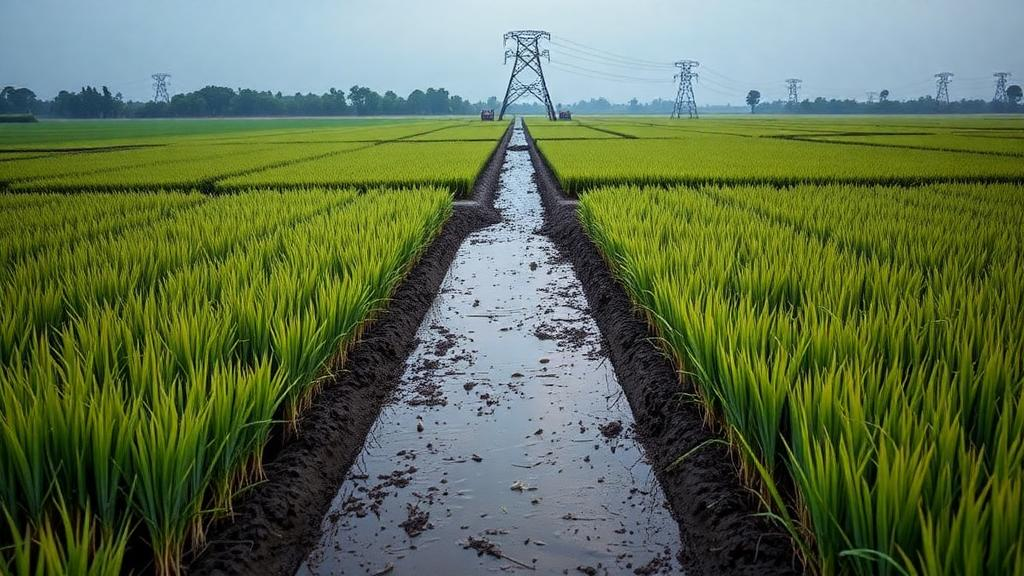
Cadmium contamination of paddy soils is one of the most stubborn problems in global rice production, and a new study suggests that the solution may lie not in expensive soil replacements or chemical amendments, but in something farmers already control: water. Researchers report in Plant and Soil that a carefully timed water management strategy, applied within a rice-for-rice cropping system, dramatically boosted the ability of rice plants to pull cadmium out of contaminated paddy fields, achieving a theoretical remediation efficiency of 43.01 percent and an actual efficiency of 37.50 percent in a two-year field trial.
The logic behind the approach is deceptively simple. Rice paddies are typically kept flooded, which keeps soils oxygen-starved and chemically reducing. Under those conditions, cadmium tends to be locked away. But rice does not need to be flooded all the time, and the moments when farmers drain a field change soil chemistry in ways that can either protect the grain or expose it to the metal. The research team, led by Xuefei Yin, Rui Huang, Saihua Liu, Jie Chen and Xionghui Ji of the Hunan Academy of Agricultural Sciences, asked whether drainage could be timed to coincide precisely with the stages when rice takes up the most cadmium, turning a food-safety liability into a remediation asset.
To test the idea, the researchers ran a pot experiment with four water management treatments, designated CK, WMG1, WMG2 and WMG3, in cadmium-contaminated paddy soil, and then validated the most promising strategy in a two-year field trial using two rice cultivars, 9311 and Pokkali, with three water regimes: continuous flooding as the control, conventional flooding irrigation, and the new targeted water management. Soil and rice samples were collected at key growth stages so that the team could track how the metal moved from soil to root to grain under each regime.
The pot results were striking. The targeted water management lowered soil pH by 0.32 units and raised the soil’s oxidation-reduction potential, or Eh, by 350 millivolts. Those two shifts matter enormously for cadmium chemistry. When a paddy is drained, oxygen floods into the soil, oxidizing sulfides and dissolving iron and manganese oxides that had been holding cadmium in place. At the same time, the drop in pH weakens the bonds between cadmium ions and soil particles. Together, these changes converted cadmium from a largely immobile store into a form plants can absorb: the concentration of DGT-labile cadmium, a measure of the metal that is actually available to plant roots, increased by 7.94-fold, and rice cadmium accumulation rose accordingly. Among the four treatments, WMG1 proved the most effective.
Even more revealing was what happened within each irrigation cycle. The researchers found that during the drying phase of every wetting-and-drying cycle, DGT-labile cadmium was on average 61.70 percent higher than during the wetting phase. In other words, each deliberate drying event released a pulse of bioavailable cadmium into the soil solution, exactly when the rice roots were positioned to take it up. By synchronizing these pulses with the crop’s critical cadmium uptake periods, the strategy ensured that the mobilized metal ended up in plant tissue rather than lingering in the soil or, crucially, being taken up by a food crop at the wrong time.
Factor analysis confirmed the causal chain: water management regulated cadmium content in the system primarily through its effects on Eh, pH and bioavailable cadmium. This mechanistic clarity is what separates the study from earlier work that observed correlations between drainage and cadmium behavior without pinning down the drivers. It also explains why the strategy can be tuned. Because the effect operates through well-understood soil chemistry, the duration and timing of drainage can be adjusted to match local soil conditions, contamination levels and the growth stage of the crop.
The field trials added a microbial dimension to the story. Under the targeted water management, the researchers documented an enrichment of iron- and sulfur-oxidizing bacteria in the rhizosphere, the narrow zone of soil surrounding rice roots. These microbes accelerate the oxidation of reduced iron and sulfur compounds, which in turn releases cadmium that had been sequestered in sulfide minerals and iron oxides. The result is a biologically reinforced version of the chemical effect: the drainage regime does not merely change the soil’s redox state directly, it also cultivates a microbial community that keeps cadmium circulating in plant-available forms. Combined with boosted cadmium bioavailability, this allowed high-cadmium-accumulating rice cultivars to extract far more of the metal than they would under conventional flooding.
The headline result came from combining the water management with Pokkali, a rice cultivar known for its high cadmium accumulation. Under this pairing, the rice extracted 474.56 grams of cadmium per hectare per year. For moderately to heavily contaminated paddies, the team calculates theoretical and actual remediation efficiencies of 43.01 percent and 37.50 percent respectively, meaning that roughly two-fifths of the relevant cadmium burden could be removed from the field in a single year of the rice-for-rice system. Because the harvested plants carry the metal off-site, the contamination is genuinely depleted rather than merely locked up, avoiding the risk that immobilized cadmium could be remobilized later by changes in land use or climate.
What makes the finding especially compelling is its practicality. Phytoremediation with dedicated hyperaccumulators such as Thlaspi caerulescens or Sedum plumbizincicola has long been studied, but those plants do not fit into rice rotations and generate no food or income. Using rice itself as the remediation crop, in a rice-for-rice system, means farmers do not have to alter the fundamental practices of paddy cultivation. The only change is the water schedule, an intervention that requires no new machinery, no amendments and no land taken out of production. The grain harvested during remediation years would presumably not enter the food chain, but the field itself stays in productive agricultural use throughout the cleanup.
The study also reframes a long-standing tension in paddy water management. Previous research has shown that drainage can reduce arsenic uptake in rice grain while increasing cadmium, creating a dilemma for farmers facing co-contaminated soils. This work shows the other side of that coin: when the goal is remediation rather than safe grain production, the cadmium-mobilizing effect of drainage becomes an advantage to be exploited rather than a risk to be avoided. With global assessments warning that soil pollution by toxic metals threatens agriculture and human health on a wide scale, and with rice serving as the staple food for billions of people, a low-cost, chemistry-driven method to deplete cadmium from the world’s paddies could prove to be one of the more consequential ideas in soil remediation to emerge in recent years. The next step, the authors’ data suggest, is matching drainage schedules and cultivar choices to the contamination profile of individual fields, turning irrigation management into a precision tool for cleaning up farmland while it keeps growing rice.
Subject of Research: Water management strategies to enhance rice-based phytoremediation of cadmium-contaminated paddy soils
Article Title: Specific water management facilitated rice-based phytoremediation of cadmium contaminated paddy fields
Article References: Yin, X., Huang, R., Liu, S., Chen, J., & Ji, X. (2026). Specific water management facilitated rice-based phytoremediation of cadmium contaminated paddy fields. Plant and Soil. https://doi.org/10.1007/s11104-026-09050-0
Image Credits: AI Generated
DOI: 10.1007/s11104-026-09050-0
Keywords: cadmium, phytoremediation, rice, paddy soil, water management, soil redox potential, DGT-labile cadmium, heavy metal contamination, iron and sulfur bacteria, phytoextraction, soil pH, food safety
Cite Scienmag News
Alan Morgan. (October 11, 2026). Timed Drainage Turns Rice Into a Cadmium-Harvesting Crop for Polluted Paddies. Scienmag. https://scienmag.com/timed-drainage-turns-rice-into-a-cadmium-harvesting-crop-for-polluted-paddies/
Alan Morgan. "Timed Drainage Turns Rice Into a Cadmium-Harvesting Crop for Polluted Paddies." Scienmag, 11 October 2026, https://scienmag.com/timed-drainage-turns-rice-into-a-cadmium-harvesting-crop-for-polluted-paddies/. Accessed 11 October 2026.
Alan Morgan. "Timed Drainage Turns Rice Into a Cadmium-Harvesting Crop for Polluted Paddies." Scienmag. October 11, 2026. https://scienmag.com/timed-drainage-turns-rice-into-a-cadmium-harvesting-crop-for-polluted-paddies/


