


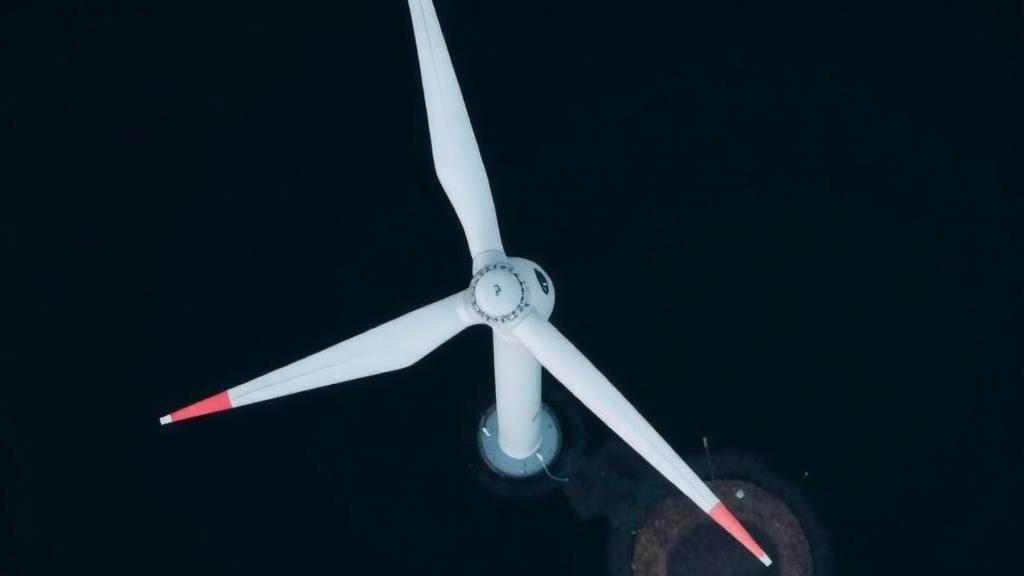
Wind turbines have become the towering sentinels of the global energy transition, but their enormous blades live hard lives. Whipped by rain, hail, dust, and UV radiation, and stressed by millions of rotation cycles, the composite surfaces of these blades gradually accumulate cracks, erosion scars, and delamination damage that can quietly grow into catastrophic failures. Catching such defects early is one of the most important maintenance tasks in the wind industry, and a new study published in Cluster Computing suggests that a carefully redesigned deep learning architecture can do it with unprecedented precision from ordinary drone photographs.
The research, led by Feng Tian, Ban Wang, Jun Li, Zhenyu Wang, and Juyong Zhang of Hangzhou Dianzi University and Hangzhou City University, introduces a framework called CHS-Net, short for Collaborative Hybrid Segmentation Network. Rather than inventing an entirely new kind of neural network, the team took the workhorse architecture of modern image segmentation, the U-Net, and systematically rebuilt it stage by stage for the specific physics and visual quirks of wind turbine blade damage. The result is a task-driven pipeline that, according to the authors’ benchmarks, outperforms a broad set of competing segmentation methods on a dataset of 2,250 annotated UAV images, reaching an intersection-over-union of 69.94 plus or minus 0.11 percent and an F1-score of 82.31 plus or minus 0.08 percent.
To understand why this matters, it helps to appreciate how deceptively difficult blade inspection actually is for machines. A hairline crack running along a glossy white surface may occupy only a handful of pixels in a drone photo, while a broad patch of rain erosion or a delaminated region can sprawl across hundreds. Defects appear at wildly different scales, with irregular, meandering shapes and boundaries that fade gradually into healthy material rather than ending in crisp edges. Lighting changes with the time of day, shadows sweep across the blade as the rotor turns, and background clutter such as sky, towers, and distant terrain competes for the network’s attention. Generic segmentation models, even powerful ones, tend to either miss the fine cracks entirely or smear their predictions across ambiguous boundaries.
CHS-Net attacks these problems at four distinct points along the classic encoder-decoder journey of a U-Net. In the encoder, the part of the network that compresses the image into increasingly abstract feature maps, the researchers embedded what they call a Contextual Multi-Scale Semantic Modeling module, abbreviated COSM. Its job is depth-adaptive multi-scale perception: at each layer of the encoder, the module gathers contextual information at multiple spatial scales so that both the tiny crack and the large erosion patch are represented with appropriate detail. Because the module adapts its receptive behavior to the depth of the layer, shallow stages focus on fine local texture while deeper stages capture broader structural context, a division of labor that mirrors how human inspectors zoom in and out while scanning a blade.
At the bottleneck of the network, the point where the compressed representation is most abstract, the team placed a CNN-ViT Interaction module, or CIT. This is where the architecture borrows from the transformer revolution that has swept through computer vision since the introduction of the Vision Transformer, or ViT, which treats an image as a sequence of patches and uses self-attention to model relationships between any two regions regardless of distance. Pure transformer models capture global context beautifully but are computationally expensive, while convolutional networks are efficient but locally focused. The CIT module blends the two, using the convolutional pathway for efficient local processing and the transformer pathway for global context modeling, with an interaction scheme that keeps the computational overhead manageable. For blade imagery, this means the network can connect a faint surface discoloration in one corner of the image to the pattern of damage elsewhere on the blade, something a purely convolutional model would struggle to do.
On the decoding side, where the network reconstructs full-resolution segmentation masks from the compressed features, CHS-Net introduces a Twin Channel-Spatial Squeeze and Excitation module, TCSE. Squeeze-and-excitation is a well-established attention technique that recalibrates feature channels by explicitly modeling their importance, and the authors extend it to operate on both the channel dimension and the spatial dimension simultaneously. In practice, this dual refinement helps the decoder decide not only which feature types matter for a given defect but also where in the image they matter, sharpening predictions in exactly the regions where erosion edges and crack tips are most ambiguous.
Perhaps the most distinctive component is the Dual-path Attention Topology module, or DAT, which replaces the conventional output head of the network. Instead of simply producing a probability map and thresholding it into a binary mask, DAT applies what the authors describe as boundary-aware topological regularization through two parallel attention paths. The motivation is topological: a crack is only useful to an inspector if it is recorded as a connected, continuous line, not as a fragmented scatter of pixels. By regularizing the output so that the topology of the predicted defect, its connectivity and boundary structure, matches the topology of the true damage, the module preserves thin, elongated structures that ordinary losses tend to break apart. For maintenance planning, where the length and continuity of a crack determine whether a blade can stay in service, this topological fidelity is arguably more valuable than raw pixel accuracy alone.
The evaluation rested on a dataset of 2,250 UAV images of wind turbine blades with pixel-level annotations of defects, spanning fine cracks, surface erosion, and delamination. Across repeated runs, CHS-Net achieved an IoU of 69.94 plus or minus 0.11 percent and an F1-score of 82.31 plus or minus 0.08 percent, which the authors report as the best overall segmentation performance among the compared methods. The tight standard deviations across runs suggest the architecture is stable rather than dependent on a lucky training run. The comparison baselines include well-known segmentation families, from the original U-Net and attention-augmented variants such as Attention U-Net and TransUNet to efficient real-time models like ICNet and transformer-based encoders of the SegFormer lineage, as well as specialized blade-defect systems drawn from the recent literature. The consistent margin across this field indicates that the gains come from the collaborative design itself rather than from any single trick.
The broader context makes the timing of this work significant. Wind energy capacity is expanding at a staggering pace, and offshore turbines in particular are growing so large that manual inspection by rope-access technicians is slow, dangerous, and expensive. Drone-based inspection has already become the industry standard for capturing visual data, but the bottleneck has shifted from image acquisition to image interpretation: a single turbine can generate thousands of images per campaign, and human analysts cannot keep pace. Earlier deep learning approaches to blade inspection largely framed the problem as object detection, drawing bounding boxes around defects with tools like YOLO or Mask R-CNN. Boxes are useful for counting defects, but they say little about the exact extent and shape of the damage, which is what engineers need to estimate remaining blade strength and schedule repairs. Semantic segmentation, the task CHS-Net addresses, produces pixel-accurate damage maps and is therefore the more demanding and more informative formulation.
The authors have released their code and data through a public GitHub repository, an increasingly important practice for reproducibility in applied machine learning. The work was supported in part by the National Natural Science Foundation of China, the Scientific Research Fund of Hangzhou Dianzi University Information Engineering College, and the Open Research Project of the State Key Laboratory of Industrial Control Technology. As drones, edge computing, and hybrid CNN-transformer architectures continue to mature, frameworks like CHS-Net point toward a future in which every turbine broadcasts its own health status after each automated inspection flight, catching the hairline crack today before it becomes the snapped blade of tomorrow.
Subject of Research: Deep learning-based segmentation of wind turbine blade defects in UAV imagery
Article Title: A deep learning framework for accurate segmentation of complex wind turbine blade defects in UAV imagery
Article References: Tian, F., Wang, B., Li, J., Wang, Z., & Zhang, J. (2026). A deep learning framework for accurate segmentation of complex wind turbine blade defects in UAV imagery. Cluster Computing, 29(12), Article 726. https://doi.org/10.1007/s10586-026-06540-9
Image Credits: AI Generated
DOI: 10.1007/s10586-026-06540-9
Keywords: wind turbine blades, deep learning, UAV imagery, defect segmentation, U-Net, Vision Transformer, attention mechanism, multi-scale perception, crack detection, predictive maintenance, computer vision, renewable energy
Cite Scienmag News
Faith Mcneil. (October 11, 2026). AI Network Spots Hidden Wind Turbine Blade Damage From Drone Photos. Scienmag. https://scienmag.com/ai-network-spots-hidden-wind-turbine-blade-damage-from-drone-photos/
Faith Mcneil. "AI Network Spots Hidden Wind Turbine Blade Damage From Drone Photos." Scienmag, 11 October 2026, https://scienmag.com/ai-network-spots-hidden-wind-turbine-blade-damage-from-drone-photos/. Accessed 11 October 2026.
Faith Mcneil. "AI Network Spots Hidden Wind Turbine Blade Damage From Drone Photos." Scienmag. October 11, 2026. https://scienmag.com/ai-network-spots-hidden-wind-turbine-blade-damage-from-drone-photos/


