


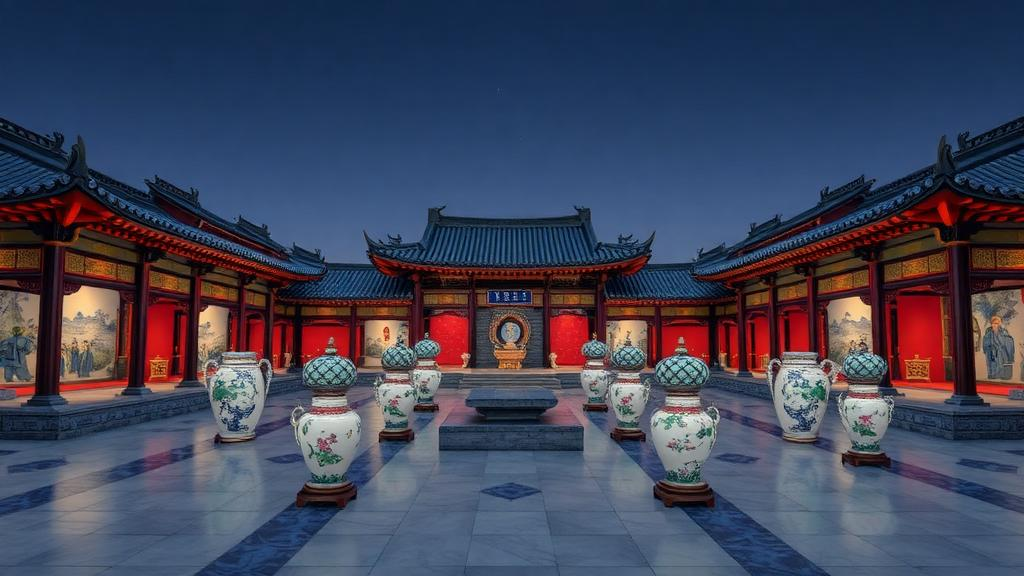
For more than a thousand years, the city of Jingdezhen in China’s Jiangxi Province has been synonymous with porcelain. Its kilns supplied imperial courts and maritime trade routes alike, and its urban fabric grew around the rhythms of clay, glaze, and fire. Today, that industrial heritage is being translated into a different medium altogether: a large-scale virtual reality reconstruction designed to let audiences walk through the historic porcelain-producing landscape as it once existed. A newly published study in npj Heritage Science describes the workflow behind this ambitious digital recreation, developed as part of Jingdezhen’s bid for World Cultural Heritage recognition, and offers one of the most detailed accounts to date of how a city-scale heritage environment can be rebuilt virtually without sacrificing scientific credibility.
The research, led by Huaqing Huang and Naifei Liu of the School of Design at Shanghai Jiao Tong University, together with colleagues from Tsinghua University, the University of Virginia, and industry partners, tackles a problem that has long divided the virtual heritage community. On one side stands scientific rigor: reconstructions must be grounded in verifiable evidence, from archaeological surveys to historical documents, and must clearly distinguish what is known from what is inferred. On the other side stands contextual narrative: an immersive display must feel complete and coherent, giving visitors a believable sense of place rather than a scattering of fragmentary, heavily caveated ruins. The authors describe these two dimensions as decoupled in much existing practice, and their central contribution is a workflow designed to reunify them.
That workflow unfolds in four sequential stages: data collection and processing, spatial scripting, virtual reconstruction, and asset production. Each stage addresses a distinct technical challenge. Data collection aggregates the heterogeneous evidence base, including surveying data, heritage documentation, maps, and interdisciplinary historical materials. Spatial scripting then organizes this material into a structured plan for the virtual environment, determining how spaces relate to one another and how a visitor’s journey through them will unfold. Virtual reconstruction translates the scripted spatial logic into three-dimensional form, while asset production refines the models, textures, and interactive elements that make the environment usable in a real-time VR platform.
One of the most consequential questions the team confronted was prioritization. Urban heritage on the scale of Jingdezhen’s porcelain industry cannot be reconstructed in exhaustive detail everywhere at once; computational budgets, production timelines, and the limits of historical evidence all impose constraints. The study therefore addresses how to determine which elements of the 3D recreation deserve the highest fidelity and which can be represented more schematically, in order to balance scientific validity against contextual completeness. This triage process, the authors argue, is where interdisciplinary judgment matters most: archaeologists, historians, conservation specialists, and digital designers must negotiate together what the virtual city should emphasize and where approximation is acceptable.
The case at the heart of the project is the core heritage area of Jingdezhen’s porcelain industry, the zone where kilns, workshops, and the commercial infrastructure of ceramic production were most densely concentrated. Reconstructing an industrial urban landscape poses particular difficulties compared with the monuments that dominate virtual heritage work. Industrial heritage is often fragmentary, with above-ground remains that are partial, altered, or buried, and its significance lies as much in processes and spatial relationships as in individual structures. Conveying how clay moved through a production chain, how kilns were organized within the city, and how workers and merchants inhabited these spaces requires a reconstruction strategy that encodes function, not just geometry.
The scale of the collaboration is itself notable. The project involved an interdisciplinary team of more than twenty experts and spanned over a year of work. The acknowledgements reveal the breadth of institutional support required: the Jingdezhen Ceramic Culture Tourism Group, known as Taowenlyu, provided early surveying data and helped coordinate implementation on the display platform; Tsinghua University and the Qingyuan Conservation team supplied key heritage data and academic consultation; and Zhongxin Digital Culture defined system technical requirements while advancing technical implementation and operational activities in parallel. The research itself was supported by the Spatial Intelligence and Virtual-Real Fusion Design Laboratory at Shanghai Jiao Tong University, where the academic core of the team is based.
This division of labor reflects a broader trend in digital heritage, where universities, cultural institutions, and technology companies increasingly collaborate on projects that no single organization could deliver alone. Heritage datasets of the kind held by conservation teams are rarely formatted for real-time rendering; game-engine-ready environments demand optimization decisions that can quietly alter historical content if made without expert oversight. The Jingdezhen workflow formalizes the handoffs between these communities, making explicit where historical interpretation ends and technical production begins, and building checkpoints into the pipeline where domain specialists can verify that the emerging 3D environment remains faithful to the evidence.
The integration of interdisciplinary historical materials, which the paper identifies as a core question of the process, is arguably the methodological heart of the work. Historical sources for a city like Jingdezhen arrive in incompatible forms: textual records, historic maps, archaeological excavation reports, architectural surveys, photographs, and oral accounts of craft practice. Each carries its own scale, precision, and bias. Fusing them into a single coherent spatial model requires decisions about alignment, dating, and confidence that are as much historiographical as they are technical. The study’s treatment of this integration stage suggests a model for other cities pursuing similar projects, particularly those whose heritage value lies in urban patterns and industrial systems rather than in freestanding architecture.
The timing of the project is significant as well. Jingdezhen’s pursuit of World Cultural Heritage status has made the legible presentation of its porcelain industry a matter of international importance, and immersive VR display offers a way to communicate that value to audiences who cannot physically access fragile sites or who would otherwise see only fragmentary remains. Virtual reconstruction, in this framing, is not merely a visualization exercise but an argument: it assembles scattered evidence into a spatial narrative that makes the case for the city’s outstanding universal value. The VR project described in the study was developed explicitly as part of that bid, positioning digital heritage tools within the formal machinery of UNESCO nomination processes.
The authors are candid that the approach carries challenges alongside its potentials. Virtual recreation at urban scale remains expensive, slow, and dependent on the availability and quality of underlying data. Interpretive choices made during spatial scripting and reconstruction can harden into apparent fact once rendered in convincing three dimensions, a risk the field of virtual heritage has debated for decades. By publishing the workflow, the team aims to make those choices visible and repeatable, so that other projects can adopt, critique, and improve the method. The article, published open access in npj Heritage Science on 11 October 2026, arrived as a peer-reviewed accepted manuscript carrying a permanent DOI, and its authors declare no competing interests. As cities worldwide grapple with how to document industrial and urban heritage threatened by development, decay, and climate pressures, the Jingdezhen project offers a template: a disciplined pipeline that treats historical evidence, narrative design, and real-time technology as equal partners in the work of keeping a vanished city alive in memory and in silicon.
Subject of Research: Virtual reality reconstruction of the urban porcelain-industry heritage of Jingdezhen, China
Article Title: Virtual recreation of urban heritage of Jingdezhen for immersive VR display
Article References: Huang, H., Liu, N., Zhang, K., Wang, S., Zhu, S., Yue, K., & Li, Z. (2026). Virtual recreation of urban heritage of Jingdezhen for immersive VR display. npj Heritage Science. https://doi.org/10.1038/s40494-026-03036-y
Image Credits: AI Generated
DOI: 10.1038/s40494-026-03036-y
Keywords: virtual reality, digital heritage, Jingdezhen, porcelain industry, urban heritage, 3D reconstruction, World Cultural Heritage, npj Heritage Science, spatial scripting, immersive display, cultural heritage, Shanghai Jiao Tong University
Cite Scienmag News
Courtney Benton. (October 11, 2026). Virtual Jingdezhen: Rebuilding China’s Porcelain Capital for Immersive VR. Scienmag. https://scienmag.com/virtual-jingdezhen-rebuilding-chinas-porcelain-capital-for-immersive-vr/
Courtney Benton. "Virtual Jingdezhen: Rebuilding China’s Porcelain Capital for Immersive VR." Scienmag, 11 October 2026, https://scienmag.com/virtual-jingdezhen-rebuilding-chinas-porcelain-capital-for-immersive-vr/. Accessed 11 October 2026.
Courtney Benton. "Virtual Jingdezhen: Rebuilding China’s Porcelain Capital for Immersive VR." Scienmag. October 11, 2026. https://scienmag.com/virtual-jingdezhen-rebuilding-chinas-porcelain-capital-for-immersive-vr/


