


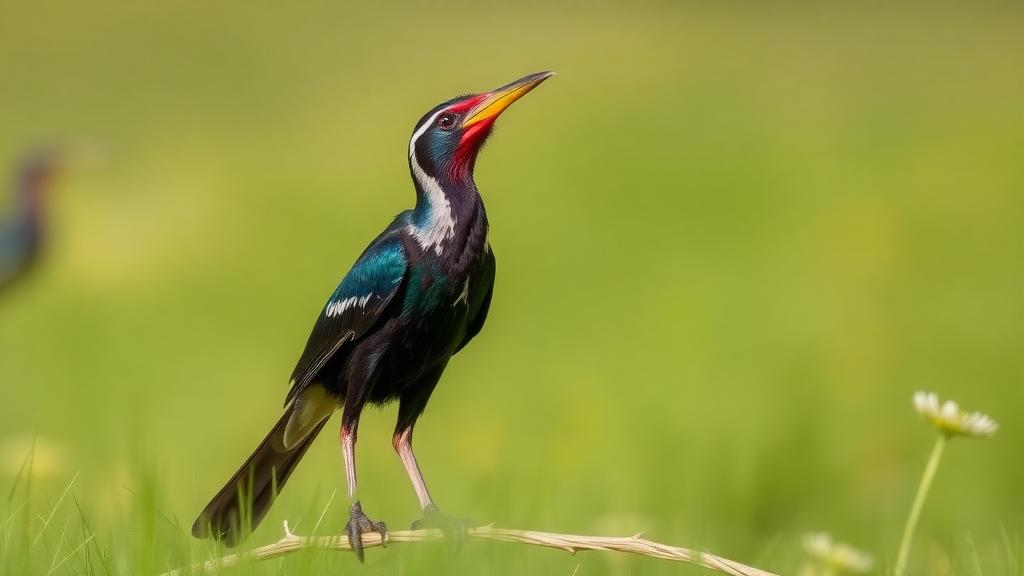
Deep in the Atlantic Forest of Brazil, a bird the size of a pigeon opens its beak and unleashes a sound that can exceed 120 peak decibels, a blast of acoustic energy comparable to standing beside a revving chainsaw or a pavement-breaking jackhammer. That bird, the bare-throated bellbird, along with a long-legged South American species called the red-legged seriema, has now been identified as a contender for the title of the world’s loudest bird, according to new research from biologists at the University of Massachusetts Amherst. The finding, published in the journal Evolution, is the product of an unprecedented field campaign that measured the call volume of 123 bird species, most of which had never had their vocal amplitude catalogued before. For the researchers, however, the record-breaking birds are a byproduct rather than the goal. The real prize is a dataset that begins to answer one of ornithology’s most stubborn questions: what physical and ecological forces determine how loud a bird can sing?
The study is the latest chapter in a career-long investigation by Jeff Podos, a biologist at the University of Massachusetts Amherst who studies the evolution of animal communication, and his former graduate student João C.T. Menezes, who carried out the research as part of his doctoral work at UMass Amherst. Podos is no stranger to acoustic superlatives. In 2019, he reported that the white bellbird of the Amazon produces the loudest bird call ever measured, an observation later confirmed by Guinness World Records. That earlier work established the white bellbird as the reigning champion of avian volume, but it also left the broader scientific picture largely blank. Scientists knew almost nothing about the range of sound levels produced across the thousands of other bird species, and even less about why that range exists at all.
The central obstacle has always been measurement. Sound amplitude, the physical quantity most people experience as volume, is fundamentally distance-dependent. A call that seems ear-splitting at one meter may barely register at a few hundred meters, so any amplitude figure is meaningless unless the distance between the microphone and the vocalizing animal is known precisely. In a laboratory, this problem is trivially solved: researchers place a bird at a fixed distance from a calibrated microphone and record the result. But capturing wild birds and transporting them to laboratories, particularly when the work involves international travel and comparisons across large numbers of species, is neither practical nor, in many cases, ethical or feasible. As a result, reliable amplitude data existed for only a tiny handful of the world’s roughly ten thousand bird species, leaving the acoustic dimension of avian evolution essentially unmapped.
The breakthrough came not from biology but from two unrelated industries. Recreational golfers drove the development of accurate, affordable laser rangefinders, devices that bounce a laser pulse off a distant target and calculate its distance from the return time. Meanwhile, occupational safety engineers refined high-resolution portable sound meters capable of capturing rapid fluctuations in sound pressure level with laboratory-grade precision. Menezes and Podos recognized that combining these two off-the-shelf technologies would allow them to do something ornithologists had never managed at scale: measure the amplitude of a bird’s call and the distance to the bird simultaneously, in the field, with the accuracy needed to standardize their measurements. Armed with a golf rangefinder and a professional sound meter, they set out to build the dataset their discipline had been missing.
The fieldwork took them to the woodlands around Amherst, Massachusetts, and across a wide sweep of Brazil, from open cerrado grasslands to the dense Atlantic Forest. In total, they gathered reliable amplitude data for 123 species, 113 of which had never previously had their call volume catalogued. The scale of the effort matters, Podos emphasizes, because the field has long suffered from a shortage of foundational measurements. Rather than testing a narrow hypothesis with a small sample, the pair set out to establish baseline data that other researchers could build on, a deliberate act of basic science in an era when such work is often undervalued. The result is the largest standardized dataset of bird call amplitude ever assembled, and it immediately revealed just how extreme the variation among species really is.
Across the 123 species, call volume spanned an astonishing 58 decibels. At the quiet end of the spectrum sits the hummingbird, whose vocalizations register around 64 decibels, roughly the level of a normal human conversation. At the loud end, the bare-throated bellbird and the red-legged seriema both exceeded 120 peak decibels, sound pressure levels that surpass the output of chainsaws and jackhammers and approach the threshold where human hearing can be damaged with prolonged exposure. Because the decibel scale is logarithmic, a 58-decibel spread represents an enormous difference in acoustic power, not a modest one. The fact that two birds separated by millions of years of evolution, and by radically different body plans and habitats, both converged on such extreme output levels suggests that very loud calls have evolved more than once, for reasons the researchers are still working to understand.
The physical correlates of loudness, at least, are becoming clear. The data confirmed that the loudest birds tend to be bigger, with bulky flight muscles that may allow them to compress air more forcefully and drive explosive sound production. They also tend to have wider beak openings, a feature that functions much like the flared bell of a trumpet, amplifying the sound waves generated by the vocal apparatus before they leave the body. These findings give biologists a set of anatomical predictors: given a bird’s body mass and beak gape, researchers can now make a reasonable estimate of how loud its call will be. In this sense, the study transforms volume from an anecdotal curiosity into a measurable, physically grounded trait that can be compared across the avian family tree and linked to the biomechanics of sound production.
The ecological story, however, proved far more elusive. Menezes and Podos had arrived at the fieldwork with a set of intuitive hypotheses about why loudness might evolve. They predicted that the loudest birds would be weaker flyers, on the theory that powerful calls could compensate for limited mobility by broadcasting a bird’s presence over long distances. They expected loud species to live in dense forests, where visual contact between individuals is obstructed and sound must carry the burden of communication. And they predicted that loud birds would practice polygamy, since a mating call that travels farther should, in principle, attract more mates. None of these broad predictions held up in the data. The loudest species did not sort neatly into any of these ecological categories, and the researchers found no clear, general relationship between call amplitude and habitat structure or mating system.
That null result is itself scientifically valuable, because it rules out the most obvious explanations and forces researchers to consider subtler possibilities. Sexual selection may operate differently than assumed, with females favoring loud males for reasons unrelated to the distance the sound travels. Predator avoidance, territorial defense, or the physics of sound propagation in specific microhabitats may each play a role that only becomes visible with more species in the dataset. Menezes notes that the team now knows some of the hows of bird loudness, meaning the anatomical machinery, but not the whys, the ecological and evolutionary pressures that shaped it. Closing that gap, he argues, will require amplitude measurements from many more species, extending the same rangefinder-and-sound-meter methodology across new regions and lineages until the patterns in the data become statistically robust.
For Podos, the incomplete answers are part of the appeal. He plans to return to the field with Menezes, the golf rangefinder, and the sound meter, guided by a philosophy he borrows from the baseball legend Yogi Berra, who observed that you can observe a lot just by watching. The work, Podos says, cannot be done in a laboratory or by mining existing databases; it demands boots on the ground and careful attention to what is actually seen and heard in the wild. In an age of increasingly remote, data-mined science, the study stands as a reminder that some of biology’s most basic quantities, like how loud a bird sings, still require someone to stand in a forest with a laser and a microphone and listen. It also leaves open a tantalizing question for the next field season: whether the bare-throated bellbird or the red-legged seriema will ultimately claim the crown now held by the white bellbird, or whether an even louder singer is waiting, unmeasured, somewhere in the world’s forests.
Subject of Research: Evolutionary biology of bird call loudness and vocal amplitude measurement
Article Title: UMass Amherst biologists may have discovered two of the world’s loudest birds
Article References: UMass Amherst biologists may have discovered two of the world’s loudest birds. (n.d.). Original publication
Image Credits: AI Generated
DOI: Not provided
Keywords: birds, bioacoustics, bare-throated bellbird, red-legged seriema, white bellbird, decibels, field research, evolution, animal communication, UMass Amherst, sound amplitude, ornithology
Cite Scienmag News
Drew Townsend. (October 11, 2026). Two New Contenders for the World’s Loudest Bird Emerge From Landmark Field Study. Scienmag. https://scienmag.com/two-new-contenders-for-the-worlds-loudest-bird-emerge-from-landmark-field-study/
Drew Townsend. "Two New Contenders for the World’s Loudest Bird Emerge From Landmark Field Study." Scienmag, 11 October 2026, https://scienmag.com/two-new-contenders-for-the-worlds-loudest-bird-emerge-from-landmark-field-study/. Accessed 11 October 2026.
Drew Townsend. "Two New Contenders for the World’s Loudest Bird Emerge From Landmark Field Study." Scienmag. October 11, 2026. https://scienmag.com/two-new-contenders-for-the-worlds-loudest-bird-emerge-from-landmark-field-study/


