


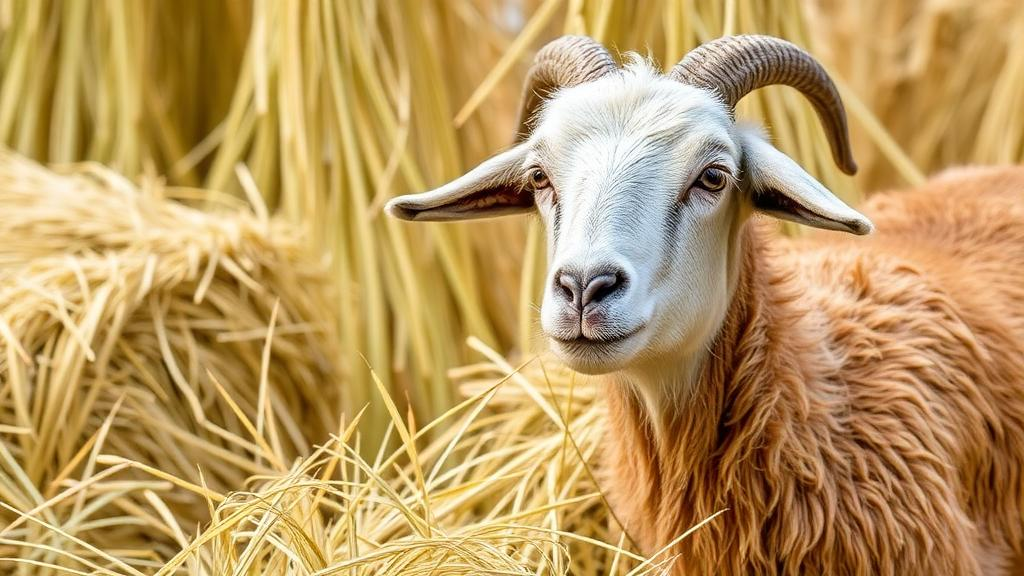
A plant that has been cultivated for thousands of years to make cloth may soon be feeding the world’s goats and sheep. Boehmeria nivea, better known as ramie, has long been prized for its strong bast fibres, which were used in ancient Chinese textiles and are still woven into high-quality fabrics today. Now a systematic review published in Discover Plants argues that this hardy perennial deserves a second career as a high-protein forage crop, capable of boosting weight gain in growing goats by up to 18 percent and milk yield in dairy goats by as much as 10 percent when it partially replaces conventional roughages. As climate change erodes the reliability of traditional pasture species, the findings arrive at a moment when livestock producers are urgently searching for feed resources that can withstand heat, drought and degraded soils without demanding heavy inputs of fertiliser, irrigation or pesticides.
The review, led by Anand Jejal and colleagues at the ICAR-National Dairy Research Institute in Karnal, India, synthesised evidence from a systematic search of the Scopus database covering the years 2000 to 2026. After applying strict eligibility criteria, the team distilled the field down to 17 core studies that explicitly examined ramie as feed, including in vivo feeding trials in ruminants, in vitro rumen fermentation experiments and agronomic assessments of forage management. The authors screened titles and abstracts independently, resolved disagreements through discussion, and followed the PRISMA 2020 reporting guidelines. They deliberately excluded studies focused purely on textile processing or on phytoremediation, the use of plants to extract heavy metals from contaminated soil, unless the biomass had also been evaluated for feeding purposes. A bibliometric keyword co-occurrence analysis using VOSviewer software revealed three dominant research themes: nutritional evaluation and digestibility, zootechnical performance in animals, and rumen fermentation dynamics.
Botanically, ramie is a vigorous perennial herb native to East Asia, propagated mainly through rhizome cuttings or root division rather than seed. This vegetative propagation confers a practical advantage for forage producers: genetic uniformity across the stand, which translates into consistent biomass quality from harvest to harvest. The crop thrives in warm, humid conditions with optimal temperatures between 25 and 30 degrees Celsius, and under intensively managed tropical fodder systems it can be cut up to 14 times per year, with upper-bound yields reaching approximately 300 tonnes of fresh material, or about 42 tonnes of dry matter, per hectare annually. The authors caution that these figures represent the ceiling of what has been achieved under specific climatic and management conditions rather than typical farm-level outputs. Ramie’s deep and extensive root system allows it to extract subsoil water during dry spells, and its capacity for osmotic adjustment helps it tolerate moderate drought, traits that give it a yield-stability edge over alfalfa, Napier grass and maize when water becomes limiting.
The nutritional case for ramie rests on a strikingly good chemical profile. Crude protein content in whole-plant forage generally falls between 15 and 24 percent of dry matter, placing it well above most tropical grasses and in the same league as high-quality legumes such as lucerne. Leaf-rich samples harvested on a 30-day interval have even approached 29 percent crude protein on a dry-matter basis. In vitro dry matter digestibility values range from 55 to 70 percent, depending on cultivar, harvest interval and plant part, while estimated metabolizable energy contents fall between 8.5 and 10.5 megajoules per kilogram of dry matter. The fibre fractions are moderate, with neutral detergent fibre between 45 and 60 percent and acid detergent fibre between 30 and 40 percent, enough to support rumination without depressing intake. The mineral profile is less straightforward: calcium is often abundant, exceeding 0.8 percent of dry matter, but phosphorus is comparatively low, producing a wide calcium-to-phosphorus ratio that demands careful ration formulation, particularly for high-producing dairy animals.
One of the most intriguing aspects of ramie’s chemistry is its content of condensed tannins, secondary plant compounds with a double-edged nutritional role. At moderate concentrations, tannins bind to dietary protein in the rumen and shield it from excessive microbial degradation, increasing the flow of so-called bypass protein to the small intestine, where it can be absorbed directly by the animal. This mechanism effectively upgrades the quality of the protein the animal derives from the feed. At high concentrations, however, tannins can reduce palatability and overall digestibility. The review found that other anti-nutritional compounds, including oxalates and saponins, are present only at low levels in the studies examined, and no toxicity has been reported at the dietary inclusion rates evaluated to date. Post-harvest processing such as ensiling or drying can further reduce these compounds, and fermentation during ensiling appears to mellow bitter-tasting secondary metabolites while stabilising key nutrients, which in turn increases voluntary intake.
The animal performance data are where ramie’s potential becomes tangible. In sheep and goats, voluntary dry matter intake of ramie-based diets has generally ranged between 2.5 and 3.5 percent of body weight in the reviewed trials, comparable to lucerne-based diets and typically higher than diets dominated by tropical grasses such as Napier grass. Partial replacement of conventional roughage with ramie increased average daily gain in growing goats by 12 to 18 percent, while lambs fed diets containing up to 30 percent ramie achieved daily gains of 160 to 180 grams. In dairy goats, replacing 25 percent of the forage component with ramie raised milk yield by 8 to 10 percent and increased concentrations of milk protein and fat. There is a clear ceiling, though: inclusion rates above 40 percent have been associated with off-flavours in milk, likely caused by the transfer of specific phenolic compounds into the milk fat, and growth performance declined in goats when dried whole-plant ramie replaced more than 35 percent of dietary alfalfa.
Beyond growth and milk, ramie appears to influence rumen function and animal health in subtler ways. Feeding studies have reported that ramie helps maintain rumen pH within the normal physiological range and increases total volatile fatty acid concentrations, the primary energy currency of the ruminant host. Blood metabolite profiles in the reviewed trials remained normal, suggesting no adverse health effects at moderate inclusion levels. Emerging in vitro work adds an environmental dimension: ramie silage lowered methane production relative to corn silage in fermentation studies, although fibre degradability declined once its inclusion exceeded 40 percent of dietary dry matter. The leaves are also rich in bioactive compounds with documented antibacterial, antiviral, antioxidant and anti-inflammatory activities. Evidence from non-ruminant species supports these functional effects, with ramie leaf powder improving antioxidant status and growth in ducks, enhancing yolk colour and fatty acid profile in laying hens, and improving carcass traits in pigs at low inclusion levels.
The review is candid about the crop’s vulnerabilities and the gaps in the evidence base. Ramie remains susceptible to economically significant pests and diseases, including the ramie moth, stem borers, anthracnose and root rot, and current control strategies lean heavily on chemical inputs that risk toxic residues in forage and inflate production costs. Forage-specific cultivars bred for resistance and quality are scarce, since breeding programmes have historically targeted fibre traits. Perhaps the most striking caveat concerns the plant’s remarkable ability to hyperaccumulate heavy metals such as zinc, cadmium and lead from contaminated soils. While this makes ramie a powerful tool for cleaning up mine sites and polluted land, it creates a serious toxicological hazard if such biomass enters the feed chain. The authors stress that ramie grown for phytoremediation must be strictly excluded from livestock diets, and that a clear separation must be maintained between remediation plantings and forage production on uncontaminated ground.
The authors conclude that ramie’s combination of agronomic adaptability, nutritional quality and multifunctionality makes it a promising candidate for climate-smart livestock systems, but they are equally clear that the current literature is fragmented. Most studies have been conducted under controlled conditions or in limited geographic regions, long-term feeding trials under commercial conditions are lacking, and farm-level economic analyses and life-cycle assessments are almost entirely absent, preventing definitive recommendations for large-scale producers. Standardised guidance on nutrient management, harvesting intervals and dietary inclusion levels is needed to reduce the variability in forage quality that currently complicates year-round feeding strategies. The research roadmap the authors propose spans forage breeding programmes, mechanistic studies of rumen microbiome dynamics and methane mitigation, and rigorous sustainability accounting. If those gaps can be filled, an ancient fibre crop may find a new role at the intersection of animal nutrition and climate resilience, turning a plant once grown for cloth into a cornerstone of feed security for the world’s small ruminants.
Subject of Research: Ramie (Boehmeria nivea) as a high-protein forage crop for small ruminant nutrition and climate-resilient livestock production
Article Title: Boehmeria nivea (Ramie) as a high protein forage crop for small ruminants focusing on agronomic potential, nutritive value, and animal performance
Article References: Jejal, A., Saxena, A., Singh, M., Saraswat, P. K., Mondal, G., & Kumar, S. (2026). Boehmeria nivea (Ramie) as a high protein forage crop for small ruminants focusing on agronomic potential, nutritive value, and animal performance. Discover Plants, 3(1), Article 453. https://doi.org/10.1007/s44372-026-00928-y
Image Credits: AI Generated
DOI: 10.1007/s44372-026-00928-y
Keywords: ramie, Boehmeria nivea, forage crop, small ruminants, goats, sheep, crude protein, drought tolerance, rumen fermentation, climate-smart agriculture, animal performance, sustainable livestock
Cite Scienmag News
Alan Morgan. (October 11, 2026). Ancient Fiber Crop Ramie Emerges as a Protein-Rich Forage for Goats and Sheep. Scienmag. https://scienmag.com/ancient-fiber-crop-ramie-emerges-as-a-protein-rich-forage-for-goats-and-sheep/
Alan Morgan. "Ancient Fiber Crop Ramie Emerges as a Protein-Rich Forage for Goats and Sheep." Scienmag, 11 October 2026, https://scienmag.com/ancient-fiber-crop-ramie-emerges-as-a-protein-rich-forage-for-goats-and-sheep/. Accessed 11 October 2026.
Alan Morgan. "Ancient Fiber Crop Ramie Emerges as a Protein-Rich Forage for Goats and Sheep." Scienmag. October 11, 2026. https://scienmag.com/ancient-fiber-crop-ramie-emerges-as-a-protein-rich-forage-for-goats-and-sheep/


