


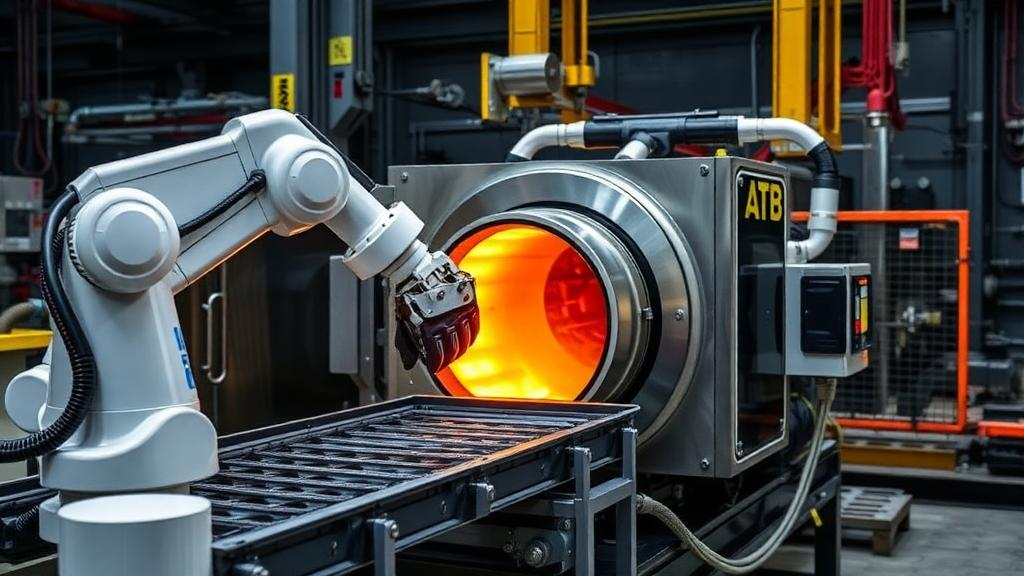
Feeding scrap metal into an electric induction furnace is one of the grittiest, most dangerous jobs in a steel plant. Workers and conventional mechanized chargers must deliver material at a steady pace into an environment of intense heat, toxic fumes, and unpredictable splashes of molten metal, and when the charging rate falters, the furnace itself slows down. A team of mechanical engineers at Kyambogo University in Uganda, working with a collaborator at Aalborg University in Denmark, has now designed and simulated a robotic system that could take humans out of that danger zone while actually charging scrap faster than the current process. Their work, published in the International Journal of Intelligent Robotics and Applications, describes a two-axis sliding robotic charging system whose simulated performance reaches 87 kilograms of scrap per minute, compared with roughly 73 kilograms per minute for the existing process at the plants they studied.
The core idea is deceptively simple: mount an industrial robot arm on a sliding base that can move along two perpendicular horizontal axes, giving the arm an extended working envelope over the furnace charging area. Rather than relying on the robot’s reach alone, the sliding platform lets the manipulator travel to the scrap stockpile, pick up a load, and deliver it to the furnace mouth without repositioning the entire cell. The researchers also specified interchangeable end effectors, meaning the robot can swap grippers to handle different types of scrap, from loose mixed material to bulkier sections. That flexibility matters because real-world scrap is not uniform; steel plants receive a wide variety of feedstock that a single fixed gripper would struggle to manage reliably.
What distinguishes the study from many robotic concepts is that it is grounded in factory data rather than assumptions. The team collected information from three actual steel manufacturing plants and used it to establish the system requirements, ensuring the design reflects real charging rates, production periods, and operating conditions rather than idealized figures. The work was funded by the Kyambogo University Competitive Research Grants Scheme, which is supported by Government of Uganda funded projects, and the authors acknowledge a group of colleagues who participated in visiting the industrial plants and compiling the data collection report that underpins the analysis.
With requirements in hand, the researchers moved through a full engineering workflow: mathematical calculations to size the system, mechanical design of the sliding base and robot mounting, development of the control architecture, finite element analysis of the critical structures, and finally a simulation-based evaluation of the whole charging operation. This sequence is standard practice in serious machine design, but it is often skipped in early-stage robotics proposals. By running structural and thermal analyses under the specified mechanical loads and temperature boundary conditions, the team could verify that the sliding base, arm mounting, and end effectors would survive the punishing environment near an induction furnace, where radiant heat and heavy, irregular scrap loads combine to stress every component.
The headline result is throughput. The designed charging capacity of 87 kilograms per minute represents roughly a 19 percent improvement over the 73 kilograms per minute achieved by the existing process. Scaled to a typical 2.5-hour production period, the researchers estimate the system would increase the amount of scrap charged from approximately 11 tons to 13 tons. In an industry where furnace utilization directly determines output and profitability, that difference is substantial. A furnace that is starved of scrap idles at temperature, wasting electrical energy and time, while erratic charging can also disrupt the melt chemistry and prolong the cycle. A consistent, high-rate charging rhythm keeps the induction furnace operating closer to its designed capacity.
The safety case is equally compelling. Manual and mechanized charging of scrap into induction furnaces exposes personnel to toxic fumes, high temperatures, molten metal splashes, and ergonomic hazards, as the authors note in their motivation for the study. The International Labour Organization has long identified the iron and steel industry as one where safety and health protections are critical, and research on occupational heat stress in hot and heavy industries documents the toll that sustained exposure takes on workers. A robotic charging system that removes people from the immediate furnace vicinity addresses these hazards at the source, and the authors’ broader research program, including a factory-level roadmap to Industry 4.0 for low digital maturity steel plants, frames this automation as part of a wider digital transformation of steelmaking in developing economies.
The design draws on a growing body of research into robots in hazardous environments. Review studies by robotics analyst Robert Bogue have charted how robots are increasingly deployed in applications too dangerous for humans, and recent work on mobile manipulators in Industry 4.0 has examined how combining robotic arms with mobility extends their usefulness on the factory floor. The Ugandan team’s approach adapts these principles to a specific, demanding niche: the charging of electric induction furnaces, which are widely used in steel remelting and foundry operations because of their efficiency and controllability. Related studies have modeled how to optimize charge and heel levels in induction furnaces and predicted melting times based on the material charge, providing the metallurgical context that any charging automation must respect.
Simulation-based evaluation plays a central role in the study’s credibility, and it reflects a broader trend in industrial engineering toward digital twins and virtual commissioning. Recent research has shown how digital twins can be applied to designing safety systems for robotic stations, allowing engineers to test failure modes and safety interlocks before hardware is ever built. By validating the two-axis sliding system in simulation, the Kyambogo team has produced evidence that the concept can meet its performance targets without the cost and risk of building a full prototype first. For steel plants in regions with limited capital for experimentation, this de-risking is not a luxury; it is often the difference between an idea that gets implemented and one that stays on paper.
The choice of a two-axis sliding base rather than a fully mobile platform or a fixed pedestal robot is itself an engineering trade-off worth appreciating. A fixed robot would be cheaper but limited in reach, while a mobile manipulator offers flexibility at the cost of complexity, navigation challenges, and stability concerns near a furnace. A sliding base constrained to two orthogonal axes provides a large, predictable rectangular working envelope, precise positioning over both the scrap stockpile and the furnace mouth, and a mechanically simple structure that can be analyzed and reinforced with standard finite element methods. Combined with a robotic tool changer of the kind commercially available from industrial automation suppliers, the architecture balances capability, robustness, and cost in a way suited to real steel plant conditions.
The study, received in June 2026 and published in October 2026, arrives at a moment when steel manufacturers worldwide are under pressure to improve both productivity and working conditions. For plants in Uganda and similar emerging markets, where the authors’ data shows meaningful gaps between current and achievable charging rates, the two-axis sliding robotic charging system offers a concrete, quantified path forward: nearly two additional tons of scrap charged per production period, fewer workers exposed to fumes, heat, and splashes, and a steadier melt cycle that keeps expensive induction furnaces doing what they were built to do. The next step beyond simulation would be physical implementation and validation in a working plant, but the design and analysis presented here give steelmakers a rigorous starting point for automating one of the most hazardous and bottleneck-prone tasks on the melt shop floor.
Subject of Research: Robotic scrap charging automation for electric induction furnaces in steel manufacturing
Article Title: Design and simulation-based evaluation of a two-axis sliding robotic scrap charging system for electric induction furnaces
Article References: Byaruhanga, L., Ssempijja, M. N., & Kangwagye, S. (2026). Design and simulation-based evaluation of a two-axis sliding robotic scrap charging system for electric induction furnaces. International Journal of Intelligent Robotics and Applications. https://doi.org/10.1007/s41315-026-00602-2
Image Credits: AI Generated
DOI: 10.1007/s41315-026-00602-2
Keywords: induction furnace, scrap charging, industrial robot, sliding platform, steel manufacturing, industrial automation, robotics, finite element analysis, worker safety, Industry 4.0, simulation, Uganda
Cite Scienmag News
Denise Maddox. (October 11, 2026). Sliding Robot Could Feed Induction Furnaces Faster and Keep Workers Safe. Scienmag. https://scienmag.com/sliding-robot-could-feed-induction-furnaces-faster-and-keep-workers-safe/
Denise Maddox. "Sliding Robot Could Feed Induction Furnaces Faster and Keep Workers Safe." Scienmag, 11 October 2026, https://scienmag.com/sliding-robot-could-feed-induction-furnaces-faster-and-keep-workers-safe/. Accessed 11 October 2026.
Denise Maddox. "Sliding Robot Could Feed Induction Furnaces Faster and Keep Workers Safe." Scienmag. October 11, 2026. https://scienmag.com/sliding-robot-could-feed-induction-furnaces-faster-and-keep-workers-safe/


