


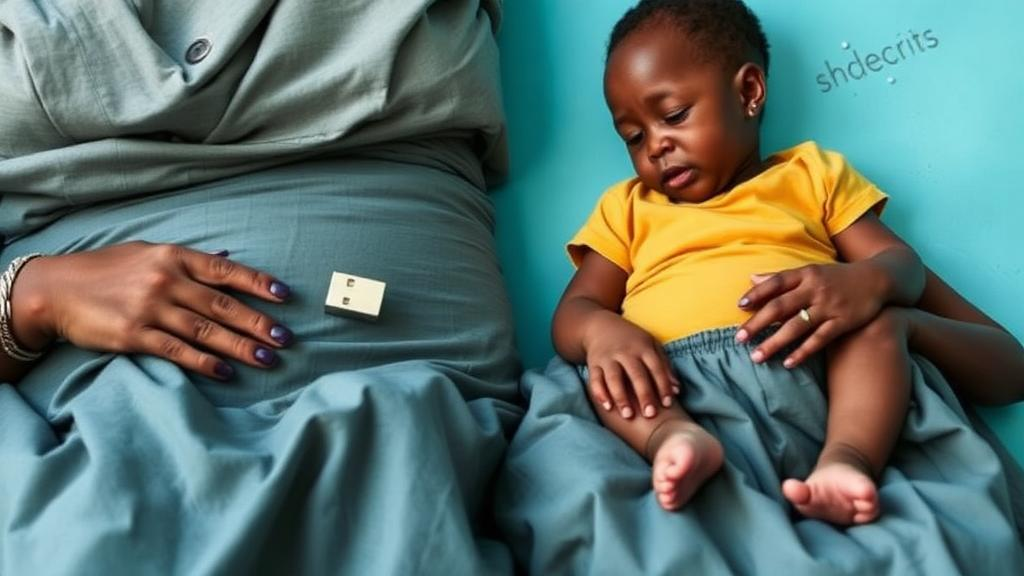
In the sprawling townships south of Johannesburg, a striking metaphor has emerged from the mouths of young mothers describing how their infants learn. “A baby is like an empty USB. Whatever you do, they store it,” one participant told researchers. The phrase, offered during a focus group discussion in Soweto, captures a conviction that runs through a new qualitative study published in the Journal of Child and Family Studies: that even pre-verbal babies are active learners, absorbing everything around them, and that mothers themselves are the primary architects of that learning. The study, led by Tom Palmer of University College London together with South African colleagues at the University of the Witwatersrand, offers one of the most detailed portraits to date of caregiving beliefs and practices during infancy in urban South Africa, a developmental window the authors say remains strikingly under-researched.
The research involved 26 mothers of infants aged between six and ten months, recruited from participants in the ongoing Bukhali randomised controlled trial, a complex continuum-of-care intervention in Soweto that begins before conception and continues through early childhood. Between 1 and 5 May 2023, the team conducted four focus group discussions lasting between 80 and 114 minutes, each involving five to eight mothers. The participants ranged from 20 to 29 years of age, and for 17 of them the study child was their first. Only four mothers were employed at the time. The most common home languages were isiZulu and Sesotho, and discussions were facilitated in English with explanation in local languages where needed, allowing participants to express themselves freely in their home tongue.
Methodologically, the team used reflexive thematic analysis, a widely applied qualitative approach developed by Braun and Clarke that treats coding and theme development as inherently subjective processes. The analysis proceeded in two stages. First, transcripts were indexed deductively against the World Health Organization’s Nurturing Care Framework, the dominant global roadmap for early childhood development, which identifies five components of nurturing care: good health, adequate nutrition, responsive caregiving, safety and security, and opportunities for early learning. In the second stage, refined analytic subcodes were generated inductively from the data itself, allowing themes to emerge from the mothers’ own words rather than from the framework’s definitions. The authors acknowledge that anchoring the initial analysis to the framework risked confirmation bias, but argue that the two-stage design preserved space for genuinely new findings while keeping the work connected to the broader evidence base.
The first major theme concerned mothers’ goals and their sense of their own role. Far from viewing infants as passive recipients of care, the mothers described themselves as active agents in their children’s learning from the earliest months. “It’s folded while it’s still wet mama. You train them now,” one mother said, invoking a proverb about shaping cloth before it dries. “Every day you are teaching your child something new,” another added. During infancy, the most frequently cited markers of healthy development were weight gain and physical growth, with mothers describing genuine excitement when the scale went up at clinic visits. A good appetite was a central goal, and feeding difficulties were a notable source of stress. Alongside this, mothers repeatedly used the word “active” as a broader indicator of wellbeing, encompassing motor, socioemotional and cognitive development in a single everyday concept that went beyond the narrow metric of weight.
Looking further ahead, the mothers’ aspirations shifted in revealing ways. Very few mentioned wanting their child to be intelligent. Instead, they emphasised social adjustment: liking, respecting and accepting other people, fitting in, and being “normal” or “like other children.” One mother put it vividly: “I want my child to like people. I want them to accept people, who they are and their situations. If they visit someone and they find that at that place they are eating cabbage, they should eat cabbage with them, they should not be judgemental.” Others spoke of calmness, self-knowledge and independence, qualities the researchers interpret as a broader vision of self-mastery rather than a narrow focus on cognitive attainment. Yet when asked directly about school readiness, mothers readily acknowledged their role as first teachers, pointing to basic numeracy and literacy, naming colours and shapes, and the knowledge children should carry with them into the classroom.
The second theme may prove the study’s most consequential contribution: the idea that nurturing care is bidirectional. Rather than a one-way delivery of services from caregiver to child, the mothers described a relationship in which both parties shape and benefit from each other. They spoke of the joy of watching first noises and small developmental leaps, of bonds that made hard circumstances bearable. “Being a mother is a really wonderful thing, seeing your child’s development as they get older, that bond,” one said. Several described talking to their babies as a form of emotional release, with one recounting a friend’s advice that “your child is your therapist.” The mothers also described routines responsive to their infants’ individual preferences for food and sleep, and stressed the importance of being calm, patient and loving. This is not to say caregiving was effortless: many reported stress, insecurity, feeding struggles and inconsolable crying, along with a near-total loss of personal time and sleep.
This emphasis on maternal enjoyment stands in deliberate contrast to the Nurturing Care Framework, which the authors describe as fundamentally outcome-oriented, framing improvements in child development in terms of benefits to the child and to society through future economic returns. The framework acknowledges the emotional bond created by mutually enjoyable interactions only briefly. Yet behavioural science suggests that enjoyment associated with an activity motivates its repetition, and that positive emotion during caregiving is associated with greater responsiveness and cognitive stimulation, while negative emotion predicts reduced sensitivity. The authors point back to John Bowlby, the pioneer of attachment theory, who argued as early as 1951 that what matters for mental health is a warm, intimate and continuous relationship in which both infant and mother find satisfaction and enjoyment. On that logic, parenting interventions that emphasise immediate affective rewards, such as joy, rather than long-term developmental outcomes, may be more likely to succeed in changing behaviour.
The third theme mapped the external forces shaping caregiving, and the picture is one of layered, sometimes contradictory influences. Many participants lived in single-parent households with fathers largely absent, though some described supportive partners contributing financially, emotionally and physically. Where fathers were absent, maternal grandmothers often stepped in, and advice from elders was generally welcomed, even when it clashed with modern conveniences. One mother contrasted her own generation’s reliance on branded instant baby cereals with the older generation’s home-cooked pap and stews. Commercial products, from Purity and Nestum foods to walking rings, the wheeled frames that let infants move upright, featured prominently in daily routines. Community attitudes were ambivalent: some mothers appreciated strangers’ interest in their babies, while others, citing dangerous environments and even fears related to witchcraft, trusted no one, including mothers-in-law, with their child.
Screens emerged as a pervasive and largely unexamined presence. Most mothers reported regular use of phones and cartoons such as Cocomelon, typically to keep infants occupied while they completed domestic tasks, though some also cited educational benefits. Only one mother mentioned reading books with her child, and her account, in which her own mother dismissed the practice as “white people things,” suggests how culturally loaded such activities can be. A few mothers worried about dependence, with one deliberately limiting phone use after noticing how instantly it silenced her crying baby. The authors note that South African evidence suggests children’s screen time likely exceeds national guideline levels, and that passive screen use may displace the interactive, responsive caregiving that drives development. Notably, the Nurturing Care Framework does not mention screens at all, focusing its early learning guidance on books and toys. The authors argue future revisions should confront the reality that screens dominate many children’s daily experience, and point to emerging international guidance that offers practical advice on content quality and boundaries rather than simple prohibition.
The study’s implications are tempered by its limitations, which the authors state candidly. All participants were drawn from an ongoing trial and were engaged with health services, and many had already received the infancy component of the Bukhali intervention, which addresses responsive caregiving, so their awareness of nurturing care may exceed that of the general population. The hospital-based setting of the discussions may have shaped responses, and the views of fathers and other caregivers were not captured. Social desirability bias, a standard hazard of focus groups, cannot be excluded, though the authors note that participants freely shared critical views on crèches, screen time and absent fathers, suggesting candour prevailed. Even so, the findings align with a growing body of qualitative work across urban Africa showing that caregivers recognise their influence on development and value loving bonds, while challenging assumptions of developmental universalism embedded in many parenting interventions. The message from Soweto is deceptively simple: mothers already know they are their children’s first teachers, they already enjoy the relationship, and interventions that build on that joy, rather than lecturing about outcomes, may be the ones that finally stick.
Subject of Research: Caregiving practices, beliefs and nurturing care during infancy in Soweto, South Africa
Article Title: “A Baby is Like an Empty USB. Whatever You Do, They Store It”: A Qualitative Study of Caregiving Practices and Beliefs in Soweto, South Africa
Article References: Palmer, T., Nkosi, N., Motlhatlhedi, M., Prost, A., Skordis, J., Gram, L., Norris, S. A., Batura, N., & Draper, C. E. (2026). “A Baby is Like an Empty USB. Whatever You Do, They Store It”: A Qualitative Study of Caregiving Practices and Beliefs in Soweto, South Africa. Journal of Child and Family Studies. https://doi.org/10.1007/s10826-026-03392-0
Image Credits: AI Generated
DOI: 10.1007/s10826-026-03392-0
Keywords: early childhood development, nurturing care, Soweto, South Africa, infancy, caregiving, responsive caregiving, Nurturing Care Framework, qualitative research, screen time, maternal wellbeing, parenting interventions
Cite Scienmag News
Courtney Benton. (October 11, 2026). Soweto Mothers See Babies as Empty USBs, Revealing How Care Flows Both Ways. Scienmag. https://scienmag.com/soweto-mothers-see-babies-as-empty-usbs-revealing-how-care-flows-both-ways/
Courtney Benton. "Soweto Mothers See Babies as Empty USBs, Revealing How Care Flows Both Ways." Scienmag, 11 October 2026, https://scienmag.com/soweto-mothers-see-babies-as-empty-usbs-revealing-how-care-flows-both-ways/. Accessed 11 October 2026.
Courtney Benton. "Soweto Mothers See Babies as Empty USBs, Revealing How Care Flows Both Ways." Scienmag. October 11, 2026. https://scienmag.com/soweto-mothers-see-babies-as-empty-usbs-revealing-how-care-flows-both-ways/


