


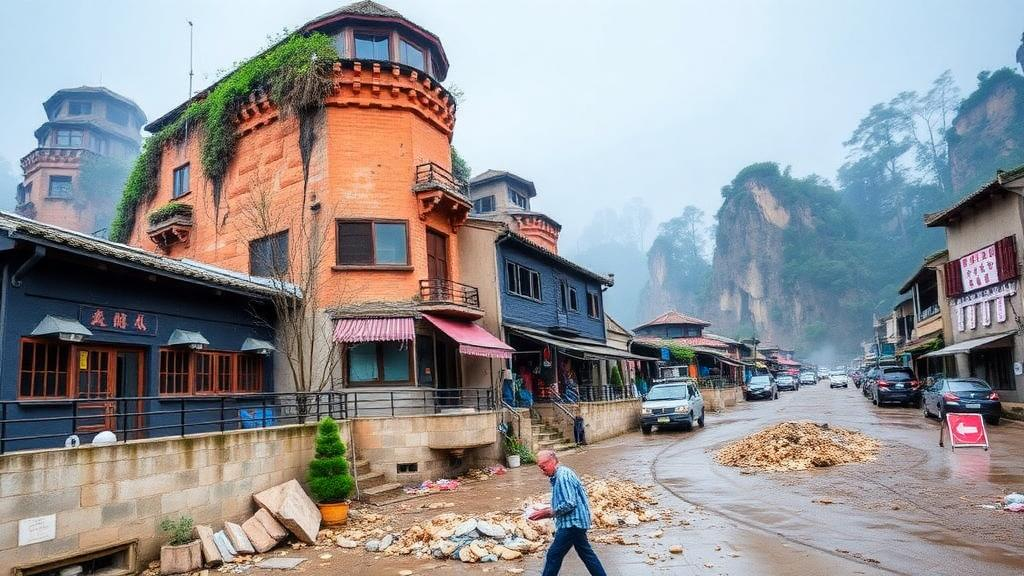
Tourism in western China’s climate-sensitive cities does not decline smoothly as climate risk rises. Instead, it behaves like a system with hidden tripwires: below certain levels of risk and income, exposure to hazards can be absorbed, managed, and even converted into a tourism asset, but once a threshold is crossed, the same exposure turns sharply destructive. That is the central finding of a new study published in Discover Sustainability, which analyzed two decades of city-level data to map where those tripwires lie and why some cities bounce back from climate shocks while others do not.
The research team, led by Lanyue Zhou of Ludwig-Maximilians-University Munich together with Hanqing Bao, Qian Wang of the Chinese Academy of Meteorological Sciences, and Junhao Li of the Northwest Institute of Eco-Environment and Resources, assembled panel data for 13 cities in western China covering the period from 2003 to 2023. Western China is an ideal natural laboratory for this question. The region spans arid basins, high plateaus, and mountain corridors, and its tourism economies range from heavily subsidized infrastructure hubs to remote destinations that depend almost entirely on scenic landscapes and cultural heritage. At the same time, the region’s development is strikingly uneven, meaning that two cities facing nearly identical climate hazards may have vastly different capacities to cope.
Methodologically, the study goes beyond the standard linear regression approach that dominates much of the climate-and-economy literature. Linear models implicitly assume that each additional unit of climate risk does the same amount of damage regardless of context. The authors instead applied panel threshold regression, a technique that searches the data for critical values of a switching variable, such as per capita GDP or a composite climate risk index, at which the relationship between climate exposure and tourism performance changes its sign or strength. They complemented this with interaction analysis to test whether development variables moderate the effects of climate exposure, and with contribution decomposition to quantify how much each factor, exposure, sensitivity, adaptive capacity, and readiness, contributes to observed tourism vulnerability and resilience.
The framework itself draws on the established vocabulary of climate vulnerability science. Exposure describes how much a city’s tourism sector is physically and economically in harm’s way from hazards such as drought, extreme heat, flooding, and sandstorms. Sensitivity captures how dependent the local economy is on climate-sensitive assets, including natural attractions and seasonal visitor flows. Adaptive capacity measures the resources, institutions, and infrastructure available to respond, while readiness reflects governance quality and the willingness to deploy those resources effectively. Vulnerability and resilience, in this framing, are not single numbers but emergent properties of how these four dimensions combine.
The headline result is a pair of thresholds with very different implications. When per capita GDP exceeds 21,357 CNY, the constraining effect of climate exposure on tourism is partly mitigated. Wealthier cities can invest in protective infrastructure, diversify their tourism products, and maintain governance systems that absorb shocks, and in some cases they manage to reconfigure exposure itself into a differentiated tourism resource, for example by marketing distinctive climate or landscape conditions that poorer competitors cannot replicate. In other words, money does not make climate risk disappear, but above this income threshold it changes what risk means for the tourism economy.
The second threshold tells the opposite story. When the composite climate risk index exceeds 1.49, the negative effect of exposure intensifies rather than fades. Under high-risk conditions, resilience and its supporting conditions, basic adaptive capacity and institutional readiness, become decisive for system stability. A city that crosses this risk line without strong adaptive foundations sees its tourism performance deteriorate disproportionately, because hazards no longer arrive as isolated events but as compounding pressures on water resources, transport networks, visitor safety, and seasonal reliability. The study’s contribution decomposition confirms that the weight of different factors shifts across these regimes: exposure dominates vulnerability in low-income, high-risk settings, while resilience indicators dominate outcomes once cities have crossed the development threshold.
Perhaps the most striking finding is that the 13 cities do not follow a single trajectory. The city-level analysis identifies three distinct transition pathways. Development-driven cities enhance resilience primarily through economic growth, using rising incomes to buy down their vulnerability. Tourism-driven cities improve their tourism reception capacity, expanding hotels, transport links, and service quality so that the sector itself becomes more robust even as hazards persist. Risk-response cities, typically those operating under high climate risk, become heavily dependent on basic adaptive capacity and readiness, meaning their stability hinges on governance and emergency response rather than on wealth or sector size. These pathways matter because they imply that a uniform national adaptation policy would misfire: a prescription that works for a development-driven city could leave a risk-response city dangerously exposed.
The study also delivers a methodological warning for anyone measuring tourism under climate stress. Tourism revenue, the authors found, is more sensitive than tourism intensity, a measure of visitor volume relative to local scale, to threshold shifts. Revenue-based indicators capture latent vulnerability and dynamic change that volume-based metrics smooth over, because spending patterns respond faster to perceived risk, infrastructure disruption, and shifting destination image than raw visitor counts do. For monitoring systems designed to give early warning of tourism decline, the choice of indicator is therefore not neutral: revenue-based measures are better at revealing when a system is quietly approaching a tipping point.
Why should readers far beyond western China care? The answer lies in the concept of threshold dependence itself. Much climate adaptation planning assumes proportionality, that incremental investments yield incremental protection. This study shows that in tourism systems, the returns to adaptation are discontinuous. A city just below the income threshold may gain little from the same adaptation spending that transforms outcomes for a city just above it, and a modest increase in composite climate risk can flip a manageable hazard regime into a destabilizing one. Similar threshold dynamics have been documented in coral reef tourism, ski economies, and coastal real estate, suggesting that the western China findings are a regional window onto a global pattern rather than a local curiosity.
The policy implications are correspondingly specific. The authors argue for threshold-sensitive and place-specific sustainability governance, meaning that adaptation planning should identify where each city sits relative to its critical thresholds and prioritize accordingly. For cities below the development threshold, the priority is building basic adaptive capacity and readiness before climate risk intensifies, since these are the factors that determine stability under high-risk conditions. For cities above it, the opportunity lies in converting exposure into differentiated tourism resources while continuing to strengthen resilience buffers. And for all of them, monitoring should track revenue-based indicators alongside visitor numbers to catch latent vulnerability early. As climate risk continues to rise across the world’s climate-sensitive regions, the study suggests that the most important question is not simply how risky the climate has become, but which side of the threshold a destination is standing on when the next shock arrives.
Subject of Research: Threshold effects of climate risk and economic development on tourism resilience in western Chinese cities
Article Title: Climate risk, uneven development, and threshold-dependent tourism resilience in selected cities of western China
Article References: Zhou, L., Bao, H., Wang, Q., & Li, J. (2026). Climate risk, uneven development, and threshold-dependent tourism resilience in selected cities of western China. Discover Sustainability, 7(1), Article 1669. https://doi.org/10.1007/s43621-026-04551-5
Image Credits: AI Generated
DOI: 10.1007/s43621-026-04551-5
Keywords: climate risk, tourism resilience, threshold effects, western China, adaptive capacity, climate vulnerability, panel threshold regression, sustainability governance, tourism economics, climate change adaptation, uneven development, city-level panel data
Cite Scienmag News
Sloane Callahan. (October 10, 2026). Climate Risk Hits Tourism Harder Past Critical Thresholds in Western China. Scienmag. https://scienmag.com/climate-risk-hits-tourism-harder-past-critical-thresholds-in-western-china/
Sloane Callahan. "Climate Risk Hits Tourism Harder Past Critical Thresholds in Western China." Scienmag, 10 October 2026, https://scienmag.com/climate-risk-hits-tourism-harder-past-critical-thresholds-in-western-china/. Accessed 10 October 2026.
Sloane Callahan. "Climate Risk Hits Tourism Harder Past Critical Thresholds in Western China." Scienmag. October 10, 2026. https://scienmag.com/climate-risk-hits-tourism-harder-past-critical-thresholds-in-western-china/


