


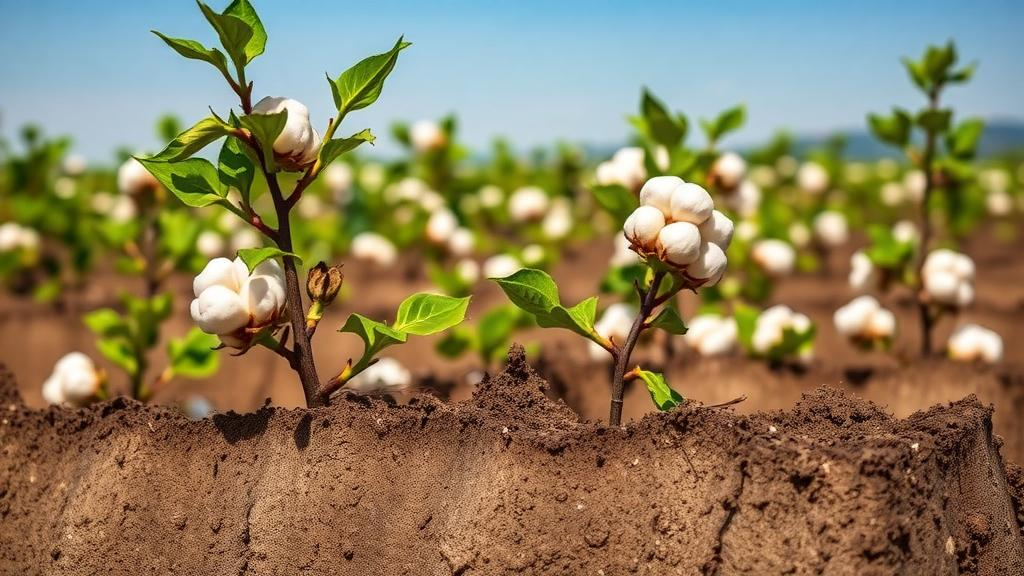
In the arid farmlands of northern Xinjiang, China, one of the world’s most productive cotton regions is locked in a quiet struggle with salt. Plastic-mulched drip irrigation has transformed desert agriculture by delivering water and fertilizer directly to the root zone with pinpoint efficiency, but the same water-saving strategy carries a hidden cost: because farmers apply only what the crop needs, there is rarely enough water to push accumulated salts below the rooting depth. Over successive seasons, sodium and other ions creep back into the soil profile, quietly strangling root systems and eroding yields. A new two-year field study published in Plant and Soil by Chao Xiao and colleagues offers a strikingly practical answer, showing that the timing and number of leaching events during the growing season matter as much as the total volume of water applied.
The research team conducted field experiments during 2020 and 2021, testing leaching quotas ranging from zero to 300 millimeters combined with schedules that varied from a single seedling-stage leaching to multiple leaching events distributed across the growing season. They tracked soil water content and salt-ion concentrations, measured root traits in different soil layers, followed nitrogen accumulation and uptake dynamics through the season, and recorded lint yield, yield components, and fiber quality. To untangle the web of interacting factors, the researchers deployed random forest modeling and exploratory partial least squares structural equation modeling, statistical tools that allowed them to identify which variables actually drove yield and quality rather than merely correlating with them.
The standout treatment, labeled W3S3, combined a moderate leaching quota with a multi-stage schedule, and its results were dramatic. Compared with the non-leached control, W3S3 increased lint yield by 112.3 percent in 2020 and 91.7 percent in 2021. Boll number, the single most important yield component in cotton, rose by 120.1 percent in the first year and 60.3 percent in the second. In an era when agricultural gains of even a few percent are celebrated, a near-doubling of lint yield through irrigation scheduling alone is the kind of result that demands attention from agronomists and water managers worldwide.
What makes the finding scientifically compelling is that the mechanism was not simply salt removal. The root responses were concentrated in the top 42 centimeters of the soil profile, where W3S3 increased surface root length density and root volume density by more than 40 percent and promoted lateral root expansion. This shallow but dense root architecture is precisely what a cotton plant needs under drip irrigation, because drip emitters wet a limited soil sphere near the surface, and roots proliferating in that moist, low-salt zone gain first access to water and dissolved nutrients. The leaching events effectively reshaped the underground environment, transforming a hostile, saline root zone into a hospitable one where fine roots could branch and forage.
Nitrogen dynamics revealed a second layer of the story. W3S3 improved soil moisture, reduced salt-ion pressure on the plants, enhanced both root and shoot nitrogen accumulation, and prolonged the effective period of nitrogen uptake by about 20 days. In cotton, late-season nitrogen uptake is critical for boll filling and fiber development, and salt stress typically shortens this window by accelerating senescence. By keeping the root zone moist and dilute in salts, the multi-stage leaching schedule allowed plants to keep absorbing nitrogen deep into the boll-setting period, effectively extending the crop’s productive lifespan. The extra three weeks of active uptake translated directly into more and heavier bolls.
The study also illuminated the tradeoffs between yield and fiber quality, a tension that has long frustrated cotton breeders and agronomists. Yield was driven primarily by boll number, nitrogen uptake, soil moisture, and sodium concentration in the root zone, while fiber quality was associated with a different set of variables: sodium levels, the root nitrogen-uptake rate, root length, soil moisture, and root surface area. Notably, the W3 leaching quota increased the spinning consistency index and fiber length, meaning that the moderate quota improved quality even where the multi-stage schedule drove the yield gains. This separation of drivers suggests that farmers and researchers can, to a meaningful degree, tune leaching schedules for yield and leaching quotas for quality rather than accepting an unavoidable compromise between the two.
The statistical modeling added mechanistic rigor to these observations. Random forest analysis ranked the importance of candidate drivers, while the structural equation modeling traced pathways linking water and ion redistribution in the root zone to root architecture, nitrogen uptake, and ultimately yield and quality outcomes. Together, the two approaches supported a coherent causal chain: leaching events redistribute water and push salts away from active rooting zones, the improved hydrochemical environment stimulates root growth and lateral branching, the expanded root system sustains nitrogen uptake longer into the season, and the combination of more bolls and better-fed fibers produces the yield and quality gains observed in the field.
The broader context makes these results especially timely. Salt-affected soils constrain agriculture across arid regions on every continent, and water scarcity is intensifying across northwestern China, making it impossible to simply flush soils with generous irrigation as past generations of farmers did. Researchers have documented the tension between water savings and salinization prevention in dryland irrigation, and long-term mulched drip irrigation has been flagged as a potential risk to agricultural sustainability precisely because restricted water application promotes salt accumulation. The Xinjiang study demonstrates that the solution lies not in choosing between water conservation and salt control, but in engineering the temporal distribution of limited leaching water so that each event does maximum work.
There are, of course, caveats and open questions. The experiments spanned two years at sites in northern Xinjiang, and leaching requirements will vary with soil texture, initial salinity, water table depth, and the salinity of the irrigation water itself. Applying 300 millimeters of extra water, even in moderate staged doses, carries a real cost in water-scarce basins, and excessive leaching can mobilize nitrogen below the root zone or raise shallow water tables. The authors’ finding that moderate quotas outperformed extremes suggests a sweet spot, but translating W3S3 into practical recommendations will require local calibration and, ideally, longer-term trials to confirm that the approach prevents salt accumulation over multiple seasons rather than merely redistributing it within a single year.
Even with those qualifications, the study reframes how scientists think about managing saline-alkali agroecosystems. The conclusion that properly timed moderate drip leaching improved cotton performance by sustaining active roots and late-season nitrogen uptake, rather than through salt removal alone, elevates root ecology from a passive consequence of irrigation to an active management target. For the millions of hectares of salt-affected farmland under drip irrigation worldwide, the message is that the invisible architecture of roots, shaped season by season by the rhythm of water moving through soil, may be the most powerful lever available for reconciling high yields, good fiber quality, and the harsh arithmetic of water scarcity.
Subject of Research: Effects of multi-stage drip leaching on root architecture, nitrogen uptake, and yield-quality tradeoffs in saline-alkali cotton fields
Article Title: Root-zone water-ion redistribution links multi-stage drip leaching to root architecture, nitrogen uptake, and yield-quality tradeoffs in saline-alkali cotton agroecosystems
Article References: Xiao, C., Chen, G., Zhang, F., Fan, J., & Zhang, Q. (2026). Root-zone water-ion redistribution links multi-stage drip leaching to root architecture, nitrogen uptake, and yield-quality tradeoffs in saline-alkali cotton agroecosystems. Plant and Soil. https://doi.org/10.1007/s11104-026-09013-5
Image Credits: AI Generated
DOI: 10.1007/s11104-026-09013-5
Keywords: cotton, drip irrigation, soil salinity, leaching, root architecture, nitrogen uptake, lint yield, fiber quality, saline-alkali soil, Xinjiang, water management, agronomy
Cite Scienmag News
Alan Morgan. (October 10, 2026). Timed Drip Leaching Doubles Cotton Yields on Salty Soil by Reshaping Roots. Scienmag. https://scienmag.com/timed-drip-leaching-doubles-cotton-yields-on-salty-soil-by-reshaping-roots/
Alan Morgan. "Timed Drip Leaching Doubles Cotton Yields on Salty Soil by Reshaping Roots." Scienmag, 10 October 2026, https://scienmag.com/timed-drip-leaching-doubles-cotton-yields-on-salty-soil-by-reshaping-roots/. Accessed 10 October 2026.
Alan Morgan. "Timed Drip Leaching Doubles Cotton Yields on Salty Soil by Reshaping Roots." Scienmag. October 10, 2026. https://scienmag.com/timed-drip-leaching-doubles-cotton-yields-on-salty-soil-by-reshaping-roots/


