


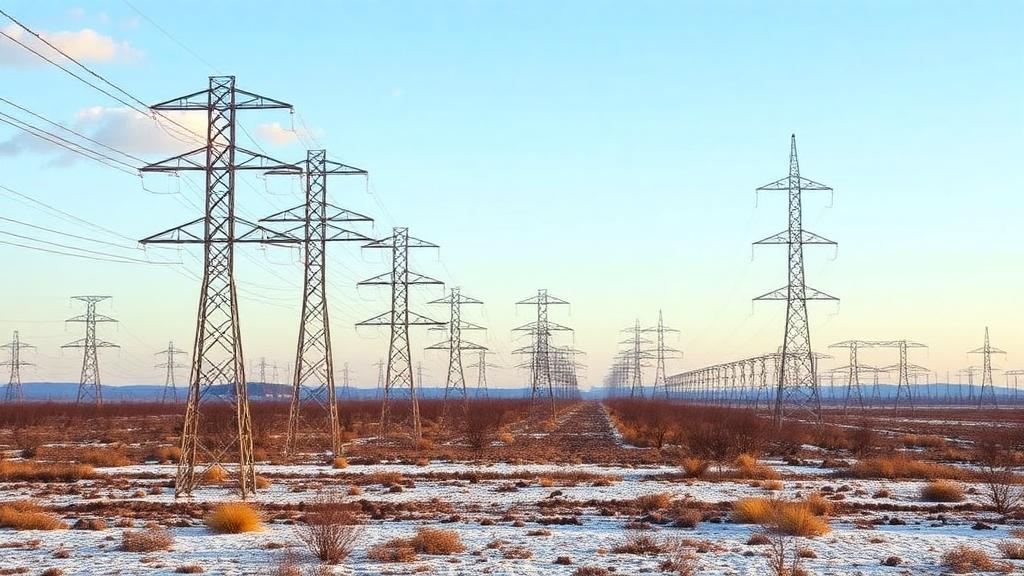
Artificial intelligence has landed on the electricity grid from two directions at once, and the collision is creating one of the most consequential policy dilemmas of the energy transition. On one side, AI has become a major new source of electricity demand, driven by the rapid proliferation of power-hungry data centres. On the other, it is emerging as one of the most promising tools available for making that same grid resilient to a changing climate. According to a new policy brief from scientists at the United Nations University Institute for Water, Environment and Health (UNU-INWEH), the question facing governments is no longer whether to deploy AI for grid resilience, but under what guardrails such deployment should occur. The publication, titled Employing Domain-Informed AI for Energy Planning and Decarbonization under Uncertainty, was written for national regulators and climate-finance institutions and is intended as a step toward safeguards that can accelerate decarbonisation targets through 2030.
The core warning of the brief is stark: governments are approving electricity infrastructure with operational lifespans of fifteen to twenty years on the basis of historical weather records that are unlikely to hold in the coming decades. Capacity planners, the authors argue, are effectively designing tomorrow’s power systems using data that describes a climate that no longer exists. This mismatch between planning assumptions and physical reality is framed not primarily as a technical shortcoming but as a fiscal exposure. When capital is deployed against stationary historical data for assets that must operate for decades, the result is a growing stock of stranded assets as physical climate risks materialise. For climate-finance institutions, the authors conclude, forward-looking risk assessment should therefore be treated as a condition of sound capital allocation rather than an optional refinement.
At the centre of the analysis is a feedback loop that makes the problem self-reinforcing. Renewable energy is a critical instrument of climate change mitigation, yet it is more susceptible to adverse climate conditions than fossil fuel-based generation. The very technologies deployed to slow climate change thus become less predictable as the climate changes, because wind patterns, solar irradiance, and hydrological conditions all shift with warming. At the same time, rising temperatures push electricity demand upwards through increased air conditioning and through more groundwater pumping in drier regions. The renewable sector is projected to nearly triple in size by 2030 according to the International Energy Agency’s Renewables 2024 report, but that historic expansion is being planned against shifting rather than stable weather, compounding the uncertainty at every stage of the investment chain.
Demand, meanwhile, is rising faster than planners had assumed. The authors warn that the growth trajectory of power-intensive end-uses, including data centres and electric vehicles, already exceeds anticipated capacity expansion needs. Unregulated AI data centres consume vast amounts of electricity and directly strain the grids on which they are built, adding load in locations and at scales that existing planning processes were never designed to accommodate. Dr Renee Obringer, Research Fellow of Urban and Interdependent Infrastructure Systems at UNU-INWEH and lead author of the publication, captured the tension in her assessment of the situation. We are asking the grid to absorb more renewable energy and more demand at the same time, she said, and we are making those decisions with data that describes a climate we no longer live in. The uncomfortable part, she noted, is that AI sits on both sides of the ledger: it is one of the reasons demand is climbing, and it is also the fastest route available for planning for what is coming.
The brief identifies a persistent institutional gap as a primary barrier to grid resilience. Research on climate impacts has advanced considerably, but it is not consistently reaching the regulatory agencies responsible for capacity planning, which continue to rely on historical weather data to anticipate demand spikes. The consequence is a systematic lag between what climate science can tell planners and what planning practice actually incorporates. The general circulation models that underpin state-of-the-art climate impact assessment are, the authors note, hard to integrate into energy planning workflows, difficult to downscale to the spatial scales on which infrastructure decisions turn, and slow to yield the specific variables that energy systems modellers need. In practical terms, the best available climate science is often too coarse, too slow, and too unwieldy to inform decisions about where to site a substation or how much transmission capacity to build.
This is where domain-informed AI enters the argument, though the authors are careful to position it as one of many necessary solutions rather than a remedy on its own. Domain-informed AI refers to algorithms that are tailored to a specific application area, such as energy systems, and that are more transparent about how they are trained than large language models or general-purpose deep learning architectures. Because these models are built for the problem at hand, they often outperform general-purpose alternatives, and because their reasoning is legible, planners can fold them into existing regulatory and operational processes. Their value lies precisely in what current tools cannot do: domain-informed AI models already deliver highly accurate short and long-term renewable forecasts, and AI climate emulators, which approximate the outputs of full climate models at a fraction of the computational cost, are progressing rapidly in accuracy.
The policy recommendations that follow are unusually specific for a field often dominated by general exhortations. The authors call on regulators to institutionalise adaptive governance frameworks capable of revising planning assumptions as climate conditions evolve. They urge the integration of energy systems modellers with climate scientists in integrated modelling that spans water, transport, and information and communications technology networks, reflecting the deep interdependence of modern infrastructure. Most pointedly, they recommend that regulators mandate transparent, domain-informed AI models as an enforceable standard for capacity planning approval, effectively making model interpretability a legal requirement rather than a best practice. To ensure safety and public trust, regulators should classify opaque deep learning systems as severe operational hazards and enforce strict guardrails against algorithmic training bias, ensuring that models trained on skewed or incomplete data cannot silently distort decisions about critical infrastructure.
The brief also addresses the demand side of the AI equation directly. Unregulated data centres strain the grid, and the authors argue that policymakers should require that AI data centres operate primarily on verifiable renewable energy. This recommendation acknowledges that the same technology being promoted as a planning tool is simultaneously one of the fastest-growing sources of load, and that allowing that load to be met with fossil generation would undermine the decarbonisation goals the technology is meant to serve. The distinction between claimed and verifiable renewable supply is significant, since it implies accounting and auditing mechanisms capable of confirming that data centre consumption is genuinely matched to clean generation rather than simply offset on paper.
Professor Kaveh Madani, Director of UNU-INWEH and a co-author of the brief, framed the dilemma as one that cannot be resolved by either enthusiasm or rejection. AI is being offered to governments as an answer to the energy transition while quietly becoming one of its largest new burdens, he said, and both of those things are true at once. Rejecting these tools would slow decarbonisation, he argued, but adopting them without transparency rules or limits on their own energy use would simply exchange one risk for another. The task, in his formulation, is not to choose between the two but to set the conditions under which AI is allowed near critical infrastructure. That framing shifts the debate from a binary question of adoption to a regulatory design problem, one that touches on model transparency, energy accounting, and the institutional pathways through which climate science reaches planning agencies.
The publication arrives at a moment when the stakes of grid planning decisions are unusually high. The renewable sector’s projected near-tripling by 2030 represents one of the largest coordinated infrastructure build-outs in history, and every turbine, solar array, and transmission line approved today will operate for decades under climate conditions that historical records cannot describe. The authors, Obringer together with co-authors M. Matin and K. Madani, published the brief through UNU-INWEH, which is marking its thirtieth anniversary of operation in 2026 and is known as the UN’s think tank on water. Whether the recommendations translate into enforceable standards will depend on regulators and climate-finance institutions, the audiences for whom the brief was written. What the publication makes clear is that the window for embedding forward-looking climate risk into capital allocation is now, before another cycle of fifteen to twenty year assets is locked into a climate that the data used to plan them no longer describes.
Subject of Research: Domain-informed AI for climate-resilient electricity grid planning and decarbonization
Article Title: Electrical grids planned on outdated climate data face physical and fiscal risk: UN University scientists propose domain-informed AI as the fix
Article References: Electrical grids planned on outdated climate data face physical and fiscal risk: UN University scientists propose domain-informed AI as the fix. (n.d.). Original publication
Image Credits: AI Generated
DOI: Not provided
Keywords: electricity grids, artificial intelligence, climate change, renewable energy, energy planning, data centres, stranded assets, grid resilience, climate risk, regulation, decarbonization, UN University
Cite Scienmag News
Sloane Callahan. (October 10, 2026). Grids Built on Yesterday’s Weather: UNU Scientists Say AI Could Save Power Planning. Scienmag. https://scienmag.com/grids-built-on-yesterdays-weather-unu-scientists-say-ai-could-save-power-planning/
Sloane Callahan. "Grids Built on Yesterday’s Weather: UNU Scientists Say AI Could Save Power Planning." Scienmag, 10 October 2026, https://scienmag.com/grids-built-on-yesterdays-weather-unu-scientists-say-ai-could-save-power-planning/. Accessed 10 October 2026.
Sloane Callahan. "Grids Built on Yesterday’s Weather: UNU Scientists Say AI Could Save Power Planning." Scienmag. October 10, 2026. https://scienmag.com/grids-built-on-yesterdays-weather-unu-scientists-say-ai-could-save-power-planning/


