


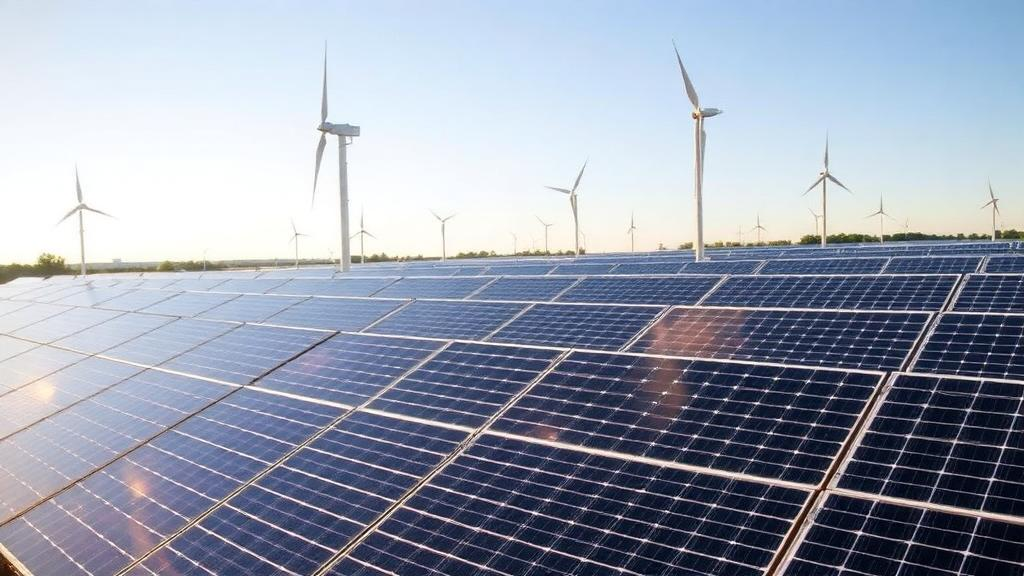
The global race to build solar panels and wind turbines is usually framed as a sprint toward 2050, the year by which most national and international climate plans envision a fully decarbonized electricity system. But a new study published in PLOS Sustainability and Transformation argues that the real challenge begins only after that finish line is crossed. Once the world’s renewable fleet is built, it will not simply sit there generating clean power forever. Solar panels and wind turbines age, degrade, and must be replaced, which means the energy transition is not a one-time construction project but the start of a permanent industrial metabolism of renewal.
Joseph Le Bihan, Thomas Lapi, and José Halloy modeled this shift from deployment to renewal using a two-phase growth framework. In the first phase, installed capacity grows exponentially as countries race toward their targets. In the second phase, capacity stabilizes at the desired level, and the industry’s job changes fundamentally: instead of adding new panels and turbines, it must manufacture replacements at exactly the rate at which old ones retire. By coupling this growth pattern with a Weibull distribution, a standard statistical tool for describing how components fail over time, the researchers estimated the annual production of photovoltaic panels and wind turbines needed both to expand the system and to keep it running indefinitely.
The Weibull approach matters because renewable hardware does not all fail at once. A wind turbine installed this year might last twenty-five years, while its neighbor could fail a few years earlier or later. The Weibull distribution captures this spread of lifespans around an average, allowing the model to calculate how many units retire in any given year as a function of when they were installed. When those retirement waves are layered on top of the deployment schedule, the total production demand for the industry emerges, and it does not always look like a smooth curve.
The study’s central finding hinges on a deceptively simple ratio: the duration of deployment compared to the average lifespan of the technology. The researchers define deployment duration as the time it takes to go from 10 percent to 90 percent of the target capacity. If that deployment window is shorter than about 1.3 times the average lifespan of the equipment, the production system overshoots. Massive installation waves are followed, one lifespan later, by massive replacement waves, and these successive cycles of building and rebuilding generate damped oscillations in annual production. The industry swings between producing too much and too little, like a pendulum gradually settling but never quite still.
If, on the other hand, deployment is gradual, stretched out over a period longer than that critical threshold, the retirement waves from early installations begin arriving while new installations are still ongoing. The two flows overlap and smooth each other out, and annual production rises gently before settling at the steady-state renewal rate, the amount needed simply to replace hardware as it wears out. In this scenario, the industry avoids the whiplash entirely, growing monotonically toward a stable production level that can be sustained indefinitely.
Applied to real-world technology, the distinction becomes striking. Photovoltaic panels have relatively short lifespans compared to the breakneck pace at which solar capacity is currently being added worldwide. Given present growth rates, the model suggests the PV industry could experience significant oscillations, with annual production swinging from 20 percent to 150 percent of global output. Such swings would translate into cycles of overproduction, with factories idling and prices collapsing, followed by underproduction, with shortages and supply chain strain. Wind power, by contrast, follows a monotonic growth trajectory in the model, largely because wind deployment is slower relative to longer turbine lifespans, keeping the system on the smooth side of the critical threshold.
The technical mechanism behind these oscillations is worth appreciating. Each cohort of installed capacity generates a delayed echo: when a large batch of panels installed during a boom reaches the end of its life roughly two or three decades later, the replacement demand spikes. If the original boom was fast and concentrated, the echo is sharp and tall. If the next boom is driven by the need to replace that echo, it in turn produces another echo, though each successive wave is damped as the system converges toward equilibrium. The result is a ringing bell of industrial activity that gradually quiets, but only after decades of volatility. For an industry that must plan factories, mines for raw materials, recycling facilities, and workforces, this volatility is not a trivial detail; it shapes investment decisions, employment, and the reliability of supply chains.
The implications extend well beyond solar and wind. The researchers frame their findings as a window onto a broader and often overlooked challenge in the energy transition: the shift from infrastructure expansion to long-term maintenance. Most climate modeling and policy discussion focuses on how quickly renewable capacity can be built, treating 2050 as an endpoint. The new analysis reframes mid-century as a transition point between two very different industrial regimes. During deployment, the measure of success is speed. During renewal, the measure of success is stability, the ability to produce replacement hardware at a steady, predictable rate for as long as the renewable energy system exists.
That reframing carries practical lessons for policymakers and industry planners today. Deployment speed is not an unambiguously good variable to maximize. Ambitious energy targets achieved through extremely rapid build-out may sow the seeds of future industrial instability, because the faster the fleet is installed relative to its lifespan, the larger the replacement waves it will generate. Slower, more deliberate deployment, or technologies and business models that extend equipment lifespans, can flatten those waves before they form. The study identifies lifespan as the second key factor influencing production dynamics, meaning that durability, repairability, and recycling are not merely environmental virtues but tools for smoothing the industrial trajectory of the entire energy system.
None of this diminishes the urgency of the transition; the world still needs to build an enormous amount of solar and wind capacity in the coming decades to displace fossil fuels. What the study adds is a longer horizon and a warning about the shape of the curve beyond it. The renewable energy system of the late twenty-first century will be less like a monument unveiled in 2050 and more like a living infrastructure that constantly renews itself, with all the industrial rhythms that entails. Planning for that renewal now, the authors argue, is crucial for ensuring the resilience and sustainability of renewable energy systems beyond mid-century, so that the clean energy future the world is racing to build does not arrive with an unstable heartbeat.
Subject of Research: Long-term renewal dynamics and production oscillations of the global solar and wind energy system beyond 2050
Article Title: Beyond 2050: From deployment to renewal of the global solar and wind energy system
Article References: Le Bihan, J., Lapi, T., & Halloy, J. (2026). Beyond 2050: From deployment to renewal of the global solar and wind energy system. PLOS Sustainability and Transformation, 5(4), e0000234. https://doi.org/10.1371/journal.pstr.0000234
Image Credits: AI Generated
DOI: 10.1371/journal.pstr.0000234
Keywords: solar energy, wind power, energy transition, photovoltaics, Weibull distribution, renewable energy, capacity deployment, industrial dynamics, sustainability, 2050 targets, production oscillations, lifespan
Cite Scienmag News
Faith Mcneil. (October 10, 2026). Solar’s Coming Boom-and-Bust: Why the Energy Transition May Oscillate After 2050. Scienmag. https://scienmag.com/solars-coming-boom-and-bust-why-the-energy-transition-may-oscillate-after-2050/
Faith Mcneil. "Solar’s Coming Boom-and-Bust: Why the Energy Transition May Oscillate After 2050." Scienmag, 10 October 2026, https://scienmag.com/solars-coming-boom-and-bust-why-the-energy-transition-may-oscillate-after-2050/. Accessed 10 October 2026.
Faith Mcneil. "Solar’s Coming Boom-and-Bust: Why the Energy Transition May Oscillate After 2050." Scienmag. October 10, 2026. https://scienmag.com/solars-coming-boom-and-bust-why-the-energy-transition-may-oscillate-after-2050/


