


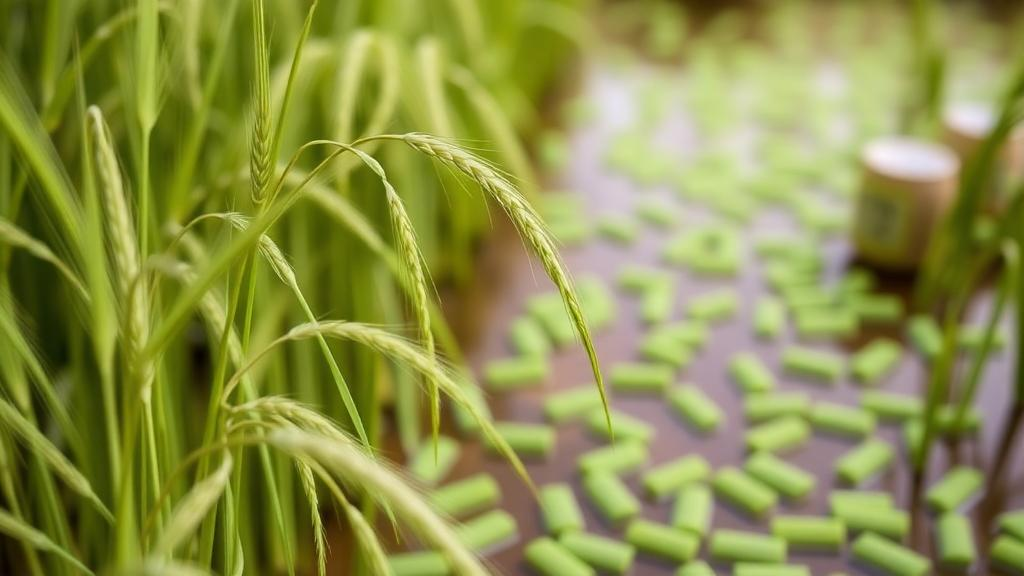
Every grain of barley destined for a glass of Scotch whisky begins its life in soil, and for decades that soil has been fed almost entirely by synthetic fertiliser. The nitrogen that drives cereal yields comes from the Haber–Bosch process, an industrial feat that consumes an estimated one to three percent of global energy and generates a comparable share of greenhouse gas emissions. Once applied, nitrogenous fertiliser can also decompose into nitrous oxide, a gas responsible for roughly four to five percent of total global greenhouse emissions, while excess nitrogen and phosphorus wash into waterways and drive eutrophication. Against this backdrop, a team of researchers at the James Hutton Institute, the University of Dundee and Chivas Brothers – Pernod Ricard has tested a radically different idea: feeding barley with dried microalgae. Their findings, published in the journal Plant and Soil, suggest that a green powder made from the single-celled alga Chlorella vulgaris can match conventional mineral fertiliser in ways few would have predicted.
The study is the first to evaluate microalgal fertiliser on malting barley at field scale, and the first to ask whether algae-grown grain still makes acceptable malt. Barley is the fourth most cultivated cereal in the world, and in the United Kingdom it is second only to wheat in production, contributing £1.16 billion to the economy. Roughly a quarter of UK barley goes to brewing and distilling, a premium market that adds £5.5 billion through Scotch Whisky alone. Crucially, distilleries and breweries produce enormous volumes of nutrient-rich wastewater that must be treated by law before release. Species of Chlorella have already been shown to thrive on such waste, stripping out nitrogen and phosphorus with removal efficiencies above 90 and 80 percent respectively in most studies. The researchers envision a circular economy in which algae clean distillery wastewater, accumulate the nutrients, and are then returned to the fields as fertiliser, closing the barley-to-malt-to-whisky loop.
To test the concept rigorously, the team ran three glasshouse trials and one field trial using spring barley cv. Laureate, currently the dominant malting variety in Scotland. In the glasshouse, they compared four treatments: an unfertilised negative control, dried Chlorella vulgaris powder alone, the same powder supplemented with potassium, calcium and other nutrients that the algae supplied in lower amounts, and a mineral salt positive control modelled on Hoagland solution ratios. Nitrogen was normalised across the fertilised treatments so that total available nitrogen reached 118 kilograms per hectare, the recommended rate for malting barley set by the Agriculture and Horticulture Development Board. The trials used three different soils from fields near Dundee, each with distinct pH and carbon-to-nitrogen ratios, to ensure the findings were robust to soil-to-soil variation rather than artefacts of a single growing medium.
The results were striking in their consistency. Across all three glasshouse experiments, plants grown with microalgal fertiliser showed no statistically significant difference from mineral-fertilised plants in any measured trait: not in earless dry biomass, tiller number, filled grain count, thousand grain weight, or grain dimensions. All three fertilised treatments significantly outperformed the unfertilised control, with earless dry biomass increasing by 18 to 28 percent, tillers by 11 to 28 percent, and total filled grain by 13 to 21 percent. The only transient differences appeared in the speed of early development, where algae-fed plants briefly tillered or elongated faster than some counterparts, but these gaps vanished by later growth stages and had no bearing on final yield. The team used linear mixed models treating experiment and block as random effects, and found no significant treatment-by-experiment interactions, meaning the fertiliser source behaved the same way regardless of soil or season.
Concerns that algae might release nitrogen too slowly and starve young plants, a worry raised in earlier literature, were not borne out. During early tillering, there were no significant differences in leaf length, leaf area, aboveground biomass or the Normalised Difference Vegetation Index, a spectral measure of leaf greenness and photosynthetic capacity, between any of the treatments. This aligns with prior work showing that phosphorus from algal biomass is readily accessible to wheat for up to six weeks after sowing. The slow-release character of algal nitrogen and phosphorus, with plant-available nitrogen reported at around 31 percent after 95 days in previous studies, may even be an advantage, since lower concentrations of soluble nutrients reduce runoff and the eutrophication that follows it.
The field trial, sown at Balruddery Farm in Angus in April 2024, took the test into conditions closer to those faced by real farmers. Here the team used Chlorella pellets and 24–4–14 NPK granules, both delivering an additional 61.6 kilograms of nitrogen per hectare to bring the soil up to the 118-kilogram target, arranged in a 3 by 3 Latin square design with nine plots per treatment. Emergence exceeded 99 percent in every plot. At harvest, dry grain yield was statistically indistinguishable between algae and mineral fertiliser plots, and both outyielded the unfertilised control by 42 and 59 percent respectively. Thousand grain weight, a key quality metric, was likewise equal between the two fertilised treatments and significantly higher than the control. Intriguingly, algae-fed plants produced slightly more grains per ear and longer ears than mineral-fertilised plants, though these differences did not translate into a yield advantage.
The most novel and commercially sensitive part of the study came after harvest, when grain from each plot was malted in quadruplicate and analysed at Chivas Brothers’ Glen Keith Technical Centre. Malt quality determines whether barley can enter the premium brewing and distilling markets, and the team measured fine hot water extract strength, soluble nitrogen, total malt nitrogen and predicted spirit yield, the industry’s estimate of how much alcohol a tonne of malt will produce. On every one of these indicators except total malt nitrogen, malt from algae-grown barley was statistically indistinguishable from malt grown with mineral fertiliser. Both fertilised treatments produced malt with significantly higher extract strength and predicted spirit yield than the unfertilised control. The single difference, total malt nitrogen, actually favoured the algae treatment in one respect: algae-grown malt had lower nitrogen than mineral-grown malt, sitting as a significant intermediate between the control and mineral treatments.
That lower nitrogen could prove a commercial bonus. The malting industry typically prefers grain nitrogen at the lower end of its target range, particularly for malt whisky distilling, and all values in this study fell below the typical industry maximum of 1.60 percent. If microalgal fertiliser consistently delivers lower grain and malt nitrogen while maintaining yield and extract quality, distillers seeking low-nitrogen malt may find it especially attractive. The researchers caution, however, that the malt in this experiment was under-modified, meaning the sugars and proteins of the endosperm were not fully mobilised during germination, likely due to poor germination conditions rather than insufficient malting time. The comparisons between treatments remain valid, but confirmation in properly modified malt from further field trials is still needed.
The authors are equally candid about the hurdles that remain. Microalgae cultivated solely for fertiliser are not yet economically competitive with mineral products, but coupling algal cultivation to wastewater treatment, turning a costly waste stream into a saleable co-product, could change the calculus. For wastewater-grown algae, safety testing would be essential to ensure that heavy metals, pharmaceuticals or other contaminants are not accumulated to harmful levels, a requirement already applied to other organic fertilisers in Scotland. Nutrient mineralisation from organic sources is also temperature-dependent, which could make availability unpredictable across a growing season, and surface-applied algal pellets may struggle to incorporate into soil if applied late as a top dressing. The researchers suggest a hybrid approach, ploughing in most of the algal nutrient load at sowing and supplementing with a smaller, later mineral application, though this retains some dependence on synthetic fertiliser.
Even with those caveats, the study represents a genuine proof of concept: at equal nitrogen rates, in three soils and one field season, barley fed on Chlorella vulgaris matched mineral fertiliser on yield and nearly every malt quality measure the industry cares about. The work extends earlier findings on wheat, which had terminated before crop maturity, into full-cycle cereal production and, for the first time, into the malting pipeline itself. The next steps, the authors say, are multi-year trials across different soils and climates, investigations of the molecular mechanisms and genotypic variation underlying the response, and experiments using algae grown specifically on distillery wastewater. If those succeed, the nutrients that distilleries currently pay to discard could one day flow back into the barley fields, making a dram of whisky a little greener from the ground up.
Subject of Research: Using microalgal biomass as a fertiliser to sustain barley yield and malt quality compared with mineral fertiliser
Article Title: Barley can utilise algal fertiliser to maintain yield and selected malt quality indicators compared to mineral fertiliser
Article References: Ashworth, D. J., Masson, S., Mulholland, T., Bulgarelli, D., & Houston, K. (2026). Barley can utilise algal fertiliser to maintain yield and selected malt quality indicators compared to mineral fertiliser. Plant and Soil. https://doi.org/10.1007/s11104-026-09049-7
Image Credits: AI Generated
DOI: 10.1007/s11104-026-09049-7
Keywords: barley, microalgae, Chlorella vulgaris, fertiliser, malt quality, sustainable agriculture, circular economy, nitrogen, Haber-Bosch, whisky, soil, crop yield
Cite Scienmag News
Alan Morgan. (October 10, 2026). Algae Could Replace Fertiliser on Barley Farms Without Sacrificing Yield or Whisky Quality. Scienmag. https://scienmag.com/algae-could-replace-fertiliser-on-barley-farms-without-sacrificing-yield-or-whisky-quality/
Alan Morgan. "Algae Could Replace Fertiliser on Barley Farms Without Sacrificing Yield or Whisky Quality." Scienmag, 10 October 2026, https://scienmag.com/algae-could-replace-fertiliser-on-barley-farms-without-sacrificing-yield-or-whisky-quality/. Accessed 10 October 2026.
Alan Morgan. "Algae Could Replace Fertiliser on Barley Farms Without Sacrificing Yield or Whisky Quality." Scienmag. October 10, 2026. https://scienmag.com/algae-could-replace-fertiliser-on-barley-farms-without-sacrificing-yield-or-whisky-quality/


