


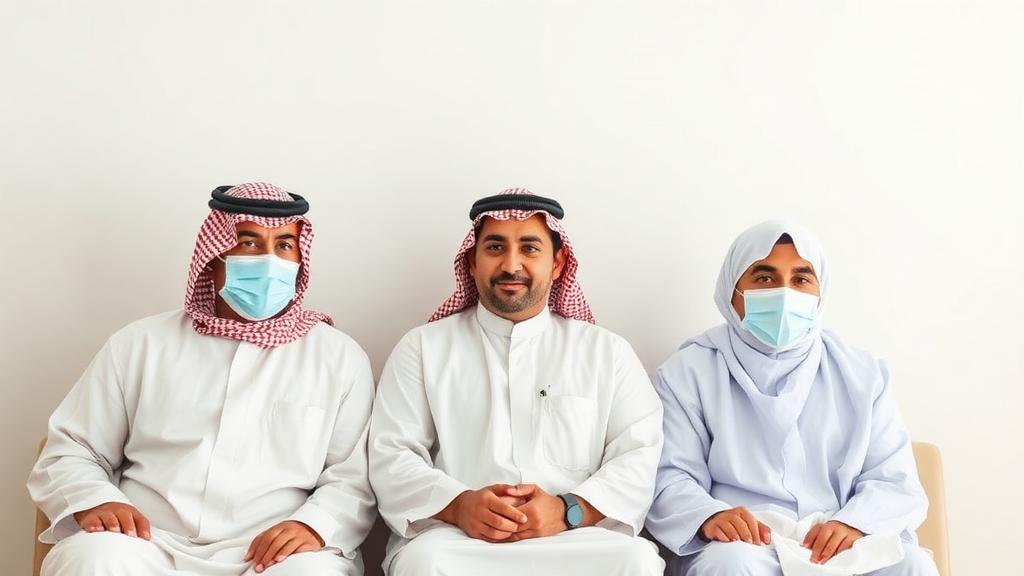
Psychological resilience has long been treated as a fuzzy, almost mystical quality — the inner armor that lets some people absorb a diagnosis, a job loss, or a chronic illness without collapsing. A new study from Riyadh, Saudi Arabia, strips away some of that mystery by treating resilience not as a single sliding scale but as a set of distinct profiles that can be identified statistically and then linked to the social lives of the people who carry them. The research, published in Discover Mental Health, surveyed 385 adults attending outpatient clinics at a general hospital and found that half of them belonged to a high-resilience group, while roughly one in nine sat in a low-resilience category that clinicians may be able to spot and support before crisis hits.
The research team, led by Rehab Alhazmi of King Saud bin Abdulaziz University for Health Sciences, together with colleagues affiliated with King Abdullah International Medical Research Center and the Ministry of the National Guard — Health Affairs, set out to answer a deceptively simple question: what does resilience actually look like in a Saudi hospital population, and which kinds of social support travel with it? Most earlier work on this topic has treated resilience as a continuous score — a number from a questionnaire that rises and falls across a population. That approach has value, but it can obscure something important: the possibility that people cluster into qualitatively different groups rather than spreading evenly along a line. A person-centered analysis asks whether the data themselves reveal natural groupings, and if so, who ends up in each one.
To do this, the researchers used a technique called latent profile analysis, or LPA. In essence, LPA assumes that an observed pattern of questionnaire responses is generated by an unobserved — latent — categorical variable: membership in one of several hidden groups. The method fits a series of statistical models, each proposing a different number of profiles, and evaluates which model best reproduces the actual distribution of responses. In this study, the winning model contained three profiles of psychological resilience: a low-resilience group comprising 11.68 percent of participants, a moderate group at 37.92 percent, and a high-resilience group that accounted for 50.38 percent of the sample. That is a striking distribution for a clinical outpatient population, where one might expect stress and illness to drag resilience downward; instead, the majority of these patients reported high capacity to cope.
The measurement instruments behind those profiles are well established in the resilience literature. Participants completed the Connor-Davidson Resilience Scale, known as the CD-RISC, a 25-item instrument developed to quantify stress-coping capacity across dimensions such as personal competence, tolerance of negative affect, and the ability to accept change and secure relationships. Social support was measured with the MOS Social Support Survey, or MOS-SSS, a tool derived from the Medical Outcomes Study that decomposes support into functional categories: emotional support — having someone to talk to about problems; informational support — having someone who can offer advice or guidance; affectionate support — having someone who shows love and affection; tangible support, meaning practical help such as assistance with daily tasks; and positive social interaction. This decomposition matters, because the study’s most actionable finding is that not all forms of support are equally tied to resilience.
The cross-sectional design recruited participants through convenience sampling in the outpatient clinics of a general hospital in Riyadh, with all participants providing informed consent under protocols approved by the Institutional Review Board of King Abdullah International Medical Research Center and conducted according to the principles of the Declaration of Helsinki. Once the three resilience profiles were established, the team ran univariate comparisons using chi-square tests for categorical variables and analysis of variance, or ANOVA, for continuous ones, to see how the profiles differed across sociodemographic characteristics and support dimensions. They then turned to multinomial logistic regression, a model that estimates the odds of belonging to one profile rather than another as a function of multiple predictors simultaneously, to isolate which factors genuinely shape profile membership.
Three sociodemographic factors emerged as associated with resilience profile: education, age, and the presence of psychiatric illness. The pattern points toward vulnerability concentrating among people with lower educational attainment, younger adults, and those living with mental illness. Each of these associations makes biological and social sense. Education is a well-documented correlate of cognitive resources — the vocabulary, problem-solving habits, and health literacy that people deploy when interpreting and managing stressors. Age, meanwhile, intersects with the accumulated experience of having survived previous adversity; younger adults simply have fewer rehearsals of coping behind them. And comorbid psychiatric illness is both a consumer and a casualty of resilience: conditions such as depression and anxiety erode the very cognitive and emotional machinery that resilience depends on, while low resilience can deepen the psychiatric burden, creating a feedback loop that clinics are well positioned to interrupt.
The social support findings add a second, equally practical layer. Affectionate support, along with emotional and informational support, were each associated with psychological resilience profiles. Notably, tangible support — the practical, hands-on kind — was not highlighted in the same way. That distinction carries real weight for anyone designing an intervention. It suggests that resilience is nourished less by what people do for you and more by what people make you feel and know: affection that affirms your worth, emotional presence that lets you process fear, and information that converts uncertainty into a plan. In a hospital waiting room, this reframes the question a nurse or physician might ask. Beyond arranging transport or medication assistance, the data hint that asking whether a patient has someone to talk to, someone who listens, and someone who can help them understand what is happening may identify the patients whose coping capacity is most at risk.
The authors frame the clinical implication in explicitly targeted terms: healthcare practitioners may need to pay particular attention to individuals with lower education, younger age, mental illness, and a lack of social support, and to design interventional strategies that strengthen psychological resilience specifically for these vulnerable groups, enhancing their ability to manage health-related stressors and thereby improve well-being. In practice, that could mean resilience-building programs embedded in outpatient care — structured training in cognitive reframing, stress management, and help-seeking — paired with deliberate efforts to connect isolated patients to family, peer, or community networks. Because the study is cross-sectional, it cannot prove that low support causes low resilience; it is equally plausible that people with weaker coping reach out less and therefore receive less. But the co-occurrence of the two, in a large and culturally specific sample, is precisely the kind of signal that justifies testing support-enhancing interventions prospectively.
The cultural context is not incidental. The authors note that previous studies support a link between resilience and social support, but that variations in cultural contexts and populations limit how well those findings generalize to Saudi Arabia. Family structure, religious practice, and community norms in the Gulf shape both how support is given and how coping is expressed, and resilience research imported wholesale from Western samples may miss those dynamics entirely. By running a person-centered analysis on a Saudi outpatient population, the study contributes locally grounded evidence — and its headline distribution, with half the sample in the high-resilience profile, offers a counterpoint to assumptions that clinical populations are uniformly fragile. At the same time, the 11.68 percent in the low-resilience group represent a substantial minority whose needs could be invisible under an average-based analysis, which is exactly the blind spot LPA is designed to correct.
There are, of course, limits worth keeping in view. Convenience sampling in a single hospital’s outpatient clinics means the sample may not represent the broader Saudi population, and the reliance on self-report instruments means resilience and support are measured as people perceive them, not as an external observer would. The study also had no external funding, and the authors declare no competing interests. Yet the methodological contribution stands on its own: by identifying three distinct resilience profiles and mapping them onto education, age, psychiatric status, and specific flavors of social support, the Riyadh team has turned an abstract psychological construct into a triage-ready framework. The next step — testing whether bolstering affectionate, emotional, and informational support actually moves patients between profiles — could transform a statistical insight into a clinical routine, one conversation at a time.
Subject of Research: Psychological resilience profiles and their association with social support among adult hospital outpatients in Saudi Arabia
Article Title: Psychological resilience and social support among adult outpatients visiting a general hospital in Saudi Arabia
Article References: Alhazmi, R., Dawood, E., Shereda, H. M. A., Alotaibi, A., Alqarni, A., Alharbi, R., Alanazi, G., & Almutiri, L. (2026). Psychological resilience and social support among adult outpatients visiting a general hospital in Saudi Arabia. Discover Mental Health. https://doi.org/10.1007/s44192-026-00613-2
Image Credits: AI Generated
DOI: 10.1007/s44192-026-00613-2
Keywords: psychological resilience, social support, latent profile analysis, outpatients, Saudi Arabia, Connor-Davidson Resilience Scale, MOS Social Support Survey, mental health, cross-sectional study, psychiatric illness, healthcare, Riyadh
Cite Scienmag News
Glenn Wilkins. (October 10, 2026). Half of Saudi Outpatients Show High Resilience, but Social Support Draws the Line. Scienmag. https://scienmag.com/half-of-saudi-outpatients-show-high-resilience-but-social-support-draws-the-line/
Glenn Wilkins. "Half of Saudi Outpatients Show High Resilience, but Social Support Draws the Line." Scienmag, 10 October 2026, https://scienmag.com/half-of-saudi-outpatients-show-high-resilience-but-social-support-draws-the-line/. Accessed 10 October 2026.
Glenn Wilkins. "Half of Saudi Outpatients Show High Resilience, but Social Support Draws the Line." Scienmag. October 10, 2026. https://scienmag.com/half-of-saudi-outpatients-show-high-resilience-but-social-support-draws-the-line/


